Category Archives: Franchises

Beyond the Earthsea

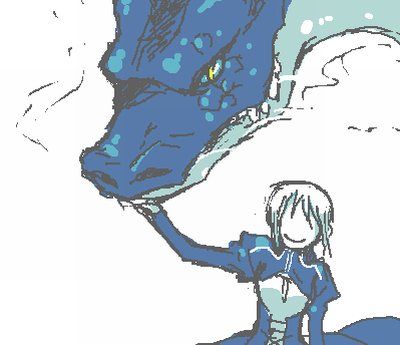
Besides its enchanting soundtrack and awesome dragons, I’m not sure what to say about Tales from Earthsea.

There's something sinisterly funny about this picture

I recently saw the DVD version of it, so keep in mind that I am probably missing out on some of the awesome visuals that Studio Ghibli lays on their viewers on a big screen at a higher resolution.

It’s definitely not a bad film per se. The lead male character is rather admirable for a change, carrying a bit of that Dilandu-complex with him. But the rest of the movie seemed a hodgepodge of Miyazaki troupes strewn together, sometimes without logic.

But maybe that’s enough. People dig Miyazaki’s stuff, so just as long as it seems like it people might like it? (Is this a form of bootlegging?)

There’s not a whole lot I can say about EarthSea that hasn’t been said–the apprentice son director, the disapproving father, the screening with the book series author, and the rest of the meta chronicle is on the internet more than a year ago.

That said, Earthsea is probably a fair shake and bake rendition of the original novels it adopted; not that I fault it (nor am I praising it), but it doesn’t add to the list of accolades your typical headlining Ghibli feature carry. Then again, I suppose no one really cared about Howl’s Moving Castle and how close it was to the book.

A general feeling of balance is tempered by an overwhelming feeling of indifference? Unlike Spirited Away, Earthsea was at least somewhat entertaining. But Earthsea surely is less artful, and that says a lot coming from a guy who wasn’t enchanted by Spirited Away either. I think I’ll refrain from comparing it with any more Hayao Miyazaki works…


Year in Review: Shafting of the Shrewd

This is really a two-fer (or three-fer): ef, Sayonara Zetsubo Sensei and Hidamari Sketch; and anime as animation, doing what it is suppose to do.

Not long ago I finished the last episode of ef – a tale of memories. It’s by far the most impressive anime of 2007. Sadly that’s just my impression and not a lasting opinion tested with time, but it was hard to deny that ef was a gimmick intended to impress. Much like Zetsubo Sensei and Hidamari Sketch, ef is the product of SHAFT, the same studio and pretty close to the same production team.

Well, except Shin Oumura, the credited director. He gave ef that touch that reminded me why Makoto Shinkai’s film will probably never break into the mainstream. Akiyuki Shinbo being the “supervising” director only contributed to how some of the scenes look. Can we say red and black railroad crossings? The other two works are Shinbo’s direct results, probably, with him labeled as the director (and who can forget his happy mug in the OP for Zetsubo Sensei?).

I can also really care much less about Sunshine Sketch’s healing properties. The serendipitous 4-koma original stuff is, I’m sure, good on its own. But that’s not here or there. The TV animation series is brilliant in how it transforms your typical manga adaptation into something unexpected, clever, but all the more expressive. And the stuff it expresses are not merely words from a book or plot points in an outline, but feelings and perspectives and attitudes. And you know Sunshine Sketch is good because, I guess, what was good to the animation staff has been transmitted through the show and to your soul! L33t haxxorz they are.

In fact, with all three series there’s this kind of connection that I see with the anime and its viewer. It’s a bridge, a protocol that transmits the beyond-mere-words content of a story to its viewer. Sure, it’s not unusual for anime to achieve this, but so few bridges are so weird and daring yet charming at the same time. It was fun.

Well. That’s that. But in the context of what’s notable in 2007, we should compare these three shows with stuff like like Denno Coil and Seirei no Moribito.

Because, lol, can you say SHOESTRING BUDGET?

Continue reading


Year in Review: The Real Zero

Code Geass is this year’s overall best-produced anime…

It also has this massive cliffhanger, but hey, nobody is perfect.

In no truer fashion did Taniguchi catch up to the 21st century with a big exclamation mark that also, admittedly, marking him fashionably late. But boy, are CLAMP designs always in fashion. It really is a statement about “design sells.” Yea, yea, at the end of the day it’s just another mecha anime, but I think this one would’ve been a huge winner if the ending wasn’t such a non-ending.

But in simpler terms, Code Geass wins because it’s just a well-produced work, with a well put-together plan that included all the “popular” things. Its large cast and diverse personalities ensure no one goes through the show without something piquing his or her attention (even for some it’s just C.C. the whole time). It even provides enough in themes and messages to keep the brainy ones thinking about questions that don’t have right answers.

The pacing is compelling. The scenario writing is solid. There is enough about the plot to keep those that has affinity towards puzzle-type shows like Death Note interested (a large group I imagine), and enough moe and cheese to keep the otaku glued to those … cheese-filled pie crusts? If it means I have to watch in-show product placement to get more financing for anime, I am all for it.

But what does Code Geass have it in for me? I think that is a hard question to answer. I didn’t watch Code Geass back when it was all the rave late last year, and I caught up marathon-style (which is probably the most appropriate way for this show) middle of the year right before the OAVs came out. And yeah the OAVs are also non-endings. What is up with that?

Still, it’s great to remind myself that there are still mainstream-appealing yet personally compelling anime series out there that are longer than 14 episodes. Perhaps I am just jaded, but I think my standards are quite easy to meet and I can enjoy a lot of shows. It’s why I still watch so many anime and I only have the chance to talk about roughly half of the shows I watch on this blog. But yeah, why Code Geass? This was simply just the best overall show that I had the chance to watch this past year. It’s something I would recommend to the average anime viewer without reservation. It beats out shows like Denno Coil because we’re talking about a very different group of viewers than those who would watch NHK on primetime hours. They may overlap in some cases, but generally speaking not at all. Is this like, a mainstream for the underground or something silly?

Anyways. Substantively Code Geass still offers something worthy of review. Seeing that it’s Taniguchi and Sunrise, we should expect violence. And sometimes that’s all it takes to get guys to enjoy a TV show, much like sometimes all it takes is CLAMP to get some sissies (like me?) and girls to watch and enjoy a TV show.

Continue reading


Year in Review: Giant Robots Play Musical Chair

I think one thing that sets TV anime far apart from any other kind of TV animation is the focus on soundtracks. Sometimes even for a crappy TV anime. It costs good money, and sometimes it shows.

And this year the choice is easy. If I was to pick out an anime title for its original soundtracks, it would definitely be the Heroic Age. But that would only be true if I was picking an anime title for its original soundtrack. And that might be a little harsh (and sort of a repeat).

If I was picking it based on how the music is integrated into the show as well as the quality of the stuff itself, it would happily scratch my itch about, heh, Gurren Lagann.

There's more to this picture if you didn't know...

This much is true–Gurren Lagann, whether you like it or not, made a big splash this year. Gainax went back and tried to reinvent the giant robot genre (again) for the 21st century. I don’t know if they were successful, but I know they did paint a fun and colorful montage of the history of giant robots from their perspective.

In this retrospective I’d definitely like to talk about the fan response to Gurren Lagann, both the good and bad. But to save this post from overly-TL;DR, I think just mentioning it is enough to jog your memories about the LOL mixi controversies, the staff changes, and on the record I’d like to say I liked how episode 4 looked.

(As an aside, Gainax shows that they consistently listen to the fans and devise rapid responses. I wish I could say the same for the majority of anime corporate bodies out there.)

While I’m at it, I’d also like to mention the ending to Gurren Lagann, and I liked how it treated Nia and Simon. Why? Because life is lived by those those who hop, jump, skip and run its length to their ends, and not those who quietly tiptoes towards death. And Nia and Simon sure lived. It may disappoint but it’s honest in its own little deceptive ways, like how the epic montage of the first half of the series leads into ambiguity, a losing-and-finding of purpose for men who only knew how to fight and love, or why this is redemptive for them even if only hardship and heartache await at the end of it all.

Along the same lines, I’d also like to mention how Gurren Lagann is glowing with a really artificial notion of manliness. I mean if I watch old samurai films, the societal norm of manliness is a much more subtle and tempered concept than this “ROW ROW FIGHT DA POWAH” nonsense, and yet both take that realistic approach towards the fate of a swordsman who outlived his purpose. There’s a beautiful parallel here that I’m not sure if anyone drew–just like the samurai went the way of the past after the modernization of Japan in the Meiji era. I guess, so are childhood dreams that vanishes with adulthood. Fighting robot fantasies have little space in an adult world. People like Simon are not this world would like you to be, this day and age, they are rugged, uncouth, drunk, or act like a loser.

Lastly, right, the music. I like the rap tie-in, if just for the exploitative effect and tension between the background orchestra with the foreground dialog within the show. I find it fun (and slightly annoying) that how the soundtrack is mixed like an OST but the vocal tracks sticks out like sore thumbs if I make my own mix, requiring some normalization. Still, Taku Iwasaki worked his magic with his usual competent instrumentation and orchestration. And it’s rather diverse stylistically as well. An epic-spanning sense of sound garnishes an equally large work.

If we can ignore the image album crap (as I’ve been making a habit of doing, no thanks to the barrage of Kyoani anime-related products), Gurren Lagann’s only fault was not making all of its sounds available to buy. But that’s one fault not uncommon and one I can sort of forget, because the handful of tracks that memorializes this show for me personally was on the Best Sounds CD.

With all that said and done, there are probably quite a few runner up soundtracks I could mention (and should mention). A starting place is j1m0ne’s top 3 soundtrack for 2007. For example I’d make more nods to Asatte no Houkou if it was actually a 2007 show, but it’s still a great soundtrack. There are many more to mention that it’d be a blog post all on its own, so you ought to go find others to read instead ;)

This post is the fifth in a series of posts, to highlight my most memorable and remarkable moments in 2007. Or just soundtracks sometimes. If I wasn’t musically illiterate (well, sort of) and can read (Japanese) I would probably do an anison blog. I cannot get tired talking about it.


Year in Review: Save Your Drama, Hitohira

…because “Save Your Drama for Hitohira” just doesn’t run as well with your momma.

Uh, what can I say? It’s a touching 12-episode series about relationships between a senior and a junior. It’s touching only because it’s drowned with sentimental realism yet at the same time much like a serving of pancakes in maple syrup TV commercials. And there lies the rub.

The problem with Hitohira is that delicious friction between its strangely yandere-ly motley crew. It’s a common thing that typifies anime made with a more realistic expectation of suspension of belief. Just like well-rendered 3D CG background that sticks out behind a poorly mixed 2d foreground animation, the cheap but attractive characters that dress the plate of Hitohira’s drama seemed rather lame. I’d use the term caricature, but that might be too good of a thing to call it.

Anime is caricature after all, but its exaggerated nature shouldn’t bleed into the actual content and characterization unless that’s what the story calls for. When the drama is in the fore, please don’t get in the way. And when it’s not, well, I guess you can act like a massive tsundere for no reason. It’s in style after all? Or something in between the two extremes? I think Hitohira was hard to watch at first because of this.

But delicious pancakes are delicious. I would say Hitohira is delicious pancake with the proper application of syrup. Fictional chocolate cakes only go so far, you really need pancakes. And maybe topped with Mugi-Choco.

I know I ragged on Hitohira back earlier this year and I still rag on it here, but I think Hitohira’s crowning achievement is to illustrate a model of human conflict where the two parties, as antagonistic as they may be at times, are moved by the blows of each and grow from their respective suffering. Contrary to common sense when people fight when they love one another, they don’t grow weaker and becoming destroyed. Rather, they grow. It’s like when Kazuma and Ryuhou go at each other, except in Hitohira the protagonists actually get permanently hurt because they are normal human beings. And to be honest I just cannot recall an example of this kind of drama without some fickle of fantasy getting in the way, when it comes to anime. It is that white-pancakebread simplicity which is both subtle but blatant, when placed in front of a drama-craving audience, that Hitohira hits its stride.

(But seriously, while violence has its place, it’s never redemptive as they are in cartoons and movies. So don’t pick catfights and expect people to be “OK” with each other after a double KO. LOL.)

I think the most important thing about Hitohira, from a 2007 retrospective way of looking at things, is that it set the pace for this year to be a very art-house amateur-drama year. At least when it comes to shows I still manage to remember today. They are sometimes sophomoric, but that is also the charm. The art shows through when the creators use these things to their advantages in their narratives. Hitohira is a great example.

And this is the fourth post in a series about anime highlights of 2007. Hitohira is a good watch and a hard sell. Even when you praise it with faint damns. Damn.