There are some spoilers, however light, in this post.

Some opinions for you to consider:
The Yard Sale
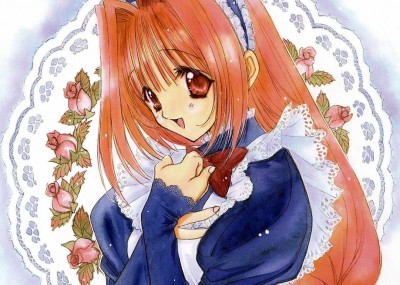 There is this 1999 Sunrise moe anime about 11 girls and a Christmas holiday celebration on an island made of academic studies and science. All it needed was X-men-style superpower heroines and trashy light novel origin in order to become something just a passing curiosity. It probably isn’t one of my all-time favorite anime, but it’s a show that I have a hard time forgetting. I blame it on Mochizuki Tomomi, but I eventually fessed up and decided to just say “I like it.” The show is Seraphim Call, just in case you were wondering.
During the days of the moe and Akiba boom, this was just one of the many projects created to cash in. In some ways it might be just too early for its time; we were not ready. The word moe hasn’t really reached its status at the time. Seraphim Call combined romance and that lonely, chilly, heart-warming (and occasionally heart-rending) package into 1-episode chunks. Mochizuki is a pretty creative cinematographer and he applied these tropes, in good 80s-extravagant-OVA-era ways, to the series. The end result is unconventional but also very memorable for me. I think it’s fair to say that this show was at least a little experimental.
I didn’t like the way the marketing for the show worked; it was pretty extreme, selling DVDs (and LDs!) of each episode individually. There was a CD single for each episode, as each episode focused on one girl and that girl fronted the ED theme for that week. Yuko Sasaki’s moe voice rolled in the OP very nicely and I didn’t think I had a similar reaction until Yakushimaru Etsuko got into anime.
I think the problem with this show was that the franchise has nothing to hook itself on. It was not consistently executed; there needed be something–idols, games, whatever–beyond just the anime and its characters. Kita E was a notably better example, but that also didn’t go very far. It is also a better example because it was dated actually after the year 2000, but hey. To be clear, this has not much to do with the experimental nature of the anime and franchise; I suppose looking back, it was one of those things that taught some people a lesson on what to do and what not to do, when they create projects like this.
One thing that bothered me about Seraphim Call was how it appealed to a set of characteristics that bothered me but yet appealed to me. It’s kind of like the irrational dislike I have for furries, but yet I can engage those tropes on some level in the mind and analyze it. Seraphim Call taps into the “Asian winged sad female[also male variant available] in piles of airborne white particles” set of tropes. It’s like games with the word “Valk-” in it. These things have this…stench. It was massively popular in Asia in the late 90s and early 00s. Thankfully for Seraphim Call, it steered mostly clear of the adhered tropes until the very last episode. I am also not particularly adverse to it, although in general I avoided those kind of things. (Valkyria Chronicles seem to be my only other vice in this category.)
 Is it fair to say that Space Brothers makes a statement about the spacefaring nature of man through Mutta’s struggles?
Let’s take Gundam 00 as an example. It has this rather cliche Hollywood theme that pits man’s unity towards an external harm as a survival instinct, a rational course of action that brings the world together in order to survive in the harsh deep space. Kuroda’s “Celestial Beings” is that artificial, external factor, that leads to the corny plot factor we discover in the Gundam 00 Movie. What goes around comes around in full circle!
A united world is hardly something unusual; Star Trek made it a known backdrop, and I think SF-attuned minds world-wide took it to heart since decades ago. But as we continue towards the future, and actually trying to go to space or make the world a better place, we experience and see first-hand the true problem with humanity’s hangups. It’s no longer fiction if we have to live it, right?
And I think Space Brothers subtly explores this “true problem.” It uses this kind-of hamfisted sort of framing around Mutta’s struggles to contrast it with his youthful past about going into space. (Well, maybe it was better in the manga.) If we take a look at Mutta and his turmoils do we see the real hurdle between man and the infinite? Does his pride issues and tendency for violence (however justifiable) reduces his chances to go to space? Do our pride issues and tendency for violence reduce the same?
This is pretty classy. But also really shallow in a way.
What’s kind of amusing is that it’s also an irrational perspective. Mutta is sympathetic and he is a protagonist you can easily root for. I think it would be great if he can fulfill his dreams of being a space dude along with his brother. But it certainly doesn’t have to happen in order for the future to continue to progress. The plot takes its cues through Mutta, but the world does not revolve around any one person. In fact that is the, like, satori, to overcome Mutta’s problems. And I think he knows this; it’s just that he cannot live with it (yet). The world may be a better place if Mutta fulfill his deepest wishes, but we aren’t presented with an equal or better alternative unlike how it is in non-fiction.
I wonder if Space Brothers will explore that theme. It has tried in a way, but it could be more honest. If JAXA and NASA can cooperate, will there ever be space for the rest of us?
You can skip to the bold letters if you want the TL;DR version.
If I remember correctly:
So there was this con and I was there. There was a panel at the con, and I was in the panel room, as I sat on the right side of the room, towards the front. That panel featured two or three guests from Japan who worked on some anime that was being promoted at the time, and it was a fairly big show. One of them was the writer for the show. And this all took place some years back, maybe before 2009, I honestly can’t recall.
If you have ever been to one of those things, things being guest of honor panels, you would expect most of the panel to be Q&A, as was this one. People queued up at the mics towards the front, and I can’t remember if it had 2 mics or 1; it may have had 2. The one panel moderator took questions from both sides like a round-robin load-balancer, in that case.
I wish I had a name for this writer-guest, it would have made writing it up so much easier. The grey matter isn’t cooperating, and I can narrow it down some, but the internet lists don’t have the right name. I can’t remember much else, besides that there was some tricky detail to that show in the writing and someone did ask how that person came up with the idea.
As for a different name, what I am trying to say has to do with how some people criticize about Mari Okada. I’m fine with free-market exchange of thoughts and critical thinking about Okada and Lupin the Third. I just want to shed some light in terms of how it could possibly went down so we attribute praise and blame accordingly, or at least, in a less-wrong fashion when we could. Let’s first recognize unless we are privy to how it exactly went down every time, we can’t really say, and we are not really in position to know for sure unless we have the facts. So the next best thing fan could do is either:
I like #1 a lot but I guess we have no choice here, right?
At that fuzzily-remembered panel, the writer-panelist explained his role in the overall project. He was the “head” writer. He had to work with the core creative folks–director, guys who storyboard, whatever, I can’t remember if it was a novel adaptation or what–and come up with the overall plan. And then he worked with some writers who banged out the detail scripts for each episode, by assigning portions of the story to them. He also wrote some of the scripts himself. I think for that particular project he wrote almost the entire thing himself, but he mentioned that he has written for other shows where he was one of the hired hands who just did specific episodes as according to specification. I also believe he had some supervisory tasks after the episode scripts were done, just to go over and make changes for continuity and other reasons.
“Series composition” is often the title credited for this role. There are also other lead writing type titles (series concept, scenario, etc) but you get the idea.
I have another name: Tatsuo Sato. This guy is probably best known for being the director (and the guy responsible) of the Nadesico TV show and movie. I recall hearing about Nadesico’s writers from Sato himself (at a con, of course), who basically said they had a lot of talented writers who just wrote great things that he took wholesale and left them as is. I think the episode previews betrayed it as much. In this capacity I think Sato acts (like most of the time for directors) as the guy who coordinates the scripts. He applied them as he saw fit. Compared to his ongoing Mouretsu Pirates, the approach is somewhat more conservative as you see Sato penning more episodes himself.
Basically my point here is that what the writer’s input in any given anime project varies greatly, and going by one name or one title isn’t going to be very helpful. When Hideyuki Kurata showed up in vintage form in Kannagi episode 7, you know he’s the guy writing it. But could you tell he was the “series composition” credit for Kaminomi or Dragon Crisis? Actually his ardent fans probably can, but not most of us. You can kind of tell it in OreImo but that’s a stretch (I still believe Kurata is the X-factor that turned a trash anime to a chart-topper). Most of the time he is just playing it safe, adopting the source material, but sometimes Kurata shines, because he is given the latitude to do so. Besame mucho, for example.
If we want to look at Okada, and why you like or dislike her, it seems a lot more sensible to deeply nitpick the original works she wrote over the adaptations, like (1) Fractale (which I imagine she just took cues from Hiroki Azuma and Yutaka Yamamoto) or (2) Hanasaku Iroha (which seems almost like her brainchild) or even (3) AnoHana (which seems more Tatsuyuki Nagai than anything), except that is still a questionable gauge as I parenthetically expressed. When it comes to Okada’s Fujiko, I’m thinking case #3 applies–it’s way more Sayo Yamamoto than anyone else; perhaps even more than Monkey Punch. In contrast, I think Okada hammed it up in her adaptation of Hourou Musuko, who is credited to write and lead the script effort, if you want a real point of criticism. I enjoyed the show, but I imagine that tickled the manga fans.

With more BRS, AKB0048 and Aquarion EVOL  under our collective belts, care we re-evaluate our initial assumptions? I thought BRS was pretty much spot-on in terms of the writing being a work of interpreting the lyrics by Okada, except people kept confusing it with the original OAV and ignore the obvious connection to BRS’s song lyrics. And it was something if you don’t “get” you won’t enjoy (in that sense very much like Book of Bantorra and Simoun, both shows Okada worked on). I don’t really know what to think about AKB0048, as not enough content is yet available to decide on the writing. Aquarion EVOL is awfully like Hanasaku Iroha’s pretentious tension, with her signature ups and downs, if you take a look at it from a structural perspective (and she’s “series composition” on both, naturally). In fact I’d guess that the two feel as different as they are on the screenplay level because Okada wrote all of Hanasaku Iroha, and only a third of EVOL.
[Times like this I’m actually very happy that the average anime script give voice actors sufficient room to play their roles in drastically different manners, even if in terms of the chemistry, the same writer tend to deploy the same tricks across different works. Or else Andy W. Hole would turn into a balut.]
If I want to nitpick on Okada’s writing, I would totally attack the way she creates dramatic tension in the script. Just saying. And at any lower level/higher resolution of detail in terms of nitpicking I will have to go bust out episodic credit lists, and I don’t really have any motivation to do so (ie., I think Simoun episodes 15-16 are freaking awesome). If you want to venture out on your own, that’ll be an educational experience I’m sure. For example you can look at how Book of Bantorra is divided up, and report back what the end result of collating the first four episodes did.
Maybe people should start criticizing someone easier to identify by his flourishes, like Yousuke Kuroda. You know, just for practice.
PS. I recall some writeup at ANN that explained screen writing for anime in detail and in a more exacting manner rather than my usual meandering style. Anyone got a link to it? I don’t remember/cannot find it anymore.
 I was half falling asleep trying to catch up on Sengoku Collection (not the show’s fault, well, mostly) when I stumbled on episode 5 as the latest spacetime-meandering warring state legends find themselves at the end of a camera. But as cute as Bokuden Tsukahara is, it was more amusing to see this large Caucasian dude trying to film a documentary, named Mike Morse. Do they spring their boom ops and camera dudes on unsuspecting Japanese folks in real life when they do these things like how it is in this anime? I can imagine David Gelb popping out a half dozen technicians in on this after walking into that little sushi bar.
But more like, I think this is almost like when that Studio 4C kickstarter promises that for their top-tier backers, they’ll make you into anime characters. And it may be a villain; who wouldn’t want to be a villain in a Studio 4C music video?
But really, taking a step back, is it more ridiculous to see a parody of a famous American filmmaker in an anime about little moe girls as the embodiment of historic generals from Japan’s warring states period; or, as anime girls that embodies said historic generals? I’m not sure. I thought the episode between Kanetsugu and Uesugi was already a bit over the top, but seeing idol Ieyasu ad trucks parading up and down the street put things in perspective. [To put THAT to perspective, I think Las Vegas is the only town in America where you’ll see moe girls on truck ads up and down the street.]
There’s an unstated subtleness to Sengoku Collection that even its mundane plot, which normally would cause clinical sleepiness, makes you want to take notice what it isn’t telling you. The ensemble cast, too. I mean, it is suppose to transpose historic situations with 2012 sensibilities, and I think most of these episodes do that. You get to think about shady documentaries that spins the dangers of ownership of sharp objects in one way, leaving me to think “oh man all my NRA-card-carrying friends would get a laugh out of this.” Except I don’t think any of them would enjoy Sengoku Collection unless they needed sleeping aid.
I suppose the whole point about cameras being weapons can be the message that gets lost in this, but to me that’s the compromise for all the liberal bleeding heart trying to enjoy this week’s historic hysterics.
There are some other random things:
One: If Sengoku Collection is an anime based on the same-named Mobage mobile game for phones, does this qualify it along the lines of:
I mean an anime based on Angry Birds or Tiny Tower would be the kind of thing that makes you think the source material is dumb, so I’m leaning towards category 3.
Two: This is not even that funny, albeit in a funny way. Worse I don’t even know how many people who reads his site get this.
Three: Can we agree that this is the most underrated anime this season? At least, at 6 episodes in. The show kind of reminds me of Seraphim Call, which is Mochizuki’s strange TV series based on an equally trite 2.5D premise that turned out to be one of my favorite moe-era work (way back in 1999!). I think it’s not an entire coincidence that Keiji Goto is at the helm on this one. That brand of simple and subtle in Sencolle is very much his.
PS. DAT MasaMUNE must be something carried over from Devil Kings or some such.