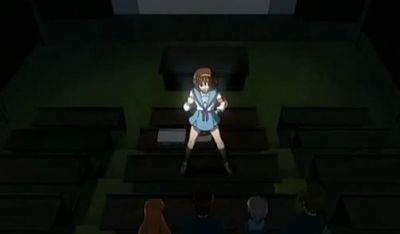
Category Archives: Suzumiya Haruhi no Uuutsu

A Data with a Kindred Spirit

I like Ryoko Asakura.

Nagato Has A Backside

Only because I like Nagato too.

To be fair, I think both character archtypes are worth looking into because they represent a very odd stereotype by something that ought to be stereotypical. Normality is rather astereotypical–reality is often stranger than fiction in my own experience. The thought goes, how about alien entities’ perception of human reality? Or even, a writer’s decision in the perception of this alien entity? Ryoko and Yuki presents us with two personalty extremes, maybe.

But it’s one of those detracting factors about Suzumiya Haruhi no Yuutsu. There are few like-minded people in this show. Perhaps some can be said of Itsuki and Kyon, and maybe Kyon and Mikuru. We can explain away Ryoko’s socially-pure persona and Yuki’s detachment with human society as a demonstration of how well these aliens grasp the human condition. We can even explain away why Ryoko has a charmingly igorant thing for death, as well as why Yuki forgot her glasses. KyoAni is no stranger to moe. But are Yuki and Ryoko so stereotypical? Maybe. They are rather colorfully played out I think, so they seemed also a little less stereotypical than other archtypes in other anime.

But Itsuki? Is he also stepped deep into the conspiracy? His commonsensical normalcy is all that’s left attaching him to this show. That, plus as a plot device.

Asakura Ryoko Is A Plot Device

Well, Ryoko is fairly just also a plot device too. I can only imagine her impact in the novel was way greater than how she gets second-handed here in the anime.

I don’t know enough about Mikuru to say much besides her personality likewise may represent (same with Itsuki, too) the perspective of the faction that sent her into this mess. It’s a well-thought-out literary parallel.

Which leaves us no surprise that Kyon is our amusing straight-man. He is us.

But what does that leave Tsuruya? We all like her too!


Bloging 101 – Creation-Traction

In the big inning, God soloed.
Babe Yuki

The internet, the blog, and you. How do you ripple your readership’s heart-string? Find their weak spot? To dazzle by brilliance, or to baffle by bullshit? To surprise, to educate, to entertain. To brighten up their life; to be “the link” people pass around at work or at school? How do you relate to them? How do you create traction?

When the world was simple and there weren’t a lot of things, there were a lot of space to innovate. To take anime blogs for example–Jascii’s review and preview site served an important purpose. It was convenient because he would watch those raws anyways, and it becomes a good first-glimpse that many of us in the internet fan community can use to gain a grip to what’s coming down the pipe.

But Jascii’s is pretty simple. It’s not fancy nor elaborate like many blogs today. It is dead, frozen in perpetuity. To give it credit, it was one of the first blogs to gain enough traction through lifting of contexts. Given that anime fandom on the internet is still mostly a fan-run machinery, doing something Newtype USA does goes a long way before Newtype USA fits the niche was rather big, if you ask me.

And NT-USA does fit the niche to an extent. Problem is, for the most part, as marketing, it smelled like marketing. It smelled like Japanese, low-grade imported bastardized marketing for the large US market. Let alone the fact that it isn’t an interactive forum like how a blog can be–there’s not much of a community alone through the publication. There is a lot of grasping but not a lot of traction. Fact is the internet fandom gets their news, like every subcultural following, from other fans straight off the internet. NT-USA doesn’t have the right context. It’s grasping at straws in an aquarium.

The shiny, pictorial editorial is very obvious form of grasping, so to speak. It takes no time before we have what we have here today–a massive sea of anime bloggers who speaks as much as through their caps as through what little (or a whole lot) they have to say. If you’re reading one of these blogs I guess you’re probably interested either as a prospective audience or as someone who saw the stuff and want to hear what the bloggers have to say. Of course framing is very important, and these blogs frames both the caps and the episodes we watch in the bloggers’ various contexts respectively.

But once you start doing that, you’re left with very little context to innovate. Recall Jascii’s blog–that was mostly innovation (granted it was an obvious idea). Now all we can do is differentiate between what shows we blog about, how our site looks like, and how we frame each episode we blog. That’s just bleh for me. For one thing, like framing pictures, you can go to a store and look at the various frames, and the pick some and see if your painting looks better in whichever one. The analogy goes, at least, with various perspectives and various shows. If I want Frame-Hayama, I can imagine just how he’d frame a show like, The Reptilian Brain. Which is to say, the only time where I get excited about reading that kind of blog is when I can’t imagine how the framing would work out with the painting. It happens fairly often, approximately only when each new season comes about, though.

How else can we bloggers innovate? If you blogged or read blogs in its first rising years (2002…?) you’d find out that a lot of blogs are just soap boxes. I personally have a slight distaste for them simply because informativeness is a virtue. Or at least, the work bloggers put in should be somewhat constructive. A LJ-style ranting doesn’t go very far no matter what you’re blogging about, unless it’s hella funny (and 90% of the time people are laughing at who wrote it).

Well, I guess I rather should say that I dislike pure soap boxes. On the other hand, I rather like those editorials that have a good point and provoke thought. I also like those editorials that simply tackle lateral/meta questions (The Harem Fallout), or latent yet interesting questions (although it can get a little too academic very fast). For example: the genre and medium divide of anime–defining what it is. Another one I like is the marketing perspective of cultural commoditization when it comes to anime and manga franchises. One thing that is pretty cool is that there are an increasing amount of academic work published about these kinds of thing. The problem I have is most of them still draw from academic contexts that I just don’t have. I’m no pop-cultural anthropologist–it’s not quite gobblygook but I find myself unfamiliar with some of the ideas and constructs/frameworks that gets referred to. But a brainy anime blog, eh. Who’s up for that kind of thing?

Maybe that’s why I still read Heisei Democracy. Not to say that porn doesn’t have traction–it gropes and sucks like all kinds of nasty. Problem with that is it becomes kind of lame and it’s fairly near sighted. But yes, this brings us to the next innovative paradigm–content. I’m sold by content. It’s what keeps me reading Penny-Arcade. It’s what I pay for when buy gyuudon from Yoshinoya. Indeed it’s not just merely ranting, or merely capping, but actually saying something interesting, too.

It’s what you do once you grasp what you gained traction?


Emerging Trends – Reffing On Haruhi-ism

Renton Reffing

Day in, day out, a stereotypical wage slave minds his own business. He may chat up something with his cube mate, go out to lunch with some buddies in the neighborhood or within the same company. He would probably maximize his commute from home with a nice cellular phone plan or some time to himself and his car stereo.

But for someone who watches anime day in and day out, do we even go that far? Well-off aficionados deck out their dens with HDTVs, walls of shelving, and probably a portable DVD player so they can put in the time on the mill and squeeze in something while at it. Of course, the more deranged of us probably have room full of other stuff too; figures, hugpillows, drawn porn, what have you.

That’s nice and all, but somehow I feel we need to strive beyond that. Month by month? Year by year? How long down the road do our anime sugar daddies like, say, UFOTable, timetable their projects? Long-term corporate strategies? How to become a leader in the industry? Does the various anime companies have their hands on the otaku pulse? Or are they going after the big bucks a.k.a. the Mainstream?

For those of us who feel concerned about things like that, the immediate question is, why? Do we watch American Idol, caring about the slew of reality TV shows modeled after it? What are the implications? I think indeed if I spend so much of my time and attention, it’s gotta be worth the price. After all, that’s what TV ads are paying for. I’m sure some are worried about their wallet, too. There’s also the always artistic tension that exists in a mass media format; would artists be free and get paid? Will the networks and producers get paid?

The fact that Haruhi has taken the fandom by storm is probably one manifestation of some emerging trends. It also reassures me that I’m not alone. It seems that plenty of people, consciously or not, actually do mind emerging trends. They notice how things were, and how things are.

I am not sure just how popular Negima was. I am not sure just how Gundam Seed Destiny was. I am not even aware of all the shows they watch over there. But if they’re like me at all, they’re probably pretty tired of harems. They’re tired of comedy based on the same routine they can see on TV and in hundreds of episodes of other shows in the past. They want fresh. They don’t quite want realism, because that’s everywhere; even on TV. But like everybody we want to be able to sympathize and yet surprised and intrigued. Some things works; tried and true–like team para-para. Some things always work, like top-notch animation quality.

But that’s just scratching the surface of emerging trends. Dilbert, for instance, was a successful harvest of such collage of ideas and forging an identity. While that budding force got snipped when corporate America got nailed from 9/11, Haruhi-Ism is just starting. We’re at the forefront of something, if someone took charge to tend to it; to put a name and face to it.

Someone to ref it!

But that said, it can go either way. I am no oracle and I cannot see this bubbling wave’s eventual apex. It takes a lot of power and money to ride this kind of a wave. Not of water but of otaku mindpower and influence. Not for exhilaration (well, possibly) but for mass profit. But unlike a surfer, if you fall you’re not going to be able to just bounce back up and watch for the next Big One.

Or, rather, the likes of Kyoto Animation has been in the shallows chasing waves for a few years now. It’s just that they’ve finally tapped a new one. It’s not like Ghibli and their own private beach, nor are they Gonzo, who’s got some kind of jet ski thing going. Or Bones…I suppose they’re really reffing after FMA now, huh?

Ultimately I guess all I’m trying to say is…look at the big picture sometimes. Watching your favorite anime is not like watching Holland doing a nice drop back turn, but seeing Talho and the rest of the Gekko State doing an orbital launch. It’s a team effort–some guy out there has to have the IP bit, and everyone pitches in their work product, feeling their way. It marks the difference between an experienced, well-financed, well-managed group with a real good idea, versus anyone else.


New Season Checklist 3

And 40 days after the flood of new anime had stopped, The Bad Guy opened a window and let loose a pair of CRV7 70mm rockets.
Black Lagoon 1

I think the winners, barring the remaining contestants, are clear.

Notice how each of those are spearheaded by a different significant production studio. Deen, for example, has their lovely Simoun flying machines complete with sound effects akin of Vader’s Custom TIE. It’s a war out there. Well, with exception of Bones and Madhouse, who also manages to hit really, really hard with Juuousei, the Lord-of-the-Flies tale of survival and becoming something more; and Black Lagoon, probably my #1 selection for the masses this season. Sucks to be Gonzo right now, though…wait a few months? This season, it seems, the studios have taken cues from 1-2 years ago and suddenly every one of them produced shows that started at around the same time, all very appealing.

And they fight like as if it’s a war–in the flea market of our minds. Some of the arsenals include kiss. Lots of kisses–girl-girl, girl-boy, boy-girl, boy-boy (well, we tried to avoid this one). Lots of blood, even more action (some involving kissing); comedy shoujo-style, comedy-no-style, no-comedy. No romance, lots of romance, mostly in-between. Low blows. Guns; lots of guns. Hot moms, lots of sisters; bunny girls? CG, fake CG, CG-looking-like-it’s-not, REALLY BAD CG. Snail-pace, non-linear storytelling, action-packed. And of course, fanservice; the shoujo/josei crowd is still at the lead of that (so much sex in Nana, so little time), of course, closely followed by the snuffy Tokko (funded by Manga Entertainment???). Can maid boys beat out magical girls from the 90s? Only if you’re a dream user…

The casualties are lost in the mindshare bloodbath, deemed to wander in the obscurity known as “faint recollections” when one browses through a list of anime at their favorite torrent site or wallpaper listing. Who the hell cares if your close friends are gargoyles or a badass tank AI?

It’s fierce, and as well it should be. That said I am not holding my breath; the second half of this year has some of the more exciting titles coming out. UFOTable’s newest project and more KyoAni in the form of Kanon are just some rememberable teasers waiting to happen.


Suzumiya Mania – Examining HARUHI ISM

Isle Haruhi

This past semester I’ve taken some classes about the power of an idea–in the context of intellectual property and mass media branding. More than just a couple times Key the Metal Idol came to mind while sitting in class. The worth of a brand and the legal protections ideas have when they come into play commercially–clasically and in today’s mass media market–can be in the billions of USDs just for a single brand.

It’s just a matter of time until that train of thought crashes into Haruhi. “How?” One might ask. Legal education is the short (and probably true) answer, but bear with me for a moment as we look into the “why?” (Which is, really, why I’m interested in the question at all.)

In some ways Haruhi is categorically a “High School Girl Idol” show. A powerful, influential, eccentric character takes the lead in the narrative. A slew of side shows play off to mirror the construct of this main character. It’s different than, say, School Rumble, as a pulp romantic comedy; different than a high school harem (of any kind of gender combination); and probably different than the hybrid (slice of lifes, for instance). Perhaps it is cousin to Gokujo Seitokai, and daughter of Yamamoto Yohko?

The story about an idol-like character is just that. My interest is in my own (and like myself, a good amount of others) facination with this idol. It’s one thing to just tell a story but harder to tell it well. But is that it? What is special with this girl? That she is a girl? That she’s a creative literary concept? I think while for many we’re still stuck at the “who is she?” stage of the game, the general topic is probably more interesting: what would an anime look like if it was to make you a fan of one of its character? Is that the same as how it would look if it was to make you a fan of itself? Are the two the same?

Idol culture ultimately hangs on that question. Building an anime that’s great to watch is well and good; but building a character means you are building a franchise that transcends the medium it first existed. Do we like Lara Croft rather than Tomb Raider? I think most of us are like that today.

To answer the “why” question more directly, yes, Suzumiya Haruhi no Yuuutsu is well-directed, written, produced, animated, and pitched after a year of rather mediocre TV animation offering. It’s exciting and fun to watch beyond its abstraction. It’s not so crude as slapstick but mysteriously unidentifiable upon first look. I can go on about it but I think that’s answering the “why” question superficially.

The next level of abstraction is a little less exciting; after all, it’s the story about an extraordinary high school girl, mired in her own genius and unteathered to this world’s mindsets. A mania in her own right, the little bit of spark of extraordinary in her ordinary world brings out the little girl unobservable otherwise from her otherworldly shell. I suppose all of that is not uncommon in anime and the art of reciting stories for escapist young adults.

Is there more to it? Do we want to care about Haruhi beyond that point? Maybe–at least by this stage of the game (episode 2), we know no metaphysical genius is an island. Haruhi will not be the Haruhi we know and we will not see an end to her meloncholy without Kyon. SOS-dan recreates a context for our hero and heroine not unlike that of an alternate world. Maybe an analogy is Otakon to Baltimore? The analysis has to end at this point, though, because I don’t have enough to go on.

But do you? I think the concept is wildly interesting when you bring idol-ism into this context. Part of why, at least for me, is my sensitivity to general idol worshipping; but otherwise in the art of manipulating people’s will, mind, emotion, and spending habits, it’s pretty cool.