Category Archives: Modern Visual Culture

Year in Review: Giant Robots Play Musical Chair

I think one thing that sets TV anime far apart from any other kind of TV animation is the focus on soundtracks. Sometimes even for a crappy TV anime. It costs good money, and sometimes it shows.

And this year the choice is easy. If I was to pick out an anime title for its original soundtracks, it would definitely be the Heroic Age. But that would only be true if I was picking an anime title for its original soundtrack. And that might be a little harsh (and sort of a repeat).

If I was picking it based on how the music is integrated into the show as well as the quality of the stuff itself, it would happily scratch my itch about, heh, Gurren Lagann.
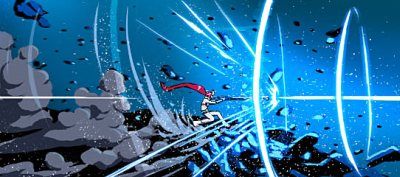
There's more to this picture if you didn't know...

This much is true–Gurren Lagann, whether you like it or not, made a big splash this year. Gainax went back and tried to reinvent the giant robot genre (again) for the 21st century. I don’t know if they were successful, but I know they did paint a fun and colorful montage of the history of giant robots from their perspective.

In this retrospective I’d definitely like to talk about the fan response to Gurren Lagann, both the good and bad. But to save this post from overly-TL;DR, I think just mentioning it is enough to jog your memories about the LOL mixi controversies, the staff changes, and on the record I’d like to say I liked how episode 4 looked.

(As an aside, Gainax shows that they consistently listen to the fans and devise rapid responses. I wish I could say the same for the majority of anime corporate bodies out there.)

While I’m at it, I’d also like to mention the ending to Gurren Lagann, and I liked how it treated Nia and Simon. Why? Because life is lived by those those who hop, jump, skip and run its length to their ends, and not those who quietly tiptoes towards death. And Nia and Simon sure lived. It may disappoint but it’s honest in its own little deceptive ways, like how the epic montage of the first half of the series leads into ambiguity, a losing-and-finding of purpose for men who only knew how to fight and love, or why this is redemptive for them even if only hardship and heartache await at the end of it all.

Along the same lines, I’d also like to mention how Gurren Lagann is glowing with a really artificial notion of manliness. I mean if I watch old samurai films, the societal norm of manliness is a much more subtle and tempered concept than this “ROW ROW FIGHT DA POWAH” nonsense, and yet both take that realistic approach towards the fate of a swordsman who outlived his purpose. There’s a beautiful parallel here that I’m not sure if anyone drew–just like the samurai went the way of the past after the modernization of Japan in the Meiji era. I guess, so are childhood dreams that vanishes with adulthood. Fighting robot fantasies have little space in an adult world. People like Simon are not this world would like you to be, this day and age, they are rugged, uncouth, drunk, or act like a loser.

Lastly, right, the music. I like the rap tie-in, if just for the exploitative effect and tension between the background orchestra with the foreground dialog within the show. I find it fun (and slightly annoying) that how the soundtrack is mixed like an OST but the vocal tracks sticks out like sore thumbs if I make my own mix, requiring some normalization. Still, Taku Iwasaki worked his magic with his usual competent instrumentation and orchestration. And it’s rather diverse stylistically as well. An epic-spanning sense of sound garnishes an equally large work.

If we can ignore the image album crap (as I’ve been making a habit of doing, no thanks to the barrage of Kyoani anime-related products), Gurren Lagann’s only fault was not making all of its sounds available to buy. But that’s one fault not uncommon and one I can sort of forget, because the handful of tracks that memorializes this show for me personally was on the Best Sounds CD.

With all that said and done, there are probably quite a few runner up soundtracks I could mention (and should mention). A starting place is j1m0ne’s top 3 soundtrack for 2007. For example I’d make more nods to Asatte no Houkou if it was actually a 2007 show, but it’s still a great soundtrack. There are many more to mention that it’d be a blog post all on its own, so you ought to go find others to read instead ;)

This post is the fifth in a series of posts, to highlight my most memorable and remarkable moments in 2007. Or just soundtracks sometimes. If I wasn’t musically illiterate (well, sort of) and can read (Japanese) I would probably do an anison blog. I cannot get tired talking about it.


Year in Review: Save Your Drama, Hitohira

…because “Save Your Drama for Hitohira” just doesn’t run as well with your momma.

Uh, what can I say? It’s a touching 12-episode series about relationships between a senior and a junior. It’s touching only because it’s drowned with sentimental realism yet at the same time much like a serving of pancakes in maple syrup TV commercials. And there lies the rub.

The problem with Hitohira is that delicious friction between its strangely yandere-ly motley crew. It’s a common thing that typifies anime made with a more realistic expectation of suspension of belief. Just like well-rendered 3D CG background that sticks out behind a poorly mixed 2d foreground animation, the cheap but attractive characters that dress the plate of Hitohira’s drama seemed rather lame. I’d use the term caricature, but that might be too good of a thing to call it.

Anime is caricature after all, but its exaggerated nature shouldn’t bleed into the actual content and characterization unless that’s what the story calls for. When the drama is in the fore, please don’t get in the way. And when it’s not, well, I guess you can act like a massive tsundere for no reason. It’s in style after all? Or something in between the two extremes? I think Hitohira was hard to watch at first because of this.

But delicious pancakes are delicious. I would say Hitohira is delicious pancake with the proper application of syrup. Fictional chocolate cakes only go so far, you really need pancakes. And maybe topped with Mugi-Choco.

I know I ragged on Hitohira back earlier this year and I still rag on it here, but I think Hitohira’s crowning achievement is to illustrate a model of human conflict where the two parties, as antagonistic as they may be at times, are moved by the blows of each and grow from their respective suffering. Contrary to common sense when people fight when they love one another, they don’t grow weaker and becoming destroyed. Rather, they grow. It’s like when Kazuma and Ryuhou go at each other, except in Hitohira the protagonists actually get permanently hurt because they are normal human beings. And to be honest I just cannot recall an example of this kind of drama without some fickle of fantasy getting in the way, when it comes to anime. It is that white-pancakebread simplicity which is both subtle but blatant, when placed in front of a drama-craving audience, that Hitohira hits its stride.

(But seriously, while violence has its place, it’s never redemptive as they are in cartoons and movies. So don’t pick catfights and expect people to be “OK” with each other after a double KO. LOL.)

I think the most important thing about Hitohira, from a 2007 retrospective way of looking at things, is that it set the pace for this year to be a very art-house amateur-drama year. At least when it comes to shows I still manage to remember today. They are sometimes sophomoric, but that is also the charm. The art shows through when the creators use these things to their advantages in their narratives. Hitohira is a great example.

And this is the fourth post in a series about anime highlights of 2007. Hitohira is a good watch and a hard sell. Even when you praise it with faint damns. Damn.


Year in Review: I Feel You, (Wo)Man

Life moves on and year after year I inevitably introspect into my own agenda and how anime fits (or more often than not, doesn’t) it all. I guess I’m one of those people whose brain keeps going at all times of the day, so I might as well grind those extra grey-matter FLOPS on something. Few years back there were some words on the street about healing and Hikkikomori/NEET-oriented anime making waves in the late-night time slot. Perhaps that’s what those typical viewers needed. Perhaps that’s what people wanted. But they were there.

On the flip side of the coin, characters like Belldandy–a Goddess literally and figuratively–always had a role in the landscape of anime idols and icons. It’s an archetype, but one not oft tread since perfect characters rarely have a role in human drama. The Belldandy-types are popular both out of the set of characteristics that painted an idealized female that rubs some western sensibilities the wrong way, and also because those are likely the only sort of fictional characters that can deal with the tragic problem of loneliness. After all who would spend time with miserable lot that is otakudom, save a God?

But that has nothing to do with my notion of “Srsly, WTB Notokawaiiyonoto” …or does it?

Now that I’ve beaten the bush long enough, be assured to know that this post is just about Sola, and in some sense, Touka Gettan 21. And about characterization. And I think it’s sort of fair to only spotlight the one show this year which was about just one character.

With that said, there are some disclaimers–Matsuri is not the only character in Sola, of course, nor is she the best in 2007 or anything like that. I’m not even sure if she is my favorite (probably not) of the year.

But her character concept, acting, and role exemplifies loneliness to a tee. It carried the show. She’s a rainy weekend afternoon–the projection of an intricate set of feelings. And just because Sola made me say that, it wins. It’s like Kyousuke’s Marble Phantasm–chase strange girls with a camera and observe the depth of their souls and of those around her. You might not care how the plot resolves around some silly mysteries about vampire, but we care because we feel for her.

Just like the one other anime this year obsessed with the sky, it managed to do something out of ordinary to express those feelings. And that’s one of the main ends to artistic expression.

I’ve alluded to this repeatedly lately, but in an anime the story is one of the weaker mean to convey feeling. Writing, animation direction, artistic direction, and voice acting make up the bulk of characterization. It’s those things that give shows of good production quality a better chance at impressing me, because they can “afford” better writing, direction, and voice acting. The same principle is exemplified with Touka Gettan. For those of you who’ve seen episode 21 you probably would know exactly what I mean: writing, animation direction, artistic direction, voice acting… who cares about the story? It’s a charming tale about a girl meeting a….boy, but that’s really it story-wise. Yet it’s how everything else that comes together and that delivered one of the best episode of anime this year.

Sola certainly does not have the best in everything, but when it comes to Matsuri they’ve nailed it pretty good.

To bring this post back to its bushwhacking introduction, it’s hard to forget that the holiday season and the end of the year is a popular time to think of the poor. Western sensibilities cherish the notion of charity. Unless my pile of donation solicitation junk mail or that subtle pricking sense of irony involving talking charity with an expensive hobby hits me on the head silly, anyways. Today’s anime give us answers, and give us characterizations that share a voice with us in that loneliness of a modern, first-world civilization. With that in mind I’ll end this post with a quote from Mother Teresa: “Loneliness and the feeling of being unwanted is the most terrible poverty.” Let’s befriend a Japanese animator today :)

This is the third part of a series of blog entries highlighting some of the memorable and remarkable points of 2007 in review. Sola is a quiet and subtle note in the soundscape of the otaku fan chatter spectrum, but all the more worthy to highlight…


Year in Review: Japan Just Can’t Get Some Things Right…

…but we should really encourage them to try and try again!

Love Never Fails

That is really my feeling about Baccano! in a nutshell. Japanese collaboration with Western producers are really one very direct way to solve some of the problems addressed by that dreaded open letter, but we should remember that Americans (and others) have been working with Japan to produce exported animation for over 10 years now. The earliest of those works I could remember was ADV’s BGC2040, but I suppose there may be earlier ones.

But Baccano! is not even a collaboration. It falls more along the lines of, say, Cowboy Bebop–straight up fantasy about a western-themed past (or future), created out of the mind of a Japanese. Yet short of last year’s fabulous exception, also known as Black Lagoon (which was also just an adaptation, I guess, so not a big exception here), there just hasn’t been a collaboration of the magnitude of western-audience-appeal as, well, non-collabs.

I guess Japanese/American collabs are just not as cracked up as they ought to be. Not only it doesn’t make anything go faster for the end consumers, the Japanese team still get stuff messed up (LOL can we say Engrish?).

But hey, if I wanted to see violence glorified and packaged in palettes sensible for an American I’d just go watch a movie in a local theater. Baccano, at least, delivers a little more. And I’m only highlighting it here because it renews my faith to know that there are Japanese people out there (I guess the opposite of a weeaboo…?) who at least tries to go at this stuff (this meaning the likes of recreating a prohibition era setting in a prose), and put together something not too terrible at all.

Sure, it won’t hold off rain (of scrutiny) if you stood under it, but at least it’ll make shade on a sunny day.

This is the second part of a series of blog entries highlighting some of the memorable and remarkable points of 2007 in review. I think Shinkai was actually one of the best things 2007 will be remembered for, but I’ll work up a climax or something from here…


Year in Review: Makoto Shinkai

You know, Makoto Shinkai made this short which debut on NHK this week about cats.

DANGER CHOBI ROBINSON, DANGER

Unlike his first known work, She and Her Cat, this colorful skit about cats is probably his first comedic work. Aside from the shared namesake of Chobi, anyways, there are not a whole lot in common. A Gathering of Cats is part of a program on NHK that highlights notable animators and have them put on a show for us. The short is merely 60 seconds long, so be sure to grab it and take a look!

Anyways, back to Year in Review: Shinkai is indeed one of the shining beacon of light dotting the landscape of the anime scene for me. This year was particularly remarkable with the release of 5cm. This will be the first post rounding out my favorited spotlights of this ending 2007.

One thing I love about anime is how it takes a very eastern, humanist message and package it in a candy shell. I don’t really care about the usual story so much that drives American television (but sometimes they do offer something interesting), so I take particular notice at this kind of thing. Unlike my more adventurous breathens I don’t steep deep into it; the random jpop tie-in of Studio 4C’s Amazing Nuts is as far as I go with the really weird this year (I didn’t watch it until 2007, bleh), I guess.

But more about Shinkai. I think 5cm is really his first film that he could be truly proud of. Hey, it won foreign film fest awards. Regardless how you like it compared to his earlier works (which definitely depends on your tolerance and affinity to the lo lo sappy romance happy end), Shinkai actually managed to tell a story with his film. In his last movie, Beyond the Cloud, he merely told us a story as a normal film did, and his film played second fiddle (albeit in Tenmon’s orchestra that is still pretty awesome) to the colliding mystery and the romantic reunion of the protagonist couple. In 5cm, the film carried the story like a master chef going at miles long of ramen dough, or insert some other familiar culinary analogy about kneading…things. The three-way partition throws people off, but I believe this all the more highlights the impressiveness of his narrative through telling us a story with what we experience overall, and not merely what we see or hear.

Plus, it sure as pretty. And I mean Pixar/Studio Ghibli pretty. I am dying to see this on 35mm. Com’on ADV!

Makoto Shinkai is definitely the most exciting prospect on the scene right now for independent anime filmmaking, and he’s just starting to make waves. Will he ever shed that arthouse aura? I don’t know, but I don’t care! It’s good stuff.

This is the first part of a series of blog entries highlighting some of the memorable and remarkable points of 2007 in review.