Category Archives: Modern Visual Culture

The Idle Master

Can I go on a blogging hiatus and go play some iM@S 2 for the PS3?

Meanwhile you can nag this guy about just what is so special about iM@S. I was this close to picking up a copy of Dearly Stars over the weekend. It was in my grasp (as in, the copy of the game was in my hand). Maybe I should have. Maybe I should not have. Maybe I should not have started playing the game a week ago. But it’s too late now. (Maybe I should hold out for a copy of iM@S SP Perfect Sun…).

There is a strange “one more turn”-itis going on with iM@S2, similar to what I experience in those 4X games. I’ve already mastered the rock-paper-scissors thing. I can, I guess, read lips. Telling seiyuu apart is harder than it sounds but it is something I’ve had some training for years, to say the least. Even when it is just by voice. (The concerts are something else, I assure you.) I still can’t read Japanese, which is what really counts in the end. Not knowing Japanese, or not knowing anything else for that matter, doesn’t present itself as enough of a stopping block, when you have websites like this. Truly we live in the information age.

[I guess Steve Jobs’s contribution to import gaming was enable that Sakura Taisen experience that I had many years ago, when going through the game on the PC (actually it was my Dreamcast hooked up to a TV card) on one side of the screen and the translation on the other, but using a tablet or smartphone instead.]

Fundamentally, the game is the core user experience. The anime is mostly fluff, although you can enjoy fluff by itself. It’s akin to pouring whipped creme in to your pie hole directly. The anime does serve better as icing on the PS/Xbox/DS cake, so much so that I want to go back and re-watch it. This is notably different than most galge adaptations. I mean I can go and play Kanon or even Fate Stay Night and get most of it from the corresponding anime (at least the adopted arc), and vice versa. I might even want to revisit the anime after I am done (although it didn’t happen for either of them). But iM@S, given its arcade lineage, has so much “game” to it that it elevates the experience beyond just a flat read of the stereotypical visual novel presentation.

[Tho I wonder if there was the “Nayuki Minase” equivalent in iM@S anime–someone who gets the short end of the stick. I guess that is what fans debate after all. And speaking of which, I even want to go re-read what 2DT shipped. Knowing the characters better, would it make more or less sense in terms of his pairing?]

The mistake I made was trying to “get it out of my system” by playing it as much as possible. Ha, never again. The light at the end of the tunnel, however, is that like all the 4X games I have encountered, the novelty eventually wear thin given the repetitiveness of it all. No amount of pretty girls dancing (prettily) will reduce the fact that I’m just hitting the highest-general-appeal-scoring-button, infinite times, every time, all the time. Okay, occasionally it’s about timing your memory appeals, but once you figure it out, you just do the same thing every time. So the question is no longer “if” I could get out of the hole Yukiho dug for me, but how deep she has dug it.

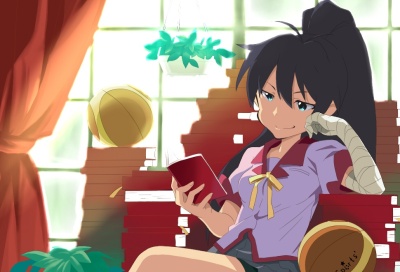

Nisemonogatari Is All Fanservice, All the Time

Back in the day when I served Google ads on my own blog hosted elsewhere I wrote about the nature of pornography and at some point Google flagged me. Probably because there’s bots for those things. But if you read my posts from back then, I don’t do anything that the word implies on my writing here.

The same can be said of Nisioisin’s animated Nonexistent Youths in Nisemonogatari. Actually we should be talking about Bakemonogatari, because that show is also similar in that there’s all this porn. Maybe not all the time like Nise, but Bake has several moments where I have to wring my brow and consider what I was truly watching.

Unlike people who shy away from the source material, Nisioisin’s treatment of his characters is key to understanding what actually is going on in Bake and Nise from the perspective of the anime adaptation. Granted, all I had was a few books translated into English, but Nisio Isin is pretty much writing like the database animal was living on his sleeves. JP mentions that so far the scenarios and set pieces in Nise are all like what you would find in a doujinshi for Nise, and it’s painfully obvious once we reduce the scenes to what they really are. What you all should know is Nisioisin’s works are all like this, or at least every one that I have looked into. I think the naming scheme he has adopted for the whatever-monogatari stories says as much about the interchangable, mash-up set pieces of his works.

By focusing the plot on these well-understood scenarios, it allows the director to do whatever the hell he wants in the mean time. That allows the story to highlight these quirky characters that live like pixel-perfect, graphed conical equations sharply focuses on the stress points that these well-curated tropes–the word trope seems woefully inadequate here–and their intended effects. It is the difference between showing you a picture of a snake and showing you the word “snake” instead, but both the image and the word behave the same. It’s like, who cares about what the snake is actually? You know what it signifies and you know how it is in your mind, you just want to get to the money shot (which in this case, for readers of Nisioisin, the animated versions of their favorite things).

Oh wait, that’s an actual SHAFT trick isn’t it?

[Next up: SHAFT draws a shark and writes SAME a hundred times in a cut in the same episode.]

When Nadeko went full-frontal in Bake I was pretty uncomfortable. I understood all the stuff that was going on (perhaps too well). But when Shinobu enjoyed her bath with Koyomi I was nowhere nearly as queasy. I think I was suppose to react to it not unlike the way he harassed Hachikuchi. Am I suppose to react to it the same way when Kanbaru got naked and wrestled Araragi? Or when Nadeko tried to seduced the same? What does that say about Karen and Tsukihi?

Well, I don’t really think how we reacted to those things are important. It’s more important to note that we reacted to those things, and not to the fact that 4 episodes in we have barely started on the arc’s main story. To me it says nobody really cares exactly what those plot events are like (unless it accumulates into some awesome fight scene that SHAFT couldn’t animate in time), but we want to see Senjougahara tilt her head or Nadeko play Twister. So here we are, full of it in Nise. That is fanservice. And if you watched Nise episodes 1-4, every episode is full of fanservice, from start to finish. It’s by far the most fanservice-y thing on the air right now.

So when we talk about the discomfort some felt when Shinbo revisits one of his favorite subjects–the aged loli vampire–we have to take that into perspective. Is fanservice expected in a fanservice show? Is this fanservice somehow different than other fanservice? By what measuring sticks are you relying to make that distinction? Is that stick one that retracts or extend upon arousal? Do we even want to know? Can we couch our hard-ons with some, well, context? I really don’t want to go and read people’s valid objections and come away with “man these people are prudes and hypocrites.” Because that’s not who you really are.

I suppose there’s always a lack of dutch angle porn on the internet, and SHAFT works hard to remedy this.


The Idol Master: The Franchise Is All One

When I took “The iDolM@ster 2″ for the PS3 for a spin over the weekend, much of the game’s aesthetics deviated little from the same arcade feel. The iconic “Project iM@S” logo looks like a page taken out of some failed bemani game pitch. Much of the gameplay is also full of rhythm and beats, leaving no room to complain about that mismatch. But in my mind the game has nothing on what really is, to me, the essence of the franchise.

Of course, that isn’t how the story begin. My first run-in with iM@S (for the sake of sanity it will remain in its insanely abbreviated form in this post) probably has more to do with being born a male East Asian during the time in this world that I did. Although it is a stretch to call that an encounter with iM@S, I think it was fundamental in the makeup of what makes up the average “Producer-san,” the anonymous term in which the various in-game characters refer to as the player.

I think the only other game to date that walked (or perhaps trailblazed) the same path as Project iM@S is Sakura Taisen, and that is one blueprint in which a video games achieve mix-media franchising immortality. It’s one thing to create a game that goes on being immortal (and we can name a dozen of these easily), it’s another to create a game like a caterpillar creates a cocoon. The game may fade over time and yield to newer, glitzier ideas, but the franchise lives on with a dim, but ever-burning core fan base that participates in its extra-curricular activities. It’s just in the case of Sakura Taisen, the cocoon hatches a zombie butterfly of some sort; undying, but not immune to decay.

And like butterflies they were in those kayou shows, those brave actors and actresses, some even came to the stage as experienced stage actors. But yes, some others were, well, the seiyuu idol variety. They had to sing and dance, and act. It was interesting in that they were not only acting out the characters from the show, but also as actors of their own stage personalities.

Back to iM@S–it is entering its 8th year since the very first game. The recent PS3 port and the anime adaptation are sure to bring in new fans for the franchise, or at least get people curious enough to check out the game, like myself. I’m slightly more interested initially at the iM@S live shows, as the cumulation of sentimental energies and collective moments of orgasm from a bunch of male otaku types. And also, seiyuu fandom. I think someone reported like >90% male-to-female ratio at those lives? Not surprised.

The point I wanted to make about stage personalities is important because invariably this girl walks on the stage, and I was like, “heh, I don’t even have to remind myself of this video being Azusa.” I mean, some people commented on how her character in the anime is acted by the same person as in that video, but there is nothing holding you back from seeing it when it is the actual person on stage.

Oh, right, the stage shows: It was “The World Is All One” two-day live July 3rd to 4th, 2010, at Makahari Messe. Day 2 is what I linked above to Danie’s write-up, a solid read if you want to know what actually happened. Day two is also the day to go if you are a Kugimiya fan. In fact both days are good for that. There are a lot of people who really dig this gal, so I’m not going to talk about it too much, besides that I watched that two-BD boxset and now am ready to talk about it.

It is at these sort of fantasy-meets-reality events where we truly get to see the meta. If I were to rank the 13 girls again like how I did for the anime, it would come out very differently. Even more so is the “cumulative” score that true fans of the franchise put on their ranks, combining what they like and dislike about each character, from who stands behind the mic stand in real life and who stands behind the protective layer of their LCD screens, and everything in between.

Well, at least now I can achieve an 80% success rate at identifying the faces of the girls behind iM@S. Which is to say before the anime started, I was probably not even 80% successful at identifying the characters in iM@S. In the few hours I’ve spent with the game, I guess it actually tried to train me to be able to listen to their voices and pick them out. That’s pretty hardcore. All told, there’s a considerable learning curve, lack of a better term, to entry to iM@S fandom. The thing has been around for a while and the games are, while a little easier to get into than Sakura Taisen, are not exactly self-documenting. Sorry Kotori, the voiceovers are not quite enough. There’s just too much crud, as part and beyond the franchise, to wade through at this point.

Instead of writing up what I thought of the two days in a song-by-song blow-by-blow way, I’ll just keep it short(er):

  1. Hibiki – Sharp-looking girl doing her dance moves. Got good presence. Can sing. A winner.
  2. Ritsuko – Slightly less sharp-looking girl making all those fetish points work but not fetishy! As much as one can harp on her singing voice, I think she is the best embodiment of this weird iM@S concert concept.
  3. Miki – Not the bombshell blonde, this Miki carries it on with the full deal. It felt like she’s got what it takes, but yet not what it takes, to do Miki justice. It’s realizations like this that makes this feel like an elaborate seiyuu event rather than an idol live.
  4. Azusa – CHUPA RIKO wwww. No, really, Chiaking is an accomplished entertainer even if her achievements are relatively minor. She can dance and sing and struct, which is more than what most people sharing a stage with her could do. Mucho respect.
  5. Chihaya – I think she sings much better on CD. Also what is up with her hair? They can surely do a better job. BTW I really like LPCM 5.1 and this is something the game was able to deliver too.
  6. Makoto – She’s definitely the most seiyuu-ish looking person on the list, if that made sense. But that’s fine, I think Hirorin is also one of the best performers with good stage presence. Kind of like Hasegawa in that sense.
  7. Iori – I owe her fans an apology for not ranking her last time, but I was limited to 12 and it had to include Ami separately from Mami. I think Kugyuu live was definitely well-received and she appears so…langly. It’s rare to see a girl in this industry like this unless they’re built like a model (which she is not). It was wise for them to not work her as much as they did for some others, and we never really ask so much from Iori anyway. She just needed to be cute and upstanding, and Kugimiya was just that.
  8. Haruka – Eririn is actually just as unremarkable as her character. However, she is still pretty good at getting the crowd going and had good stage presence.
  9. Mami/Ami – If I wasn’t already positively predisposed to Asapon, I would probably rank her lower than Maya-chan. She didn’t quite pass the cute as cute would do, but her vocals were solid.
  10. Takane – It feels like her character is just an overly-embellished version of her on-stage performance. Pretty looking person I suppose.
  11. Yayoi – Guh. Actually out of all the girls I think I respect her the most. You can also tell how none of this is lipsynched given how terrible it was. It was sheer and paper-thin presence that managed to carry the performance. It’s like magic made of unrelenting willpower to carry out an act that just didn’t make sense visually. Again, endless respect–Maya-chan impressed, even if the performance was one of the worst.
  12. Kotori – I was glad she was there, but I guess so was she!
  13. Yukiho – I put her last but I think that is more because she was the least notable. The NEW Yukiho is a bit more of a looker though. Well, I won’t go into details, but someone has to hold the bag, be #12, and it was just the easiest thing to put her there.

I guess in the end I still didn’t really describe the magnitude of that 2-day live. It’s a big deal if you were into it, and I don’t mean into iM@S alone–it is more like if you subscribed to iM@S you probably subscribed to all the things that independently iM@S’s live had as separate parts. It became greater than the sum of its parts, but the sum itself was a big deal already. It’s like you had to be born a certain way and grew up a certain way and got exposed to certain interests, and it comes together like some crazy thing.

But then again, I guess even I too missed the train there.

What is left is trying to know all the songs, and that is a task too tall even for me, lest I get serious. But I just want a short fling with iM@S! I don’t want to turn into this guy (I jest). Even if some of those songs have the cutest/catchiest/funniest calls.


Cultural Exchange: Roman Baths, French Metalwork, Boats and Cars

First of all, I want to share this WSJ article which summarizes a prevalent East Asian attitude about Elitist Japan.

Then, go watch Thermae Romae. It’s an enjoyable show. Not because what is amusing about that show is how it subtly extol exactly that virtue. But what’s even more amusing is the way our time-traveling designer/architect adopts those technologies for his own use.

I mean, it’s almost offensive if you read it too deep.

[Also, when I see Mingosu on stage I always think “FLAT-FACED TRIBE” now. Also #2, inc. iM@S post.]

It makes the cultural exchange in Croisee a little more palatable (rather than boring, I suppose) because now you have at least two cultures of similar status trading things.

As opposed to, say, in Aria, which is more just tourism.

The other day I read an article about how Sony is considering shutting down its battery manufacturing operation within Japan and moving to some other Asian country. That’s how everything in the electronics industry is going these days, as well as many others. But there are still some consumers who cling to that national brand/identity as a synonym as quality. It belies the nature of IP and mass production, at least by today’s standards. Of course, I am not going to disagree to the observed reality that at times, one factory can produce something better than another producing the same SKU, but usually there is some specific reason that can be (and often is) resolved by engineers, managers, and employees, on the road to globalization. I mean don’t Honda and Toyota spend a ton of effort and money to fight this problem?

I think more concretely, and importantly, there’s something to be said that in the end, at the end of the day, at last, we can enjoy Thermae Romae as a fun piece of entertainment. It is just like how I can surely enjoy the tastes of the best French cuisine made in Japan, or the best Japan has to offer, imported from Ohio. Or go to Uniglo and see how everything is made in the same countries that makes clothes for every other brand anyway. This is the truism that props up this whole cultural remix-ism and give people even the slightest reason to give it damn.


The Bridge to an Otaku’s Heart, Over the River of Bank Accounts

It’s another case when I try to articulate the obvious: Buying stuff–why we do it, what it means.

TL;DR: Sub-licensing companies need to focus on the question “Just because you like it, will you buy it?”

Partly inspired by reading Funimation’s latest survey on what they should license next, I had a moment of clarity in how to articulate this issue. I live in a land where legit DVD and Blu-ray releases are relatively cheap–anywhere from $10 to $50, you can buy a season of something. You can definitely buy a single, new movie at that price, save some crazy special release.

I ask myself: why do we buy what we buy? I can think of lots of different reasons that are common enough: love for the show, wanting to support the creator, liking the physical format, want to collect stuff, convenience, as a gift, etc. The money is not a big barrier at any given SKU in that price range.

Contrast this with people who, for this week, propped up over 6000 copies of HanaIro #7. It’s just an example. A copy of HanaIro #7 is still over 6000 yen at Amazon.co.jp, which is one of the cheapest place to buy Japanese anime (new, not used). That makes it 5800 yen before tax, or about $75 USD by today’s exchange rate.

It isn’t like Japanese otaku are rich people. A lot of people are doing it because they really love the thing, so they can afford the mental fortitude and determination to cut whatever they need to make ends meet. And there are 9 volumes of HanaIro in total (I think). At the same price that comes to $675, which is like, a lot of money for 26 episodes of anime. Well, the actual cost might be a bit more or less, but you get the idea.

All I’m trying to say is the majority of people who buy Japanese releases are people who really loves to own that very specific title. Only truly the rich buy anime just so they can collect stuff. The guilt trip, the store sale bonuses, the ultra-high quality release details, all that and more, are purposed to solicit people who already like a given show to take that next step and become owners, in a physical sense.

[It just occurred to me I bet a lot of people bought HanaIro just because they are fans of particular seiyuu-things. Maybe. Or maybe they work for the Toyama Prefectural government.]

It is in bizarre America land where we still treat TV anime like, well, OVAs. The OVA market is half-dead in Japan, for lots of reasons. The economics just don’t hold up as well today than it did during the “good o’ days.” Well, in America it was still the “good o’ days” until just recently, and today we are still expected to buy the anime we want to watch sight unseen. And not just high quality, high budget OVAs, but almost everything anime. Can this business model truly work in the long run? It seems like a very far-fetched idea. But I guess “sight unseen anime on DVD” still has a market if the price is low enough. Supply can meet with demand when the price is right, to go back to 16th century economics.

I hope you see what the problem is.

[Ok, it’s not immediately obvious what the problem is, but it is definitely why the anime market in America is not growing organically, when there already exists an entire generation who grew up on Pokemon and Japanese video games, who are now entering the workforce. The Naruto Generation is due in another 8 years or so?]

Of course there are some titles, namely movies and OVAs, that could be treated this way. And we continue to do so. And it works. But the bulk of shows that gets pumped out by the usual R1 distros are not such things.

Because nobody respects the gap.

I think this is something everyone is aware of, or at least everyone that matters. Again, I’m stating the obvious. Again, this is why Funimation asks you what they should license, but also what titles you will end up buying. I mean after all this good talk about Redline, does this mean I’m going to buy it on Blu-ray? Probably not, at least not until it’s $10 or something. Kind of like why I didn’t buy FLCL on Blu-ray, since that would quantify as a triple-dip. Seeing Redline in theaters was enough for me.

There are countless ways why someone may buy or may not buy something. That is the bottom line. It has a correlation to quality, but it is not causally linked I would think. I have only my observations to support that conclusion, but I think it is sound.

This is one place where spreadsheets will tell the tale.

The real issue I want to get at is why Japan keeps on making moe anime that some people complain about. It’s because those sort of show fosters some kind of obsessed fans, in the way how idol fans buy everything a group releases, three times over. Shows that largely appeal only to people’s good tastes, however, don’t foster that kind of attitude towards their product. “Cool story bro.” You know the drill. And that doesn’t pay the bills.

Shows like Kaiba or Tatami Galaxy are great, and I like them. But it’s incredibly difficult to feel obsessive about those shows the way I do, say, Manabi Straight. (Did you know that thing is getting a BD remaster?) I’m sure some people loved those shows enough to buy it on home video, but it should not be surprising to see low sales for them, at the usual otaku-only price points.

In order to get people to not just like, but buy, anime, there needs be some kind of added factor. A franchise, a release, whatever, needs to build that allegorical bridge. Sure, you can simply drop prices, but the distance between my heart and the show would not have moved closer by even one centimeter.