Category Archives: Popular Culture

Notes on Tokyo 2013

I went to Japan to do otaku stuff, to meet with people, and to relax. I think I accomplished all three to some extent, and now the internet gets to hear about it. Actually, it’s just about the food and the nerd stuff. Bullet-style.

But first, loot pic. And this isn’t even everything.

Lots of loot

Continue reading


Schatzkiste

Schatzkiste front door

Today I visited the maid cafe Schatzkiste. Their main claim to fame is the annual horror events that they do on Halloween, which is reported over at bigger venues like Kotaku and, well, any site that writes about maid cafes on any semi-regular basis. What’s actually interesting about Schatzkiste is how it’s one of the more unusual maid cafes in Japan, given how it’s not about calling out at their masters “welcome home” and it’s more about the basic and more “classic” fares involving maids just working in a cafe.

In some ways, it’s really just a counter-cultural maid cafe, I think. The fact that some of their furniture was hand-made or that they bake their own sweets are just the little things which makes it an attraction in a market that is full of other entries offering the usual cafe or izakaya fare, or the stereotypical moe omelette thing. But, really? Maid-made furniture sounds kind of boring. Respectable, but “doujin furniture” inspires as much confidence as what that phrase sounds. It’s not exactly what I am looking for in a maid cafe, anyway.

What they do add is the intangible aspects. There’s this hyper-artificiality about maid cafes as presented by the gallery of leafletting maid army that lines Akihabara’s nerd shopping district, or the massive Maidreamin banners that hang on top of building corners. And if you ask me, walking down Chuo-dori from the south, it’s the immortal Dejiko that makes me feel at home, not the images of hair-shaving army of idols and maids, as “pure” as they may also be.

But Dejiko can’t serve me tea, where as the lovely maids of Schatzkiste can sure pure a pretty good one. For 500 yen per 30 minutes, you can get as much tea as you can drink, and you can help yourself to one of their books, magazines, board games, or purchase some additional refreshment like a soup of the day. There are also events that go on periodically, which I presume are posted on their website.

It seems that the owner of the establishment produces a doujinshi of some sort for the cafe periodically and in it, explains what the story is all about. It feels kind of the same way when you sit down at the cafe, going through their menu and “concept” about how the maids at Schatzkiste were originally working for a master of unknown origin and is far away from home. In the “house” that they were in (which is Schatzkiste’s old location), they turned the “attic” into a cafe.

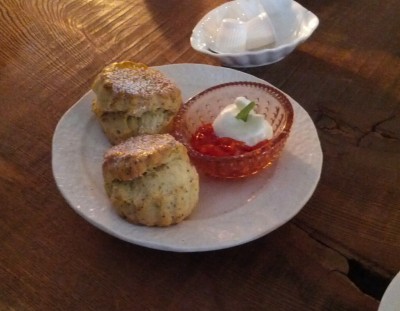
That is all well and good and serves little practical purpose, but it’s pretty thick in a vanity purpose sort of way. In a weird post-modern kind of way, it’s exactly that in which adds warmth, and value, to the maid cafe fantasy. Well, what isn’t vain was the scones; I had some and it tasted pretty good. It feels exactly as home made food should.

Scones

It’s the kind of maid cafe that you bring people who want a cafe experience, not a maid experience, so to speak. I think there’s a lot to be said about people who enjoy going to this sort of a place, and I also think Schatzkiste is not really what most tourists want out of a maid cafe. In a way, what makes Schatzkiste interesting is exactly how it isn’t rooted in the shallow kind of vanity that outsiders see Akihabara as, but the pure emotions that makes people spend countless waking hours and even more money on AKB48 events or the motivation behind the existence of such a thing, like Schatzkiste.

PS. I dig Schatzkiste’s boardgame angle. Check out their live streams.


Remembering Ebert

Roger Ebert died this past week. He was not only a star-like entertainment figure, but he popularized the movie critic and turned it into a legitimate thing to be. May he rest in peace and my condolences to his friends, colleagues and family. That said, I never really held his opinions in much of any esteem. Rather, I enjoy his prolific and professional approach to that core task he does so well–reviewing movies. It’s in his rather-concise form in which I learn about movies I typically never get to see (and probably don’t want to watch). It’s his consistency, approach and criticalness that is truly worthy.

The one thing I always found interesting is how Ebert put Graves of the Fireflies on a pedestal. It’s at least his favorite piece from Ghibli. It hung with me because I watched Graves for the first time only a year ago, so for the longest time I wondered how well it stands against the expectation and weight from the raving reviews and trigger warnings people give. After seeing it, everything makes sense. It certainly belongs to his 100 great movies.

I also think it’s a great demonstration of what I call “anime no chikara.” And by that I simply mean the power of the animation medium, style, format, whatever.

In his review of Graves of the Fireflies Ebert spelled out in a way why he likes it so much. However I think he spends most of the review explaining what makes Graves a great film–the “chikara” part. The part how anime makes a movie about the torturous fate of two war orphans during Japan’s WW2 period? He points it out in a couple sentences here and there–something about imagination and the ability to convey realistic human emotion without the constraints of realism.

Compare that to a later recalling in Ebert’s review of another harrowing anime film, Tokyo Godfather:

…the themes are so harrowing that only animation makes them possible. I don’t think I’d want to see a movie in which a real baby had the adventures this one has.

I mean, in terms of the story, Tokyo Godfathers is a movie that really can be only done via something like animation. [As a bonus note, it’s always fun to see one of the most popular and accessible movie critic trying to explain to everyday Americans how “real” anime expresses itself.] But in a way the power of anime is most potent when it deals with the most harrowing, the most tragic, and the most depressing.

Did anyone ever write a paper about how Japan’s collective trauma plays a part in this? Anyways.

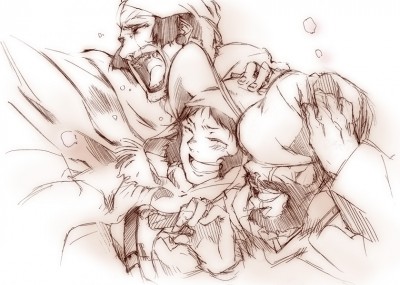
Godfathers

Of course, this doesn’t mean sadface anime tend to do well. I think to Takahata’s credit, a film like Graves of the Fireflies also had that patient, measured and poetic rhythm, something that few anime has; it’s not slice-of-life for the sake of being a portrayal of life, but rather the impact is the best when presented in the silences of everyday life. It’s driven by the sinking realization of hopelessness, not by exasperation of melodrama. It is in the gap where we see Setsuko playing with piles of mud that we rend our hearts, not because, for example, it’s a pain in the butt to go home in Tokyo Magnitude 8.0 (not to single that one out, just the first to come to mind).

On a more positive note, did you know Satoshi Kon’s best-reviewed film on Rotten Tomato is Millennium Actress? Ebert didn’t write that one up.  The news about Ebert only serves to remind me the passing of Kon, as these two, in my mind, are the greatest figure for anime in the movies in the 21st century from a westerner’s point of view. I just hope someone who will not die any time soon will show up and change my mind.


Boomslank Tees

The guys at Boomslank sent me a couple shirts for review. I don’t do product reviews outside of Jtor because it’s just not something I’m comfortable in doing, but these guys have been on my mind over the past year so when they cold emailed me about it, I figured why not. Call it a delayed favor, because these are the guys I referenced to back in this post (all the way at the end).

I think I first saw their wares in the flesh at Animazement last year. They’ve been sending out some PR-type things and as always they have some pretty striking artwork. Original anime-style apparels is a tough market with a hard sell. Most people who wear that stuff tend to go for the references (which I have a mixed feeling about re: the J-List category of unlicensed clever shirts) and the official licensed goods tend to be kind of, well, boring. (Unless you are Cospa, which then you don’t make any shirts bigger than a L and would cost you $50 a pop.) But maybe that’s what nerds want.

On the other end of the spectrum we have your usual catalog of wearable memes and the stuff you find at shirt.woot.com or Threadless. It passes for either super nerdy or somehow mainstream enough for normal people, and everything in between.

Boomslank

From what I can tell, Boomslank is trying to marry the two.

It’s hard to say if this stuff is fashionable. I think it makes sense in my mind, but I am no trend-setter. Maybe more like a risk-insensitive trend-detector? I’m not sure. But it’s the closest you can get pixiv-style ink spoiled on your shirt short of actual pixiv-style artwork on your shirt. Think vania600’s impeccable landscapes, but toned down so your dryer won’t destroy it after one wash.

Oh, wait, there are no trains. You know what you need to do next, Boomslank guys.

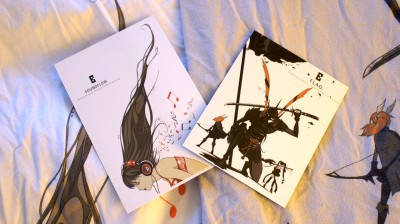
And that kind of sums up my issue with Boomslank’s offerings too. On paper all the artwork you see on their store fit the design profile of stuff I would want to own and even wear. But they all lack just that little something to push it over that I’d fork out the $25-30 to buy. Maybe it needs to be more cheeky, in the case of “Flag” (which is one of the samples they sent me). It’s a nice image but not at all remarkable beyond “cool graphics tee,” at a glance. I guess that’s nice if it’s what you’re going for, but there’s more you can do in terms of the layout to showcase the clever details on it. (For example, it would be pretty neat if they sold 2 companion shirts from the angles of the two characters from the back.)

the shirts have been worn a couple cycles, but the note cards have not

Another example, the “Carwash” one, well, could look just as cool with a bullet train, and it would… anyway. I mean, it’s a slick piece of art and a great idea as is but it lacks that one slant that makes it really stand out. Maybe if it was a retro prop aircraft with high-tech hoses attached to it? The other tee I have for review is the “Soundflow” image which is not listed on their website; it comes printed with the key graphics on an offset, where you see the anime-style girl bust-and-up image from the bottom of the shirt. The headphones are a major plus. Unfortunately given how you have to wear it properly for the full effect, I can’t really quite pull it off during the period I had to test-drive the tee (winter is…cold), so I’ll reserve my judgment on this. I might still have a pair of baggy jeans somewhere (yea it’s not quite my style). I guess I rarely have to cosplay as a homie from the 90s. In retrospect I probably should’ve shot some more photos when I first got them, whoops.

As far as the bread & butter aspect of t-shirts, these Boomslank shirts are cotton, unisex Fine Jersey short sleeves tees (I guess that’s American Apparel’s?) and they’re of good quality and comfort. It looks comfortably worn after 2 dryer cycles. I like it, it’s on the thick side but not too thick. Each of the shirts came with a postcard with the illustration and name on it, so you know what it is. I guess it’s good to note that what they offer on the online store is just a section of their total offering, such as XXL shirts for certain items (at least I can’t find it on their store). One real important thing about these shirts is that they’re really colorful and vibrant looking, so I probably won’t even recommend using a dryer if you want to really maintain the color accuracy on these. Keep them fizz free guys–always wash your printed tees inside out, etc. For a couple of these, like “Gate Keeper“, you might want to wash/dry it especially careful–it’s super colorful for something that isn’t custom made.

(Test notes: I wore the 2 shirts, each at a time (lol) for a whole day at a time, over the course of about 2 laundry cycles. Just in my routines on weekends when I’m out and about doing stuff. Of course being sub-freezing half the time makes testing the T-shirts in public rather difficult but it’s showing when I go indoors, usually. The shirts go through my usual wash routine–nothing fancy, just liquid detergent–after each use. )

I think my favorites are the two flying fish ones, although only “Pieces” is available as a shirt, where as the other, flying-with-Cenco “Blue Serengeti“ is just a print. But it’s always the kind of question where you have to ask yourself, “Do I really want to wear a flying aquarium?” At least, major props to Boomslank for offering phone cases for the Samsung GS3, a welcome break from the iPhone dominated marketplace for graphic phone cases (and they have those too, and for other iProducts). It’s that kind of stuff that will be necessary to push P-shinobi’s guys over the verge of being something worth my monies.


Robert Napton’s ANNCast

I don’t know if it’s the best ANNCast, but it’s one of the better ones, partly because it clocks in at a massive 2.5 hours, goes over Napton’s involvement with the comic boom during the early 90s with Image (he worked for them as a writer), some anecdotes from Nippon Books and US Rendition, and it’s basically the final salute/farewell to Bandai Entertainment USA. This podcast is also great partly because it namedropped “Anime Expo 2007” and “Yutaka Yamamoto.” And partly unlike most ANNCasts, it talks a lot about Turn-A Gundam. It’s all over the place. But ultimate I think it’s great, because I think Napton has a narrative going on. And you might know how I like narratives.

The people who have better things to do than to listen to a 150-min podcast can get a detail list over at AODVD/FP thanks to WTK. But I’d like to drop my own spin and do  my own distortions like a crappy dubstep remix. I think all the talk about manga and Napton’s career is actually quite fascinating, but it’s kind of off topic so I hope you’d just go listen to it to get the most out of it.

What’s probably more important is that Napton posted an errata of sorts in the ANN forum which ends with a paragraph that extended the main problem as raised by Quarkboy. Let me reconstruct it here so you understand what I mean.

First, from Napton’s POV, throughout the podcast, the reason why Bandai Entertainment USA closed was because Japan decided to restructure. Bandai Entertainment USA was trucking along, doing the “right things” and making themselves as a sustainable business. The rug was pulled out from under them, as the saying goes. It’s probably good to understand, also, that after the Namco merger, Bandai was really more a collection of independent units/businesses that operated with a lot of independence. As a unit, Bandai Entertainment USA was doing fine however. (For example, as repeated elsewhere, K-ON was doing well.)

It seemed that the Namco-Bandai mothership wanted to come up with an unified international strategy, which is described below. I quote:

I’ve heard things here in Japan from within Bandai “corporate” as to the reasoning for the shutting of Bandai Entertainment…

The reason why it seems so senseless is because Robert is only considering the situation in the US market, as if Bandai in Japan made the decision in a vacuum. The decision to shutdown Bandai Ent. was part of an overall restructuring that affected all parts of Bandai Group’s audio visual units, within and outside of Japan.
The new overall philosophy is that Bandai should make physical products in Japan, and sell them overseas.
You remember how you said it was so silly for Bandai Ent. to have to pay Japan (bandai visual or sunrise) to license the shows? It seemed silly to them too, especially when the market had shrunk so much. Why should Bandai have a licensing and sales unit in the US but not everywhere else in the world, for example?
Their new strategy is to treat videogram sales more like gundam kits, and export Japanese made products to the world. For broadcast and internet license to local companies, and for sales export your Japanese products.
In this new strategy it didn’t make sense to keep a sub company like Bandai Entertainment around. In fact having it license things in the US just made it harder to control a global marketing strategy from HQ. Bandai Group wants to treat the global market as much as possible as a single entity.

A couple days later Napton actually posted some errata to the podcast (you can read it here) but I want to highlight the below:

As for the future, after reading some of the comments, I’d like to make the analogy that President Obama was re-elected because his campaign did a better job on the GROUND in the battleground states. More people knocking on more doors. The R1 US anime market cannot be salvaged without a dedicated ground effort, which cannot be accomplished by manufacturing discs in Japan with subs and dubs and importing them long distance with no one here speaking on their behalf. Aniplex is succeeding at the moment because they have a US based group heading up their North American effort. I would hope in some form or fashion, Bandai Japan realizes that this is the best strategy for the US market because I believe it’s the only way to really accomplish the goal of selling more DVD and Blu-ray product in the R1 market, which is the understandable goal of any company.

I’m inclined to agree with Bob. This is basically how I feel about that Daisuki thing, if you recall. The internet is wondrous. Having Japanese releases with subs is excellent. But it does not address of the value that Bandai Entertainment USA had in terms of a “footprint” of anime in North America. Maybe that footprint is changing, the market is adjusting. Sure. Stuff gets left on the table. What is a footprint anyway? The people, the con presence, the PR, the store they had, the line of manga, all of that has some kind of value. The question is what value is it? What and how should corporate value it? How should consumers value it?

Is this why K-ON’s marketing falls into a pit once the license switches hands? All of this is non-trivial, important stuff that the average consumer kind of misses. In this “American fans party, don’t pay” atmosphere of narratives, I like Napton’s “Star Blazer mountain” narrative because ultimately the middlemen are the true critical failure point. It’s just now we’re dressing it in greater clarity. It’s reasonable to expect unreasonable fans to go crazy on Turn-A Gundam at a panel, even if that is a bad thing. That’s what is suppose to happen. It’s not reasonable to expect fans to reason with you on the causes why Japanese licensors are disconnected with the US market realities, even if that is a good thing. Because that is the whole point to the localization business.

But I think this is not a story about good and bad, people or business decisions. This is a story about how things are changing. Here we have Napton, a guy who got into anime because of Star Blazer. Now we have people like EJ, who … what does he even like? I mean it in a “is this guy just a dude workin’ or is he like, a fan?” kind of way. Napton namedropped a bunch of the new guards of marketing. He even namedropped some Japanese guys who get it, like LOL Henry Goto. Well, good for them. I just hope all these baton hand-offs resolve with fewer stranded licenses and laid-off employees. It’s the least that could be done.

Kiraboshi!

Instead of a billion post-scripts, I just want to highlight other notable points of the podcast. I mean, that’s why this is worth listening to. I’m not really a podcast guy but there are some quality ANNCasts after all, such as this one.

According to Napton, they sold out of FLAG at A-kon. Why? Is it because of some autographing tie-in? That’s my best guess. FLAG underperformed, which is no great secret, but somehow it sold well in Texas and nowhere else. Wonder why?

He mentioned Anime Expo 2007. I think some of my fellow seiwota chasers agree that it was a tragedy of a con. Napton didn’t go into details, but I’ve heard enough from everyone else to figure out what was going on… You should too. I think you get the best “heat” if you actually go to AX and interview some of the people in line for autographs. It’s things like this that bonds Marketing Directors with congoers.

Yamakan got a name drop. His statements that rattled the 2ch-types got referenced to. And yeah, spot on bros. And the Endless Eight dub idea sounded neat–Napton said there was an internal idea about having different people dub E8 and have role switches, but it didn’t work out so the idea didn’t go.

His point about the Bebop dub and how those actors connected with R1 anime’s humble beginnings made a lot of sense. As someone who doesn’t track dub actors directly but is invariably always just one degree removed from that scene, it’s a pretty fascinating look.

There were a fair bit of discussion regarding Bandai Visual. It seems that where it failed isn’t the idea but in the execution. While the strength of the titles as an issue was obvious from the get go, the whole distribution aspect is something you wouldn’t know until probably a good bit after the fact. I wonder how Loy got roped into that in the first place.

What’s equally enlightening is the “changing of the Bandai Entertainment” image. I guess I never really saw it that way, partly because anime itself has changed in a similar way, so it was more like out of the growth of the licensing more titles? I don’t know. It always licensed shows like, say, FLAG, anyway.  There was always the Gundam series of the day. Bones shows. I think maybe when Bones started doing weird things, maybe then? I can understand why Napton namedropped Soul Eater. That did feel like a Bandai title. Heck, Full Metal Alchemist (both series) felt like a Bandai Entertainment title. I guess you can see how it goes. Maybe the better question to ask is, are they changing the image in part due to the licensing pressure as a result of having too narrow of a focus in a field that isn’t widening? I suppose Lucky Star was like, the one turning point for them.

In some sense, this podcast isn’t as “enlightening” on a factual level. I thought it was more like a canvassing of an era (90s and 00s) from someone who was both in it and as an observer. But there are some pretty interesting stuff, especially if you followed this sort of news throughout that period.