Simoun Wars I – The Attack of Adolescent Themes

I take back what I said about yuri and Simoun, because it has the most pure kiss scene in anime ever (at least this past year).

The Best Kiss Ever

Positively, this show reminds me of Utena in how wry it transitions. A little bit of a bait and switch, really. Originally I pinned my hopes on Ouran Host Club, but that left me in the cold when it spent a good part of its first 12 episodes making fun of shoujo manga and doing the cliche stuff shounen anime has been doing the past few years. It’s not until episode 13 where I got served. And I sure did. Even then, however, all that mysterious vibe has disappeared somewhere between the light bulbs of episode 1 to the starfield of banana peels in episode 13.

Simoun, on the other hand, cracked its unforgiving whip almost like Glass no Kantai. I don’t know what to say about it because just like Glass no Kantai, I am totally at the mercy of the translation. That’s my first gripe, really: there has been only one “good” translated fansub for this show out there, that I can find. And even then, it reads kind of poorly. In a lot of ways, doing a translation for Simoun is like doing one for 12 Kingdoms, but you don’t have the books for reference. We don’t have that kind of neck-breaking pace, but so much has already happened in the first 8 episodes that if you can’t get a grip, you’re going to get dropped. In that sense I think that is my problem with the show. At first, so much was going on that you have no clue about, it became boring to watch. It’s not until each characters’ introspectiveness grabs you that you can then starting to care.

Staring to care why Nevile was so troubled? Starting to care for the big question about the differences between Mikos and Galaxy Angels? And starting to care who is who? Of course, if you’re like me, the first thing that grabs you is its fantastic setting–a world where everyone is born genderless (not quite female) and people can then “choose” which gender, or have their local deity or doctor do so for them. Oh, that’s the second thing: this is not just a theocracy. Tempuspatium is amongst us.

Yeah, 12K indeed.

The second sin Simoun committed is its odd visuals. I suppose I am not in a good position to complain, but given what else is vying for my attention it really only made sense when I’m done with my HOOOhis and LagOOOs, I can stand to watch this average-looking animation.

To its merit, Simoun is still the story about a bunch of youthful girls, even if they aren’t technically. It’s hard to hate an entire harem of 12, and that’s just those on active duty. Well, it might also be a merit that large amount of Simoun’s adult populations also look like girls…as in fememine guys with boobs. I’m not sure to who these may be meritutous, but I am glad they explain that stuff up front. And as a result, too, its neck-breaking pace made good use of the first half of episodes, and I’m looking forward to see more. It would be pretty hard to call it a day at 13.

But why am I actually blogging about Simoun? Because of its wonderful delivery of its themes. To me, that is the heart of this show. Once you grasp them, you get it. If you don’t, you’ll be eternally wondering what the hell everyone is doing, why they are so emo, and why don’t get just get it over with, whatever it is. That is partly what made 12K so wonderful for me too, but that’s probably another rant.

And Simoun makes it easy. At one point Nevile stated it up front. People’s motivations are clear as a book and as diverse as the harem itself. How can I hate a collage of themes about growing up, about overcoming difficult rejections, betrayals, obstacles, brokenness, heartache, adversity, and finding of one’s self? The innocent lost? The lost innocent? Indecision propelled by circumstances? It’s a bit of a cheat to have such a big cast, and each of them are matched neatly in pairs (at least for now). There are some other nitpicks as far as personalities go, and I was kind of bothered by episode 12 in some ways…

But I’m on board to see how these kids turn out. Even (and especially) Dominura. Seeing Aeru grow up and how Nevile deals with Paraietta would be nice, but so much surrounds our key triangle that even the least of these girls will be of some interest. Maybe it’ll strike out. Maybe not.


The Starry Divide

NobuYuuki@Otakon06!

It was a long time ago when I first decided to find out who voiced an anime character that was interesting. I think the reason was an image song used in the show, and some related extra material (a music video or something?) gave me the first glimpse of of who they were. I think that is still the most prominent way voice actors are featured today–DVD extras, image songs, and the occasional documentary.

I get the impression, over the years, that many of us are aware about voice acting. Disney made a point to give well-known actors and actresses chances to feature their voice in feature films. There are also those who were consistently more famous doing voice work than their live-action counterparts. In a lot of ways the only real difference between the American voice acting industry and the Japanese one is the sheer size–America is small, in this instance.

Over the years I’ve read up on a fair share of voice actors as well. Many of the older generations in Japan had training both as professionals and as students in acting as “voice acting” schools didn’t really pick up until recent years. A few even branched over from live action acting, like this charming lady. Many more applied their acting skills into voicework, some more vocal about it than others.

However, what always strikes me as a peculiar aspect of the Japanese voice acting industry is its repeated attempt to package some of their better talents. In some instances they really are talents; they eventually breach genre bounds and make a career for themselves. In other instances they fall into the fold as we know as the pop idol industry not unlike everyone else, but it just seems less brilliant than they could have been. They’ve made it, but they aren’t that big.

As stars in the sky, these stars are just as interesting though. Interesting enough that I think someone can really fansub this piece and uh, we’ll watch it and go “oooh” and “waah” and maybe we’ll ask smarter questions at anime convention panels as a result. Yea, it is so relevant… In as much as it is a curiosity, it is a story for every one of them, pioneering in a strange industry that only really exists in Japan, and yet making things so big for themselves that their fans overseas would wait in line for hours just to hear them. As much as I’d like to attribute things to personal insanity, part of it might just be due to the fact these stars are brilliant.


Bishoujo Senshi Insani Super H

It really is an identity crisis.

Perhaps the best way to look at my fascination in terms of categorical attractions (content, then gameplay), explain why identity is important, and bounce the ball back to you. I apologize if I am going to get kind of down and dirty in this rant, but I might as well come clean.

I mentioned Graduation 2 in my earlier rant on the topic. It isn’t really the start or the finish in making me a “prospective fan” of the genre but an arbitrary midpoint. Being born Chinese means not only I have used or/and pirated software, but maybe I have more of a natural affinity for this kind of gameplay. It is probably the first time I bought a game of this sort, though. I also mentioned Graduation 2 because it rests on a precarious area where the gameplay intersects with content. It is this intersection that pinpoints the games I want to play.

Which, I confess, I’ve played a handful of the more pornographic variety of these games. It feels as if I have played more than I actually did because I have also seen even more ripped images from these porn games (as they are rightfully called). But why am I turning this into a confession? Probably because Japan needs to confess–the majority of games that fall into this genre is pornographic. Some are really, really bad. I hope you know what I mean so I won’t have to describe it.

The sad economic truth is that porn does sell. As a new content delivery system bishoujo gaming (as I use this term as I did in my earlier rant) is driven by this stuff. You can even see the mark it left in the annuals of gaming. What was the date on that? 1992? I think I was playing Knights of Xentar back in 1994? It’s been a while, pardon my poor recollection. The point is, it’s been with us for a long time now.

But just as porn drives delivery systems, delivery systems grow from the ashes of lesser things and into more relevant, interesting material. We have games like Princess Maker 2 (probably one of the most wide-spread English-language bishoujo game, and one of the better ones–now that it’s basically abandonware), Konami’s Tokimeki Memorial games, and many others–like Graduation 2. There were a lot of different types of porn games too, as the genre was in the process of finding itself.

Here is where my story branches. Porn games have been with us for a long time, and what I said about delivery systems just now applies to every kind of game we know–platformers, RPGs, tactical games, etc. All on top of what we usually know such as casino games or some of the more creative flash game type stuff. Well, even as I say this, where is the porno version of FF7? Or Starcraft? Appearently, they kind of exist. Why? Mainly because Japan needs to confess, it manages to have a rather diverse and healthy porn game industry compared to the US.

Honestly, however, I’m talking about porn games only because bishoujo gaming is like that solitary, delicious shiitake growing off a pile of cow dung that we know is the porn game industry. And that analogy applies as to how to make this genre proliferate outside of Japan. Quite simply, for that kind of stuff to sustain itself in the mainstream, it has to either live with its cow-dung underpinning like what these folks have done, or grow it independently. I don’t really want to play porn games, believe it or not; and certainly aside from my copy of Tsukibako I will never spend money on it.

And to that end, I am also honest about these kind of games–I only play ones that are fun. Graduation 2 was pretty fun. Harvest Moon is pretty fun. Tokimemo is pretty amusing, and especially the latter ones like 2 and 3. I suppose I could say the same about Baldr Force but I haven’t had the chance, despite the pornographic stuff. Tsukihime is pretty fun, but my Japanese skills are insufficient. I am all for the growth of the bishoujo gaming genre independent of pornography.

Which is why Insani’s All Together efforts are the bomb–they port not only legally less-grey doujinshi games, they are also not pornographic for the most part. They convey what is fun to play about these kinds of games in the unique gameplay varieties rather than catering to familiar content. Fact is, porno Super Mario is still Super Mario. But a visual novel is a novel; and a dating sim is not at all like any other sim in that Sim City is no more or less different than Sim Tower, for example. I think this definition should please the Ren’ai gaming fans (to me, it just means people who like games with romantic narrative underpinnings)?

So, back to you. What can we do to grow bishoujo gaming? What can we do to resolve its identity crisis? I suppose we should be open-minded. If people want to play their erogee, they should be able to. While that means it is both extra work for the rest of us in trying to differentiate the gaming image (kind of like how anime has to escape the hentai taint categorically), it also probably helps the bottom line of companies and encourage more commercial effort in this area. Certainly, if companies are porting games over that is in that narrow pinnacle within the gameplay axis that intersects with the bishoujo motif, we should support them however we can–both pirating and by buying? Sure.

I think it’s only fair to end this little crisis on a positive note. With things like the demo for Polyphonica available to us for free, and things like Ever 17 for a moderate cost, it is definitely the best time to be a bishoujo gaming fan today than ever before. It doesn’t even matter where you stand on software piracy! Go kick some ass with your moon powers!


The Spilling Ink Pit of Fanservice Looks Like a Black Lagoon

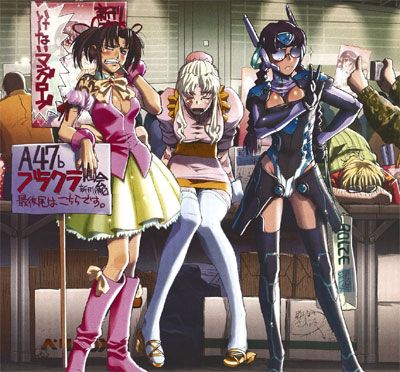
Comiket Is Ground Zero For Cosplay Indeed

I sort of went over services in general, so I hope you understand how I use the same idea here is rational, in that it is rational to pander. It is a no brainer that there is a maid bloom over at Akiba, and it is not really news–it’s just an obvious trend. People squirm, either in displeasure or euphoria, for whatever reason, at the obviousness of it all. In the grand scheme of things, it’s very Japanese.

Looking back at Black Lagoon, it is a rather Hellsing-esqe series where the key difference is only in the original concept. As much as it doesn’t look it, Black Lagoon has some kind of core, character-driven story idea behind it; Hellsing only gives us that initial setup which carries it until the mangaka figures out something better and more interesting later on.

What do I mean by Helling-esqe anyways? Cool action, old school wetworking? Maybe. Badasses, girls with guns? Lots of other stuff have that too. In as much as ink is black and most manga are inked, the paintbrush of what is cool and what are services to the audience is really broad, after you’ve been at it for a while.

In that sense, it makes Black Lagoon the anime so much sharper and powerful than Hellsing the anime. Re-scrambling, we now have the Hellsing OAV which recaptures what was euphoric about that delightful coolness which surrounds the manga series. I am guessing that was the difference.

Perhaps it is good to step back and realize that a good story is still the bedrock foundation of good telling of stories? I’m not a big fan of calligraphy, but to me that’s high art; yet the same ink, the same words, the same people use the same tools to communicate the most mundane things. No matter if you’re a doujinshi artist, a race queen, or MAKO doing a sitcom skit over the internet, it’s the same rationale going forth. Without that bedrock, it’s just spilling ink in vain.

Where fanservice intersects with narrative, there is hope, love, faith for the genre and goodness. Anime is now Japanese, omo gets excited, money exchanges hands, blog posts written. Lesser is when a story exist in vacuum–it becomes something you google up, and maybe read once, or hear others retell it better. Worse is when fanservice exists in a vacuum: it’s pornographic, cheap, boring, and beneath notice.


Casulties of War

Hanabi is copyrighted, but sad gothloli in france is probably patented, too.

Last week, the potentially landmark lawsuit LabCorp v. Metabolite got dropped from the US Supreme Court. The three dissents were hell bent on kicking patentability back a notch, and I am with them. However I think everyone who is actually practicing patent law would prefer to let the sleeping beast sleep for some more.

But I guess we shouldn’t speak too fast. In the mid-to-late 1900s we’ve had some serious caselaw over what is obvious in respect to what can be patented. Needless to say it’s a big, grey mucky area that no one can say for sure all the time. As a subscriber of the future curve theory of social and scientific progress, I feel like a war profiteer, going into this industry during such a time of unrest. Indeed times have changed, will our jurisprudence remain?