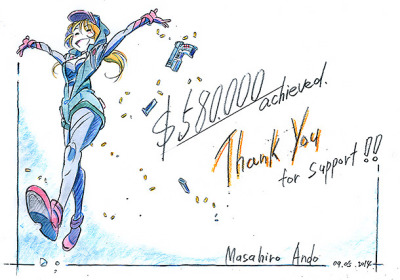
One of the PR points repeated in the Under the Dog crowdfunding campaign (disclosure: I backed it) is that these creators struggle with production committees not taking a stab at the global audience, and instead are inwardly focused on the domestic, “moe” crowd. This sounds okay to me, but it also sounds like a truism and misses the point.
I am all for addressing that risk-averseness and the tendency for these funding committees to ride that bicycle, so to speak, that there is no gain if no risk is taken. However I think poorly of the “targeting oversea audience” bit. It basically comes down to how we define anime and why we like it.
In some sense, I work on the assumption that ultimately Japanese fans like a lot of the stuff oversea fans like. There is a huge common ground. The question is more so, how do we tap the wallets of these people, who are probably not going to dole out $$$ to buy a standee, or whatever iconic act of being able to gravy-train a vertical.
In that sense, it’s putting the money before the product. A more natural perspective is how do we enable the creation of “marketed animation projects” in which delight fans per se, but are outside the influence of that creative committee? By “marketed animation projects” I mean distinctly something that’s not like the pioneering crowdfunded project, Kick-Heart.
Kick-Heart (disclaimer: I backed it) is a cool art short (15 minutes) by Masaaki Yuasa and given the amount of work that went into it, I think it’s a fair trade. In this sense we are engaging the production of animation in a pure way: backers pay and get what they paid for. We are literally buying anime. You are not even buying an ad that’s made to sell what it adopted from, let alone buying into some long-term arrangement (eg., being a P, or something about identity politics, whatever) that is more like a relationship than a simple purchase. I’m not sure anyone who isn’t into arthouse-type animations will pay into Yuasa’s kickstarter in a significant way. That’s not to mention, if you will recall, the whole significance of Kick-Heart Kickstarter about funding independence and giving animators good enough pay. It never was clear if crowdfunding can be a solution to those issues then, and even today, but it certainly doesn’t hurt to try. The problem with that is, to me, that becomes a false motive in terms of why a rational entity will put money behind a crowdfunding effort, once the rhetorics and sense of bandwagoning fade away. In other words, it is all idealism, not really something backed by a matter of practical proof.
Of course, I do hope that there are enough of us out there that would gladly fund a lot of anime, over time, via crowdfunding. I just think the four that I’ve backed (Santa Company, LWA2, UTD, and KH; and they’re different from localization projects like BGC, Mai Mai Miracle, Time of Eve, etc.) only indicate that there’s money there. And it’s probably one reason why (of many) Japan hasn’t gone ahead with a more land-grab style production en mass on Kickstarter. It’s a legitimate concern as to how much money per period of time that the crowdfunding community can support in terms of anime productions. After all, anime is kind of expensive to make well. Given the cost of failure on a crowdfunding project (which probably deserve more study from a bizdev point of view), is it worth the while to have more animators pitch on Kickstarter? It’s a real question that we need answers to before we can answer questions that Hiroaki Yura kind of parried about how crowdfunding is an alternative to committees.
Which is to say, UTD is not any of this. To me, UTD wants to create something cool, and the anime is just a vehicle. What I like about their PR, despite their aging assumption on anime fans and fansubs, is that they clearly just wanted to do this anime in ways they exactly wanted. I’m not going to ever disagree with that being a good reason to head to the crowdfunding market. But that implies some things. For example, most likely Ishii has already pitched the idea at some point and he wasn’t happy with the changes. The question is then, why did they wanted to do it? Because, if you’ve read their sales pitch, is because the creative team behind UTD believes in Ishii’s script and ideas, and want to turn it into something. And I’m not sure they can deliver, because that something is not just an anime.
I think here are some questions people should ask:
1. Why anime? And not, say, a video game? This struck me the most relevant after thinking it through. And the answer, as far as I can gather from reading the various AMA or KS updates or Otakon reports, is because some of the creative people wanted to do an anime because of prior experiences, relationships and situations. To that I think it’s great, but also it reflects sort of on the nature of the production. In Ando’s capacity, anime is probably the best format, and I expect that group to hand in some quality work–maybe not GITS movies level but certainly very good. But when you commit to release an OVA, you are kind of committing to a certain release format (Short Piece aside, I guess), a certain way of funding it, and a certain way of marketing it. This changes dramatically once you want to release a PS4 game, or a live action movie, and it can actually address some of their concerns from the funding point of view.
2. Why the assumption that there are enough people out there that would enjoy a 1997-style, GITS/Akira-influenced story? Those are successful anime franchises that failed to monetize in a big way in recent years. Does UTD address this concern? I mean if you are any kind of an old aniota over in the west, you might remember the large number of failed western-targeting anime works that dotted the 90s? Do we really want another Armitage or Appleseed? Do we even want to cater to fans who like Armitage and Appleseed today? Â [Bonus: Do we even want to cater to fans who liked Sword of the Stranger? It’s a great movie that gained little traction in the USA.]
[Okay, I guess we can even go a step further and talk about making anime on nostalgia and is it really a good idea rather than spend that energy to make something newer, but I don’t think we’re far enough to make a claim like that.]
3. How are they going to market it? Without the help of production companies how can you reach the not-hardcore, or fallen-out fans who might actually enjoy UTD more than fans who like modern stuff in the post-moe period?
4. What if UTD sucksis not so good? This is the kind of concern that SC, LWA and KH are immune to. The fact that Yuasa is making an anime is already going to bring a smile to my face; even if he drew stick figures it’ll turn out awesome, because the guy is a freaking genius and we measure the output of his work on its merit (ie., Art House vs. Hollywood). LWA episode 1 is “young animators” and there’s no way LWA episode 2 is going to be worse as that limitation is gone. And at worst it’s not going to be worse than Kill la Kill as far as an animation vehicle, so that’s a baseline guarantee because of what we know about Trigger as a 100% Trigger production. In KH and LWA the backers are literally buying animation for animation’s sake. UTD strikes me more like “hey Ishii has a cool idea/script and these pro animators want to do it, let’s let them.” which is perfectly okay but it really requires a lot of faith. CANAAN comes to mind. And that’s sort of the ironic complication about UTD–part of it is about the hype, but the hype works against the clarity to ascertain the quality of the production. In other words, if Yura and company took the money and created something nobody liked, they still have to be okay with it. We have to be okay with it, even if that’s not what they’re selling anymore. Is this true?
I don’t want to come away being negative, and there’s a good reason not to be. UTD is actually the kind of anime kickstarter that is more anime than most. By that I mean the UTD crowdfunding addresses directly the problem about making “anime” as we know it. LWA and Kick-Heart, to me, is not what people think when they think about anime. It’s not televised and it’s not a marketing campaign to sell crap. That UTD kind of wants to not be such a thing but is kind of asking people to fund it so it can behave similarly is a direct challenge to that committee-based production model. This is the real crowdfunding anime against the machine, guys.
PS. What if Santa Company tanks? Answer: It is impossible. Santa Company is an anime about kids and Santa Claus, it’s a bulletproof concept like cute babies or weird Japanese animal mascots. And maybe that’s a more honest approach: the buzz words used for UTD triggers. As an anime fan who’s been around since Akira, I lost track how many crap shows tried to use that moniker to sell itself over the 25+ years since. I’m not so sure those marketing terms are any good; actually the fact that anime fandom in the west are still stuck on it is a troubling sign. And to be less unfair, that includes fans who tried to describe shows using that word, or just because a certain staff worked on Akira or Evangelion or Bebop or whatever popular works these animators have connections to. Calling me a skeptic is a truism, and it’s important to see UTD for what it is. Thankfully it’s nothing that terrible.
PPS: Kickstarter for UTD, ANNCast, Live Stream, Reddit AMA, Otakon stuffs?
PPPS: Here’s something fundamental about the way I see anime. On this blog, I tag my anime as categories and via WordPress, I use a parent category to track all these names for shows. The parent category is called “Franchises.” I realize this is not how most people look at anime, but somebody’s got to do it. I like, and it tickles, that UTD’s marketing bucks my way of doing things from the get go.