Category Archives: Modern Visual Culture

Scryed End for Some, Play in the Play for Others

I’m satisfied with how Star Driver ended, and this is why.

For starters, Star Drivers is pretty meta. I think it would be almost stating the obvious to say that this is not a good Mecha show. In the various interviews our lead dudes have professed of not having that sort of knowledge, but in the case that you didn’t follow those delicious behind-the-scene notes from Igarashi and Enokido, it’s hard to miss that there’s this Utena-esqe flair in a lot of the elements in the show. In fact the story seemed more like a regular high school intrigue thing with random battles thrown in there for good measure. In that sense it’s kind of like Utena, too: wait, was there anybody watching that as a Samurai flick? I guess the setup is not too dissimilar to a typical story where an outside guy comes in town and raise havoc. And I mean Utena not Star Driver…

The mecha battles themselves are pretty fun to watch per se, but they lack a certain sense of grit, as if it wasn’t really obvious that they were merely vehicles [/zing] to express certain resolution or points of catharsis for character development. But all that glitter and fabulousness isn’t going to fool me! Maybe that is where some find the show disappointing, like all the reused footage in Utena or the lame sword fights.

The second point, to talk about Utena again, is the structural similarity between Utena and Star Driver. I think if you get one show, you should be able to understand the other. This is not to say anything else about how the two are similar, but it is more like we are getting different themes expressed through the same mechanisms. To use an analogy, it’s like being able to understand one story told to you in gibberish probably means you can understand another, different story told to you in the same language. But that analogy also shows how sometimes you may be able to understand something out of familiarity of subject matter despite how that communication is less than perfect, like a weeaboo talking to a Japanese fan of the same, despite a language barrier.

Then we have the meta-of-meta problem. I talked about the play in a play before, and that sums up both what makes Star Driver work and also arguably its largest flaw. And it should surprise nobody that the series ended just like how the play did. Wako poured her heart out during that battle scene, and that’s as close as we’re going to get to a concession (despite the whole “hey, isn’t that voice-over gimmick what someone does in a play?”) And isn’t that a (relatively) radical message in of itself? It didn’t give me a feeling of “woah that’s pretty awesome” like, say, the end to Canvas 2 anime (it’s a spoiler) but this is a much better way to do it than, for instance, Asobi ni Ikuyo. The problem about meta is simply that the audience tend to get caught up in that and miss the main point behind it all, despite that the meta is an illustrative device serving overall thematic ideas.

I phrased it like a problem, but the meta is a guiding post to understand what the hell the show is actually about; it’s an intended feature, not a bug. Maybe you would think Star Driver could have done a better job by trying to express thing, y’know, normally? I suppose that is up to debate.

Lastly, what goes well probably also ends well. Regardless of our feelings about epic bromances, Takuto and Sugata’s final duel was something, wasn’t it? It’s a good note to end on.


Pinpointing Miku’s Success: Free as in They’re not Suing Us!

I read a piece about the troubles Nokia faced as a large tech company that was in essence focused on making commodities; its structural thinking ran contrary to the core impulses that keep tech companies alive and thriving. At least, so said one ex-employee. In some ways this is exactly the key ingredient we talked about in part one of Miku’s interesting perfect storm. However, what we didn’t talk about is how it was made possible in the first place. [You can date this post now, right?]

Understanding this second point I’m trying to illustrate is, in essence, an overview of an aspect of copyright and trademark legal concepts. Or at least that’s how I look at it.

I won’t be the first or last person to make statements about the way we think being shaped by the way certain commercial practices are set up; advertising and branding are two big ways in which we can come to understand modern popular culture and consumer behavior. Branding, specifically, is a powerful thing that people have long since taken advantage of as a way to sell possible crap. Crap, I say, because trademarks is a label you apply on something so you don’t have to verify or experience it on the surface. It saves you the trouble to objectively verify and compare it to your alternatives, or more commonly, it is a value-added factor. In a media-rich environment it saves time and filters signal from noise; brands are convenient.

On a basic level, brands have to be regulated or protected. The first reason behind this is that if you don’t control what gets branded what, people would take advantage of a brand and pass all sorts of things under it, thus diluting it and making it less useful. Part of that concern is also preventing your economic competitors from reaping the fruits of your labor. You see this most excitingly play out in markets like biotech and other consumer markets.

But we’ve moved beyond that today. Not only do brands facilitates transaction, but at times it has become a part of the transaction as well. In marketing identity, brands are the actual products, and what the physical thing you can buy with the brand on it takes a back seat. (Best example: Nobody cared if the iPod benchmarked poorly compared to many of its competitors until in recent years.) In essence, it is the mysterious factor that distinguishes things beyond their objective merits. It is value-added, just like how a sports celebrity may endorse a product, and thereby associating his or her identity to that product in the mind of some people. Mascots are of a similar way.

However, in the end the mascot is still associated with something; a brand is about, like, clothes or food or heavy industrial equipment. This is where I think Miku is the next frontier. For one, she already signifies a sort of genre, when we talk about the music aspect of vocaloid fandom. You’ve got the vocaloid stuff, which is, largely speaking, a musical instrument. So it’s sort of like saying “stringed music” or “percussion music” when we go on about vocaloid music. Miku is kind of the biggest symbol among vocaloids, so maybe we can liken her to “piano” and Megpoid as “harpsichord” and Keito as “accordion” or some such.

“But wait, doesn’t that mean it is no longer meaningful as a brand”? Is it genericide, in trademark speak? I don’t think so. It is something a lot more than that: Miku has transformed into a living identity. You can’t “genericide” Lady Gaga, just like you can’t do so for every single Nat King Cole knockoff that has come our way, or every band that draws from the Beatles or Rolling Stones. I guess suicide is possible though.

Well, that isn’t even possible with a virtual diva. They don’t get into sex scandals nor do they go around shopping their recording contracts to rival recording companies and producers. What are virtual divas? Characters. And furthermore, they are like character copyrights.

The merger of a trademark and a copyright is not exactly a foreign concept. The two can seen as partners in certain lawsuits. But I’m not here to talk about lawsuits, or rather, I’m here to talk about the lack there of. By evoking copyright I am not so much trying to describe what legal protections are afforded Crypton, but the nature of Hatsune Miku as transformed from merely a kanban musume into someone more akin to a character from an actual literary creation, and all of its subsidiary derivatives and the support of its canon.

Well, by canon I mean the attempt to try to draw a circle around the loose federation of what makes up what the collective of all of us think when we think about “Miku Hatsune.” There is a clear fan-generated and fan-acknowledged canon. The leek is officially endorsed. And like Yuu, I have no idea why a tuna goes with Luka [okay I have a vague idea].  This is important because by specifying the mascot in a way that is akin a fictional character, we have a definitive (although may not be as specific as copyright law would like it to be) set of characteristics. In this sense it is akin to saying a Playstation looks and feels like such a way, or how a Volkswagen has to have this symbol here. The difference is that like other character copyrights: Mickey Mouse, Clark Kent, Bruce Wayne, etc., are more a canvas for fans rather than a list of specifications derived from a tangential narrative that happened to be so-called “canon” because it is the legally permitted work/derivative work of the original creator. So yes, it’s okay if Miku and Mickey play around as super-deformed characters; it’s not okay to pass off an iPhone after being rolled over by a road roller.

The freedom I’m trying to illustrate is the key second point to Miku’s success. It gives fan a certain range of freedom not unlike how Gibson or Fender has no say in the way you smash their guitars during an on-stage trance (let alone what music you may play with these instruments), yet at the same time companies can point at Miku and say, hey, we can use this brand to sell stuff, and people would know what it is. Sort of. Put it from the opposite perspective, it is more like Crypton wouldn’t have to worry about Miku competitors so much (like all those UTAU stuff) since it’s now something with a totally unique identity (even if it’s unique like a generic pop idol). It is like an outpouring of creative hive-mindedness meeting producers with money at the juncture of a legally grey sector. We already mentioned in part 1 that the actual engine to Miku’s (largely financial) success is its participatory culture, and functionally she’s an inexpensive, turn-key solution to some of life’s trickier creative problems. What I’ve covered here is more the overhanging shelter that made it a sensible economic choice even for creators out to exploit the market in a financially significant way.

I mean, somebody has to be able to explain things like this, correctly or not? Who in their right mind would advertise Miku on the streets of Tokyo? That cost money! This is how they can make it back.


SaiMecha Nonsense, Remembering Mechanical Designs

This is a neat idea, but I don’t have time for yet another one of these. It does presents the opportunity to make me feel slightly excited yet largely apathetic, a “what do I feel in your shoes” moment for my mecha otaku counterparts, coming from someone who can be moe-obsessed at times. Given that I just don’t have time for this stuff, I won’t be emailing in a nomination or anything.

That said, mecha is still the root of my anime fandom, so it’s a good time to do a short list. The very first anime that I was a fan of was no other than Go Nagai’s Mazinger Z, and there’s some pretty glorious stuff from that show. In fact from a design perspective the various iteration of the Z has stood pretty well against the test of time. Or maybe because they keep on releasing slightly redesigned versions of it.

I think the fact that Mazinger threw a rocket punch or did super kicks and shot beams out of its chest was all pretty cool to a 6yo, but at the time I was more infatuated with its wings and Aphrodite A’s famous boobie missiles. (I guess I was a moe fag from a young age?) More relatistically, the wing attachment was simply the coolest thing ever (at 6yo), and missiles are obviously weapons of the future. I mean look at how old Mazinger Z is, and we are barely getting started on actual laser weapons in field testing, with some prototype cannons fired from naval vessels. I suppose this is just to say way back then, I was more a wargame/military weapons boy than a pure fantasy person.

Coincidentally I hated how swords are used in giant robot shows. I mean, dude, these are super cool weapons of destruction from the future! Why are they using stuff we stopped using, like, 100 years ago?

Strangely enough, that impulse or leaning doesn’t push me towards “real robot” over “super robot” when the divide was made clear 10+ years later. If anything, how “unrealistic” real robots were became a major turn-off. (The Aestavalis system’s focus over logistics was the only one that pulled it off in my eyes in a convincing manner.) When it comes to anime and mecha, I was mostly a student of design and of setting elements. And when it comes to sexy mecha designs, there were very few that can rival Shoji Kawamori’s work in anime. Macross-style folding for FTL travel? Yea I can get behind that. Variable fighters? Sexy.

The first Macross mecha/spacecraft that I took to was probably Focker’s VF-1. I mean, it’s basically the F-14 in an alternative future. Nevermind that the F-14 is this aging aircraft that should have been retired from the US Navy 10 years before it actually did, it was pure, jet-engine-grade fantasy fuel. I didn’t think much of the Guardian form–I think at first I didn’t quite get the point of it–I mean, it’s a jet with legs? Things like vectored thrust were not entirely clear to me, in the early 90s. Or for that matter, how the basics of flights like how attack and lift worked with each other. Nonetheless, the swept wings, the transformation from plane to robot, the toys that did the same, the “calves” of the ship that was part of a vector thrust thing, the lines and curves, oh my.

I suppose it is a blessing in disguise that I was not well-informed, so something like Macross’s complexity is enough to pull the wool over my childish eyes. At least I was able to ignore the fact that it had arms, as it was at least justifiable in terms of having hard mount points that were on a robotic arm given the range of motion a Valk had.

Speaking of arms and curves and Macross, I was a big fan of those VR-052Fs in Mospeada too, although I was more taken with the way how action scenes and battles were depicted, combining the fact that it is a motorvehicle and a robot. In fact I didn’t get the same kind of feeling until way later that I finally got to see Priss & the Hardsuit girls. Shinji Aramaki hit a good spot. It was not the first “moe moe” fusion, as it was later coined, but if sexy models and car ads were like bread and butter, Aramaki’s motorcycle-inspired designs were the equivalent of buttered croissants. It is about mastering streamlined curves, and express loudly through design the function of things it may do.

I think as I got older, my fervor for mecha slowly dropped over time. I think part of the reason was simply because there weren’t a lot of variety. I could never really get into gunpla largely because they mostly looked alike, and between the variants of the same models and how the same model would get different releases based on grades it just kind of turned me off. Other franchises didn’t help much; I’ve definitely watched a lot more anime since then but fewer mecha were as awesome as how child perceived coolness for the very first time.

That said, there were plenty of interesting stuff, ranging from Escaflowne’s pulley-driven artifacts, CLAMP’s crystalline beasts, and even occasionally invoking from the best, such as the first scenes of Gundam 00. Maybe I just got too old for Gundam Wing and just right for Syd Mead: Turn-A featured innovative designs, just none very awesome . Maybe I was too young to hold the classic GM or the Guntank dearly in my heart (although the GM did age gracefully, perhaps much more so than anything else in UC): I appreciate the variety, even if to me it is not diverse enough. It’s good, but not moe, you know?
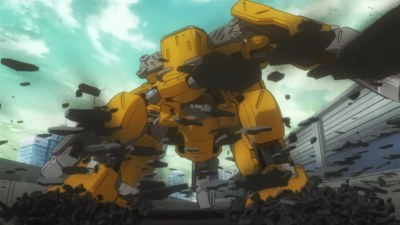
I do like a strong sense of industrial design; but unlike many others like myself I am not overly taken with things like, say, the glorified forklift from Alien 2. Still, I was in utter delight when Railgun featured one of the best take on the forklift weapon with those sexy grapple rocket punches (did it ever get a name? I guess). Tethered! I wish I can take the GAMA home. The MAR hardsuits were already pretty neat (but they were more like the tepid oasis lost in a sea of sand–yes, I am a hardsuit fan, no there are not enough hardsuits anywhere) but that final boss thing takes the cake. Sure beats a weird alien fetus anyways.

Speaking of Railgun, it was probably the last time I felt that dissonance when everybody else watching the show were busy oogling at middle schoolers, and other than Mii I could care less what they were really doing. It’s a solid show that somehow featured something everyone can appreciate (a cool final boss) but that was not what people were looking for.

I’m just limiting myself to humanoid stuff. I have no idea if it counts, but many of the Guild ship designs from Last Exile were superb. Ao no Rokugo’s submarine is something I want one for myself as well. I will probably never be able to afford a replica of ND-001 or any of her sister ships. The Kildren fighters in The Sky Crawlers were one of a kind. Macross Frontier reinvented the mothership/carrier concept with Macross Quarters, and it now is one of my favorite spacecrafts in general. Well, that is technically a humanoid mecha too, although I don’t think of it that way per se.

Let’s just stop here. Because I can go on…and on and on. I don’t really keep up with the newest development in the anime mecha world, nor do I want to. All my database-animal receptors for mecha are present and working, and that’s the thing that truly matters.

Run Ichika Run

Ok, so it finally made sense. Ichika is someone that unites the girls in their simple goal of… winning for whatever their hearts desire. Revenge, currying favor, satisfaction, confidence, whatever it is that drives the multi-national cast, all for one, one for all. It’s a pretty neat theme. Thanks, episode 11.

In that sense, Infinite Stratos is an exceedingly appropriate anime during a time of crisis in Japan. Japan needs our help, so France, Germany, China and the UK are going to step up to the plate and help ’em out right?

In the “final” ending sequence, people are running in sync. In the previous ones, Ichika ran at the same pace only with one other girl at a time. Who knew running would bring it all together? I guess it would be something I noticed earlier if I wasn’t spending all my time staring at Charlotte’s legs.

Other random comments about Infinite Stratos ED:

  • The Japanese chick is the tallest and biggest! Wau, what a bold statement.
  • Only if all the English chicks are oujosamas.
  • Wait, if Laura’s pants are designed like the skirts, why aren’t Orimura’s?
  • I like this seiyuu ensemble thing. Anime otakus do, too, generally. I think I’ve liked them like, every season. Or do I just like Marinajou’s and Hiyocchi’s vocals?
  • There’s no way they are running at the same speed, since their legs are of different lengths.

I guess I’ll leave the obvious LOL-American (not quite anti-American) and the usual nationalist slants to someone else.


All Good Girls Have Twin-Tails Inside

I’m sympathetic to 2DT’s take. I always thought Azusa was someone who had to be liken to in some way to a previous experience. The stereotypical saccharine-filled neko-mimi sweets-lover is not why she won Saimoe last year, nor is it why Azusa is probably my favorite K-ON girl (tho I think Yui is still the best, whatever that means).

To put it in the right context, 2DT saw the light because he realized that Azusa is actually based on some real-life notion of ideals. In the comments he explicitly stated this connection (emphasis and added link mine).

I wasn’t so much a fan of her myself… until I realized that all the students I have who are like her, I love! [] Such a sweet, good child. I understand her classic moe pull.

I’m not going to talk much about that classic moe thing (by the way, classic moe is better a term than old moe, because there’s, well, actual old moe involving old people). It is different than the somewhat more mature, hime-cut Yamato Nadeshiko moe (Really? You’d think a Yamato Nadeshiko is naturally attractive?) that is better characterized by Mio, so even “classic” is not exactly a great moniker. Furthermore, moe is so dead, I would rather not talk about it if I could avoid it.

What I will share, however, is my previously-mentioned (well, it was over a year ago) note on how I like K-ON because I see that band dynamics play out in my own experience. In short, Mio reminds me of this guy I know. He is adorable, musically talented and everyone likes him, just like Mio is among her friends. Both of them had a fan club. Well, YMMV, as it is with anything personal.

People are multi-motivational and complex things. It takes time to get to know them, and it is is tough to do fiction where part of the charm comes from mapping characters to actual people in a typical yet lifelike way. The good-girl appeal, however, is always going to be a draw to people who like them. I think it channels some sense of righteousness that many of us have within us, a sense of right and wrong, or good and evil. And going by that measure, that applies to most. I just want to separate out the two different kinds of good girls.

So the story goes, to begin with a scene from Conan the Barbarian (lol thanks JP):

Mongol General: Hao! Dai ye! We won again! This is good, but what is best in life?

Mongol: The open steppe, fleet horse, falcons at your wrist, and the wind in your hair.

Mongol General: Wrong! Conan! What is best in life?

Conan: To crush your enemies, see them driven before you, and to hear the lamentation of their women.

Mongol General: That is good! That is good.

Thanks to a certain parody subber, I have long since fallen with Simoun–more importantly, Mamiina. Simoun has a large cast that comes together for some pretty delicious drama. One of these is exactly the very heart-warming, turn-around good girl that newfags may find familiar in the character Kyouko Sakura from Madoka Magica, if Simoun is unfamiliar to you. Just like Kyouko, Mamiina is not a model citizen. In fact there’s nothing to her that makes me want to stick a pair of cat ears on her head. It’s the difference between a stray cat and a house cat, I guess. But it’s just that Mamiina screams loudly, through her actions, that she is indeed the very sweet, good girl you find in Studio Ghibli’s adventures, even if she is at times antagonistic.

The same idea plays out along the lines of all these Azusa-type moe characters. This is where 2DT’s observation comes into play, but only to a point. Because while we have our Kikis and Sheetas, there’s the Sans and, arguably, Nausicaas in the Ghibli lineup. I’m going to say that there are two sides to the Good Girl archetype, and the difference between the two is a philosophical divide in which only some of us can reconcile.

Back to Mamiina. She is a good girl because she jumps this gap between antagonism and protagonism in order to demonstrates her inner qualities, and she does the Right Thing at the Right Time. It leaves an emotional crater, a desired dramatic impact, especially when framed in the context of her intercharacter relationships. But at the same time, I can imagine a Mamiina-type character would be the nemesis or rival to an Azusa-type character (it probably is the plot to some battle show, wouldn’t surprise me). Without the external stimulus that put these characters through the crucible of tragedy or suffering, maybe the difference between the two types of good girl archetype lies within the answers between the random Mongol and Conan. Conan was just some normal barbarian at first, after all.

Another hypothetical may demonstrate better. Remember the YuiAzu episode? Let’s say if we replace Azusa with the antagonist version of Azusa, what would instead happen is that rather being a type A Good Girl, the antagonist Azusa would not volunteer to help Yui with the performance, yet later on do so anyways for some plot-specific reason. It seems like a typical gap moe tsundere type thing, but that is not directly relevant to a demonstration of character. You can be good or bad and still possess this duality.

I suppose that’s all part of the specification of being good; there is a strictness within Azusa’s tenderness, or the flip side of the coin, a tenderness in Mamiina/San’s intensity. It turns some of them evil, some of them slaved to passionate antagonists, some to reason and some to strange plot devices about clones. I’m not sure how much I can stretch this, but all I’m trying to say is that are Good Girls among us, and there are many. And like girls generally, they have a plurality of face!