Category Archives: Modern Visual Culture

Star Driver, Sharks, Theater

The phrase “jumping the shark” only has meaning when we walk the careful planks over a suspension bridge of belief. Do we want to use that term in regards to Star Driver? Does it really matter when Fonzie jumped it? Does it really matter when Takuto pulls out a new trick every battle?

The answer for both cases, of course, is that it does. In Star Driver’s case, however, sharks are a regular of the set. Maybe that’s just how it is on the planet of Fish.

In reality, the ebb and flow of the series tumbled up and down and we were on something like a roller coaster for the past 22 episodes, ever since Mr. Protagonist beached on a certain southern island. For each, uh, shark, that we hopped over along with Takuto et. al., we lost some people on the bandwagon. The overly theatrical nature of the series doesn’t help at all, either.

And Star Driver is, if anything, theater. Should it bother us when Mizuno, uh, jumped the bus? Or when Sakana-chan had weekly one-person plays? I don’t know; but a little, almost-undetectable hair-fracture-slice of my belief in the show evaporated for each Kiraboshi salute or for each time Professor Green’s underboob showed up on screen. It isn’t that I disliked any of it, it just became something that was, for its own sake, theatrical. I no longer understand why it is theatrical.

I mean, at least Glee gave me a song and dance every now and then.

Maybe Star Driver just needed more dancing; Utena had the right idea with that at least, although I too appreciate it when giant robots tangoed under a prismatic starry sky. Perhaps all that we need is a bed of roses and an ax. Star Driver, instead, gave us an Inception-esqe school play (a play within a play?) as both an allegory for viewers and an alternative way to communicate between characters, within an already exceedingly theatrical construct at the basic level. Was there anything unusual in this latest installment besides over-subbed dialog and artful display of constraint in prop use (to signify this is suppose to take place on a stage)? In other words, isn’t a dream in a dream still just a dream? Why do this to us? It’s too much.

In conclusion: there needs to be a stage play for Star Driver. Or better yet, Star Driver: The Musical. Someone makes this happen, please!


Moe Is Dead Part N+1: Mind the Gap

It is kind of incredible that people are still unfamiliar with gap moe. Well, people meaning people who watch anime like KoreZom episode 8 or consumes whatever crap Japanese modern visual content industry pumps out day in and day out. Kind of, only because I’m talking about people who live outside of Japan and generally don’t interact beyond the great barrier of the foreign, moonrune language.

But even I know what gap moe is, and I’m just your average chump when it comes to talking about moe. So do yourself a favor and like, read about it.

On that note, KoreZom episode 8 is almost authoritative on this topic. Too bad it doesn’t have any male-type gap moe examples. Unfortunately it is still not a text book on the matter, so unless you gain a working level familiarity on the subject, it can read like a book with no words in it.

And thus this is where we proclaim gap moe’s death: there is a professionally produced anime in which a whole 20-some-odd minutes is spent to expose, explain and exemplify the various notions of gap moe. Granted they stuck in some plot material in those minutes, but it’s quite something to dedicate an episode on a single trope, to this extent. And given it was KoreZom, there was barely any plot material anyways.


Jealousy’s Ugly Heads Aren’t So Ugly

If not for being announced on the same day as each other, I would not have compared Catherine with School Days. In some ways they are two very different but two remarkably similar games, so the comparison do stick.

On one hand, School Days is a fairly novel game from 6 years ago that took the anime and visual novel media one step closer to each other; much of the first chapter of the game is actual animation. It’s also remarkable for the large number of well-portrayed endings the player can end up with, and a large number of them aren’t exactly what we call “happy” endings. The combination was pretty sensational in an otherwise relatively more-of-the-same genre of bishoujo games with adult content. That is, of course, on top of the slightly different take on the renai motif that is closer to Jersey Shore than the experience of some fantasy animu transfer student who forgot he has a cousin that he is now going to live with, or something.

On the other hand, Catherine, to borrow words from others, is the adult-erotic version of Q*bert. But more specifically, Atlus’s chic-cool Persona team pulls out the stops to make a thriller game based on a man’s instinct to run away from commitment in a relationship? Fielding top seiyuu and animation from Production IG, much of the game take place animated and in a narrative style, like some modern bishoujo games. I think the marketing for the game speaks oodles about why I think Catherine is highly comparable to School Days in terms of using jealousy as a driver, as protagonist Vincent (Kouichi Yamadera…he even looks the role) has to choose between Katherine with a K (Kotono Mitsuishi) or Catherine with a C (Miyuki Sawashiro), while trying to not get killed by either of them, or the mysterious dreams he is having.

Oh, yeah, people die in these games. People meaning possibly you, the protagonist/player. Here’s another bit of similarity for you.

I think it’s safe to say that I am excited about both games coming over and being ported into English. I’m still kind of hung up about buying games with pornographic content, so I’m sitting on the fence for School Days. Isn’t it weird that the game full of high school kids is the one with all the explicit sex? And it isn’t like Vincent doesn’t get any; Catherine’s portrayal of sex is, perhaps, a little more mature and  little more appropriate for a game about a 30-something trying to straighten out his love life? Or maybe it is a little more appropriate for a game being sold to a bunch of 30-something herbivore men? But then again, like myself, the two demographics probably overlap somewhat, despite the entirely opposing approaches to the appeal of realism.


Death Loli Survey

By “loli” I mean it in whichever broadest way I could have used it in a serious manner.

The strange thought came after viewing Infinite Stratos 8. Actually, it started a few weeks ago when someone made an off-comment about the lack of DFC in the series, to the extent that “wait, is it just China?” China’s representative herself is not exactly flat; probably just closer to normal for a high school student. Soon enough we were fixed of this with the appearance of France and Germany. One is magically flat, the other flat by archetype. And that is the archetype I want to talk about today: the killing machine loli.

There had been a fair number of the loli-born-of-science over the years. I think the all-time iconic stoic deadpan tsurupettan still is Ruri Hoshino, in her original, pre-teen tsukkomi self. Granted, she was not particularly violent, but when combined with some super computers in battleships, the results don’t leave much to your imagination. Evangelion’s Rei is another all-time favorite, so I won’t go into how she’s any different.

German-chan, or Laura, has a backstory that is slightly spoiler, although I don’t think it matters; so bear with me. I think she stands more in line with Gundam00’s stoics better, who inherits from their generational Zeon experiments, starting from the original ethereal space beauty, Lalah Sune.  To cut to the chase, I think Zeonism is pretty much drawn from Nazism, if only in some vague sense. German-chan would fit right at home.

On the other hand, I have a hard time coming up with an American death loli. In fact the only loli of any sort that I could think of is the all-American fujoshi, Susie Hopkins. And even so, she’s not exactly loli by definition. So where are they?

I mean Italy has a whole line of deadly lolis (and probably bonus point to Russia and maybe even..Tunisia? Netherlands?). Where are the French, Spanish or English ones? Well, they’re probably out there, just none coming to mind right now. I’m not well-versed in this subject matter, so it’s an arduous task for me. Can you help?

Also I wonder if this has any connection with Japan’s national stereotypes of foreign nationalities. It probably does, but it’s a subject for another day.


QB156

Just some thought dumps, since it’s all I have time for this week.

CrunchyRoll’s newsletter has an interesting take on B156. I am not sure who contributes to their newsletter but I thought this is a particularly empathic take, and one that I don’t disagree with much. Namely it points out the maturing of anime has something to do with blurring between the genres that were categorically adult and what clearly weren’t. It’s a logical thing to say because it is obvious; you can see it happen. It’s good that I’m no fan of Moetan either (although I don’t think I hate it). More pertinently, the maturing of anime probably comes from the notion that its audience has grown up (age-wise), but this was missing from the write-up. I quote:

Sex sells; or more specifically, moe. Moe is rife in modern anime, more than ever before. Granted, sexual content has been present in anime (who hasn’t heard of hentai or ecchi?) but up until recently, the boundaries between mainstream and hentai were well established. These boundaries have blurred considerably with series such as Strike Witches and Moetan leading the way in using moe to promote questionable or feeble material. The latter is particularly responsible. The main character, Ink, is meant to be sixteen years old and yet she looks like she’s ten. The dialogue enforces constantly that her age is sixteen but there’s no getting away from the fact that she DOES look like a pre-pubescent girl. That was three years ago. Nowadays, there’s always at least one series per season that tends to one-up the previous season in terms of sexual content sparking outrage with organisation and public figureheads like Ishihara.

This leads me back to the title of this article. I believe that this legislation, if it goes ahead as planned, could stimulate anime into producing more mature and accessible series that are more engaging narratively speaking and less sexually awkward. However, I’ll make this clear. I’m not a fan of Ishihara and the need of a bill to make anime not resort to controversial tactics to generate interest regarding a show. Studios and directors should come to that conclusion themselves and not out of fear of reprisal from the government. I liken anime in 2011 to a teenager – exploring the boundaries of risque subject matter whilst not being able to fully comprehend the consequences for doing so. A bill may change that – whether it will be a positive or a negative action remains to be seen.

I think the blurring or pushing of boundaries is natural. It’s how almost everything evolves. It’s certainly how art and entertainment evolve. Of course what should go hand in hand with this boundary condition is socially responsible application of boundary pushing. If that is what B156 pushed for, it’s certainly not written in it anywhere, although it does make sense in this context. Still, this Masako guy might be right even if how he came to his conclusion may be wrong–that eventually we’ll get something pretty darn cool because things will have evolved.

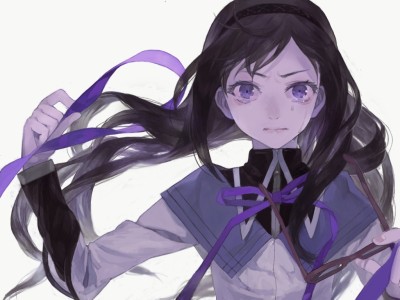
Like Magica Madoka: You know what was the coolest thing so far? QB’s real name. And it’s a bilingual trick too, by taking the second and third syllables of QB’s real name (which is basically English lol) to make his other name. And just to think if we didn’t have an aging audience clinging to magical girl shows they were infatuated with when they were younger, how possibly could we have had this strange mix of deathly despair and frilly-cute combat outfits? I suppose I should also talk about the other word play reveal at the end of episode 8, but someone else probably can do it better.

Before QB’s reveal, though, Homura’s strange outpouring on Madoka is somewhat … funny? I think this doujinshi explains why I find it funny (and it was made a few episodes ago no less). The only question left is: how GAR can she get?