Category Archives: Modern Visual Culture

New Season Checklist 2

Not quite yet over, but I gave in to the Cap.

Nordic != Bagpipes?

AMG TV2 knows what it’s doing. Same with Aria 2. The sequels generally score high and because they exist second-generation that’s probably indication enough. OTO…Wulong? Hack//ROOTS?

Eh. Well, the CG fest anime this season, Zegapain, scored well with me; I probably still won’t follow it, but I dig its high school romance aspect. The combat was very well-done, too. Especially if they can get it all on HD. Simoun, OTOH, was better called “Lez Exile” in its similarity to Last Exile but the whole airship/feudal warring states concept wrapped around a very strange weird girl-girl relational triangle, tied with equally impressive mishaps when the balance breaks. Pass.

The rest of the average grind mill seems barely worth mentioning, even if it has its gems in the rough. Ray had a great pilot but it’s a BlackJack spinoff, so I don’t know. Inukami is probably worth checking out if you can handle the zany UY-ness. Airgear is pretty but the manga hits the spot way better. Seeing the skating in action helps, along with the right dose of fanservice…but it’s going to tank as a matter of time.

Witchblade seems to take root between something like Guyver and Blood+, so that’s probably doing exactly what it’s trying to do (the Mamiko helped). Magipoka, for me, was the surprise hit. Loli comedy, if such a thing can be called, is usually hit or miss. Definitely superior if you’re looking for that in terms of Girl’s High, or the disappointing Disgaea animation. A more curious comedy, in the form of Ouran High School Host Club, is probably worth checking out for its Utena-esqe character constructs. It’s totally not-serious shoujo anime done with a self-parodic bent, so guys can probably enjoy it as a mockery of shoujo generical norms. Shoujo as aberration in anime continues to be a rule of thumb with Nana, too. Not a piece for Noitamina, this Nana bosts way more production value than ParaKiss, if that’s even the right piece to compare to.

I’ll probably update next with PriPri, Spider Rider, Gargole Family, and the rest of the lot. Otanoshimini~

LIPS!


New Season Checklist

(Ok, just Haruhi is worth it so far)

Super Director!

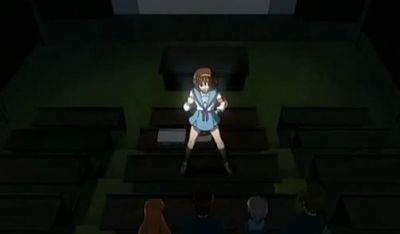
The Melancholy of Haruhi Suzumiya (Suzumiya Haruhi no Yuuutsu). What can I say? When I first watched it, I went in blind. By the time I was able to finish it, I was glad I did it blind. Part of the problem is that this show was giving me so many double-takes, I had problem even going through the first handful of scenes and had to stop.

The animation was clue enough that this is a worthwhile title. I don’t know about you, but the animation direction is something that easily bothers me, especially when it’s done so uniquely like this–imagine framing your scenes as you would in Blair Witch Project…? Okay, save for the wobbly darkness; it must’ve been a major pain in the ass to do the background shots for the first 5 minutes of this episode.

I mean, you thought it was the opening (or I did), but it sounded like…something’s wrong. The animation looked to be cuts from the episode–not unusual for an anime’s pilot. I stopped watching (the first time I put it on), because it really needed my full attention (as I was talking to someone meanwhile, and watching TV out of my other eye). Later on, I got past the opening, got used to the first few scenes. Then the “fanservice”? I stopped because it seems rather weird; skipping around took me to other weird shots. I didn’t check the ending.

I put it on a day later. Marched through the ill-orchestrated opening and finally starting to put the pieces together. Yes, it’s a home-cam production. Mimicking poorly edited film-club quality video is hard in the anime form, especially given the fact that what makes fan films of that kind stand out is the way the background moves… Needless to say I’m as impressed by the feat as well as the fluid animation the rest of the episode gave us. The ending was a riot, too.

I don’t know; it just seemed to be surreally funny. Easily the first anime ever to pull that off since FLCL, probably. That alone makes this probably the best show this season. It managed to channel where Futakoi Alternative failed to do so, yet the flourish is both subtle and to the point. A must watch, even if just for this episode alone.

So far anything that could even possibly measure up to that level of entertainment quality is School Rumble 2nd semester. Alas, though, that’s just more of what has already been well-tread. Well, I’m keeping my mind open for what new stuff that lies ahead. Like Higurashi, Air Gear (heard it didn’t fail?), and what have you.


Life Is a Canvas, Too!

Elis Housen

Life is a canvas
And the paint is hope and promise
The world is ours
No one could ever take it from us
The sky is blue
The day is new
The sun is shinin’ down
You know life is good
We got each other
And that’s all we need

Maaya Sakamoto’s lyrics got pretty close to the heart of the matter. If a carefree, positive attitude is the approach to life you take, then the climax and resolution of Canvas 2 is the dark, evil twin. Admittedly the last two episodes did a number on me.

… It’s an understatement that the last couple of episodes did a number on me. It really changed my mood after watching it the first time. I felt about as bad as my first couple times going through End of Evangelion. Admittedly I’m a strange creature when it comes to my emotional response to EoE, and Canvas 2 has nothing similar with End of Evangelion aside from my emotional reaction. I had to put off a few days just to try to even write down what was going on in my head.

Part of the experience is a weaving and the coming-together of a lot of parallel theme concepts. The fact that it was a silly renai/bishoujo game adaptation didn’t matter, even if you can see the marks of such. I think I would have missed some of the threads if not the ending bothered me so in a screwed up way and got me stuck thinking about it. It was definitely thought provoking.

The quality of writing regarding Elis was beyond expectation. Her character concept is deep and yet understandable, appreciative yet realistic to her teenage self. The struggle, the progression from fawning to materializing her feelings for “Onii-chan” was (the bulk of the narrative’s burden aside) subtle and then it surfaces like Tessa’s Tuatha De Danaan–a genuine surprise; showy for your emotions and deadly for your moral calculus. Much, MUCH better than the typical drama you’d expect from its peers like Da Capo.

I think it makes more sense to tell the Canvas 2 story from Elis’s perspective rather than the typical Hiroki angle. Even by the end of it all he sucks at letting people know what is going on in his head. I think what bothered me about him was that unlike Elis, who changed drastically from the first episode, he was still pretty BLAH about it until he decided to answer Elis’s affection with his own.

The foil that is Kiri, then, is a bit of a satire against a realist’s perspective of romance. Indeed, it’s probably fair to say that the writers went out of their way to paint that relationship almost ideally. A lot of the fault falls on Kiri, naturally, in exactly how she pursued her relationship. For a comparison…maybe Belldandy’s relationship but sans the divine blessing?

Which is to say, that’s why it hurt all the more (for me! and some of you, I bet) when Hiroki parted ways and Kiri just took it like a man… Well, I’m all for women like Kiri and who can take the emotional punishment. She is a saint by normal people’s standards.

Upon more thought, the train of logic goes, is how Kiri and Hiroki would have fallen into a cherished state in their past if not for the fact that Hiroki was still looking for “whatever it is” and the whole Yanagi angle. Yanagi was an interesting element that, IMO, added a lot of realism along with his misappropriation and all.

Some credit is still due to the supporting cast. Kana Hagino probably gets the best prop here for the subtle introspections the writers managed to cast and clue me in; a cliff-note of the ongoing drama in short truisms. Mami Takeuchi & the Art Club helped earlier on much more so, and it’s nice they get a nod and saved Takeuchi’s coolest moments for last. Sumire Misaki sadly looked as if she’s a tack-on now that Tomoko stole the show… But far better was the Tomoko Fujinami angle; you’d almost expect they play that angle more. It’s my favorite because not just how it related to Elis but because they went out and bought all the cheap tricks they could with her. She does dress how she feels. Loneliness was a theme, at least as far as I can tell, that Elis seems to struggle with. I think overcoming that was the key in her maturity. Once she managed to reach out and “touch” Hiroki, the rest snowballed into the ending we have here. I guess that’s why I thought Tomoko’s role was huge.

I wonder how the writing changed due to the fact that the PS2 version had 2 more characters that had such large roles in the anime writing…

Some other musings:

  • Elis, like Yanagi, was the “bad” guy in the love triangle. Is that why she didn’t like Yanagi at all?
  • It is still pretty messed up. I confess no matter how I dress it up and while the THEME is fine, what transgressed is a nod to the realist’s ideal in heart-breaking and being a retard at handling your relationships. Sure, you can’t please everyone, but you can try a little harder at communicating clearly.
  • Kiri is clearly at fault too, but the harder question is what did she do wrong?
  • I like the ending theme and ending.
  • The LAST Tomoko trick is LOW DOWN DIRTY. ARRG I fell for it. But…how can you not?

Overall I have to say it was a great ride. It’s definitely a little slow; the first set of 13 painted a fairly interesting story but they could have gotten it over faster. The intercharacter drama between Kiri and Hiroki lifted the show from being dropped, I bet, for many. Yet Elis…wow.

Makes me want to rewatch Koikaze.

REC Is No Wreck

hands

In a lot of ways REC fits in line with a history of short, excerpted anime series adopting from manga and other mediums to present us with something heart-warming. The historic example of it is Android Ana Maico 2010. I think because how close this (and amusingly, it’s really not close to the original manga at all) adaptation has to do with the entertainment industry, I bet the creators felt it had to be somewhat uplifting.

And it is uplifting. Long story short REC is drama between a man and a woman, both with their drastic failing and reconciliations. The focus is the definition of their relationship; the hook is being a seiyuu, the setup, cuteness, and Audrey Hepburn; but ultimately it is warm, fuzzy fun. The drama is a little serious sometimes, and to its benefit despite the surreal fantasy that it kicks off from, there’s a lot of appeal to realism within the subsequent struggle between the main characters.

It’s good to know that nine episodes and 9*12 minutes later, we get our satisfactory ending. It’s probably no better than Cosprayer the Movie, but it really makes you want to watch Breakfast at Tiffany’s or something (which probably has a longer runtime).


Canvas 2

Hiroki Irony

I’m probably jumping the gun because I haven’t finished watching the show, but at episode 22 out of 24 (plus some vaguely mentioned continuation/oav/type thing) I’m rather enjoying it. Perhaps it is just formulaic, continuing the tradition made popular by the adaptation of Kiminozo (Rumbling Hearts as its official English name), where drastic drama and difficult dilemma pump the viewers from episode to episode. It is a recent trend that by taking a lot of girls and girl angst, whirling them into a foundue of a trainwreck? Mai-Otome Destiny (and much of Mai-Hime), the Da Capo series, and the popular Shuffle are just some of the key pieces that grabbed various fanboys by their balls.

But more succinctly I think what kept me interested (so interested, in fact, that I marathoned all 22 episodes in less than 3 days) was the character acting. Instead getting annoyed and bothered as I would with the likes of Ed Elric or Miaka Yuuki, the adolescent drama was realistic and sweet, as opposed to extreme or hackneyed. The hard-to-like Elis Housen (I love the name!) was truely hard to like only because of her character flaws that were explicitly drawn and defined over the course of the series. Slowly she defined her complex, drawn the lines, and walked out of it. By this point in the game I’m totally on her side, despite what lurks beyond in episodes 23 and 24. Raws here I come!

Of course, the show just won’t work if we don’t spend the rest of the narrative on older, better characters like Hiroki and Kiri. Not even I could tolerate Elis for that long. It’s safe to say that these two made Canvas 2 what it is–a notch above the the average bishoujo adaptation crowd. The two of them form the diagonal in Canvas 2’s love quadrilateral (lol like a canvas) and are the backbone to the narrative. Kiri, especially, seems antithetical to Elis in so many ways that it made the drastic drama deliciously available in the meta, rather than the foreground of the narrative. Keeping things serious as Canvas 2 does means you have to also keep the drama tucked away, avoiding the trainwreck (at least till the very end). I think that’s really what made the show work–being just subtle enough that it doesn’t bother the heck out of your serious viewers, yet obvious enough that people have an easy time figuring out what’s going on inside people’s heads.

Of course, Canvas 2 scores major points for being fresh, taking that old-school narrative, polishing it, and inserting it in a modern bishoujo game adaptation. That’s also a boon for me personally–the illustrations and design perspective is hawt! I’m so sold over the ending sequence… Come to think of it, the way the show was written is kind of similar to Koikaze. There were some major differences, of course, but the writing seemed to be “fresh” in the same way. Definitely something worth exploring.

Well, enough leching over half-French-half-Japanese high schoolers. Despite Elis’s whacked complex and Hiroki’s unseeming inability to grow up…what’s wrong with Kiri again? What would a reasonable, fertile young woman of the proper social, economical, and emotional stature do in a case like this? She can’t deny her feelings, that much is clear. But she really stands to gain in the long run by actually befriending Elis seriously. Elis may be her student and a “child” in a lot of ways (which ironically is something Kiri explicitly sympathizes with Elis), but there’s so much of her “wisdom of age” that can be passed down. I mean, as someone who is single and over 25 I’m pretty sensitive to that, so it goes. Surely if I am serious about this girl, I’d try pretty hard to bond with the girl’s brother. Well, that’s just me. Is that the moral of the story? :)