This Cyber Monday… Find the true power of soft power.

Flood the market with sweat labor from the K-ON voice actors?
The Yard Sale
This Cyber Monday… Find the true power of soft power.
Flood the market with sweat labor from the K-ON voice actors?
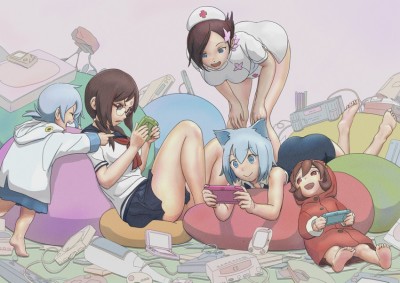
Over the years I found myself more inclined to approach fanservice (the sexual kind) as a plus than a minus. I think part of it has to do with recognizing it as a value to be delivered for some people. Part of it has to do with my growing appreciation for it as I sink deeper in that dark, dank ditch.
Is this why I think Yozakura Quartet – Hana no Uta is the best, at least on a technical level, animation on TV for this season’s anime? The way it simply just puts the light-hearted fanservice out there is natural and fluid and I didn’t even bat an eye half the time. On the flip side there are some characters who are simply walking sex symbols, even with developing personalities and roles to play as a part of an ensemble cast. Then there are the usual moe tropes. And the “We Dollars gonna protect Ikebukuro” nonsense. Except YZQ’s hood is nowhere as cool.
Maybe I feel that way only because Kyousougiga is also on the air, and it shows when you compare and contrast. Not to say that show isn’t well-animated–it is pretty nicely done at times–but as far as the “sakuga” of the thing, as far as hand-drawn animation of moving things, YZQ is a must-see this season. In my mind it blows away Kill la Kill on a technical level, at least purely on this point. And that other point–it’s way more fanservice-y? Maybe? Kill la Kill has full-blown naked people covered by only the shadows of censorship standards. Or clothes. Or what you see when you read Hentai Kamen. But it’s played largely for laughs. Ryuuko doesn’t come across as some pin-up looking to be exploited so she can exploit the viewer for viewership ratings or video sales. Nor anyone else in the show for that matter. Very different than YZQ.
I guess in that sense, we are blessed. All three aforementioned anime are very good storytellers. They’re preoccupied with the narrative and with the characters (when appropriate). They’re not as concerned (well, I’d argue Kill la Kill is very concerned, but it’s easier to argue they’re concerned about everything) about giving fans what they want as much as giving fans what they want but on the show’s own terms. They’re here to awe and I think most of us are okay with that.
And that statement, in some ways, is only not-as-ironic in a post-moe, post-tsundere-song world.
I would also include some other titles in this bin, for this season, like Samurai Flamenco and Non Non Biyori.
Not included would be Arpeggio, Galilei Donna, VVV, NagiAsu, Kyoukai no Kanata, OBC, Gundam BF. But just because they aren’t giving us ultimatums, it doesn’t mean these show can’t approach things their own ways either. I think Gundam Build Fighter is a good example, only because Gundam fandom is sufficiently convoluted and twisted that the meta juice is dripping like a baked turkey during its final hour. The gravy makes itself.

This is not about Ah! My Goddess, the still-running, super-long-running manga. But about that Max Factory 15-year-anniversary figure that is recently released.
It’s a beauty. I mean, it’s easily one of the best figures in my collection, not counting any emotional attachment I may have for the figure, for the franchise, or any other figure that I own. In some ways it’s a problematic figure because it’s slightly too tall for a Detolf. It’s also problematic because it’s a limited, every-figure-is-numbered kind of thing that I feel I should never, ever open it. And I normally don’t have this kind of inhibition about little plastic girls–it’s just the second time ever as far as I can remember; it’s partly because I am NOT emotionally attached (so much) to Bell or Holy Bell (which, thanks to my regimented Sakura Taisen training, I am entirely immune to their visual appeal). I appreciate this figure for its craftsmanship and design. That it is huge yet so well-detailed, lovingly sculpted from top to bottom, and is not a massive affront as a tengu would be (at least potentially a less offensive talking piece at any rate). If I was more emotionally attached to a figure I would likely open it. Of course, if I don’t open it, despite the way the box do a good job showing it off, it will never look as good. This is the dilemma.
In reality, the majority of boxed figures in my home are boxed because I don’t feel the excitement for it anymore. I probably could end up selling a lot of them. There are some exceptions–Belldandy besides, my World Is Mine Miku is boxed because I have in mind how to display it, and just never gotten around to set it up (require wall shelving and acrylic, basically). A Motocycle Saber sits in a box because the area I will be displaying it needs to be cleaned up and shelved. That might be it? I have a couple boxed Nanoha monsters that I still think of fondly but the thing is, I just rarely think of them at all these days.
The flip side is true. Since I got that Love is War Miku I’ve displayed it at a prominent place in my home so I see it all the time. It’s a very nice figure to boot, so things work out pretty well. Most of it is grunge plastic of black, blue and grey anyway, so it actually kinds of fits in my poorly-lit interiors. It is mostly base, not much Miku. It’s definitely a reminder that Miku is a thing.
Then again, do I want to be reminded that Ah My Goddess is a thing? Not really. I guess I can think about Hidenori Matsubara or something, and more of his stuff should get turned into figures.

Speaking of lyrics…
KOTOKO’s latest full solo album is called Kuchu Puzzle. The limited edition version of the thing is actually loaded with bonus stuff, except you wouldn’t be able to tell just by looking since it sits in a standard clear slipcase form factor. Continuing the trend from her last album there’s this art project angle to this that makes me scratch my head, as the cover of the LE version is an actual jigsaw puzzle, but it’s KOTOKO so who am I to complain?
One of the bonus item is a bonus CD. In a single clear jewel case, the sheet of paper on the cover says as much: “→Unfinished→ -English Ver. KOTOKO”…
If you didn’t know, →unfinished→ is a collab between KOTOKO and Sats, who is most notable for being the guy behind Fripside and Ultima. He wrote and arranged the song, while KOTOKO furnished it with lyrics and vocals. In the English version of →unfinished→ (which somehow uses a capital U instead of a lower case u) motsu translated the song into English and KOTOKO sang it. I am someone who likes the original version of this song. I wish I was unapologetic about liking this song–it’s very Sats–but I certainly cannot hide this fact. I certainly can’t hide it after typing up some song lyrics.
My impression? I like how it’s in English. But while the lyrics retain the meanings for the most part, it lost a lot of what made it signature KOTOKO. Instead, it’s very much like motsu’s other works. The anison rapper is most notable for his English skills, and of course, rapping skills. And the ability to do push-ups. I don’t know, but the active half of MOVE has his own signature touches and phrase choices, and it feels very motsu at times, in this version. It’s not bad, but it’s definitely different.
KOTOKO’s delivery is pretty okay. I mean, I am in no place to say anything LOL. There is already an extensive block of English in the original version of this song so you should have an idea of how it would be like if KOTOKO just kept rolling.
→Unfinished→ English ver.
Lyrics: KOTOKO English Translation: motsu Music & Arrange: Satoshi YaginumaHurry up, hurry up, to your place hurry up
It’s a voice in my mind, makes me run so fast
What am I chasing for? how can I overcome?
All I got to do is accelerate for you*
we are tossed by the waves of pain and tears
I’m tossed into the fray
..tossed by various fortune
wake up your brain!
flashed in the sky
It’s a burst of sensationForgot to stand up long ago
Didn’t know just how to try again
Since when I haven’t had my voice?
Although it was a beautiful silenceSo when I was down on my knees
You came up and made me see
The view that was monochrome
Suddenly turned into full of colorsNow that I wish you are just the way you are
Now that I wish you never stop going through the world
Let your voice be so free, baby send it for me
Oh anytime we are connected through the blue sky**
Moving up, moving up, to the place moving up
Your heart, my heart, now that they start moving up
To the touch, to the feel, wanna know everything
With the spiritual sense of my world
Hurry up, hurry up, to the place hurry up
It’s a voice in my mind, makes me run so fast
What am I chasing for? how can I overcome?
All I got to do is accelerate for you(* Repeat)
Staring at the darkness
Tell me what are you looking for
Struggle inside of yourself
It’s now that I can feel you more and moreIt’s no one but you that I have in my heart
It’s no one but you that I can share the whole of my life
in a virtual paradise, it’s an unstable life
Oh only we have to do is believe each other(** Repeat)
You would cry for me, I will smile for you
For your eyes that I adore, wanna make them shine more
Heart beat with the heat now it goes so deep
The unfinished dream will come trueMoving up, moving up, to the place moving up
Your heart, my heart, now that they start moving up
To the touch, to the feel, wanna know everything
With the spiritual sense of my world
Hurry up, hurry up, to the place hurry up
It’s a voice in my mind, makes me run so fast
What am I chasing for? how can I overcome?
All I got to do is accelerate for you
All I got to do is accelerate for you(*2 Repeat)
Guitar: a2c
Recorded & Mixed by Satoshi Yaginuma
Vocal Direction: motsu
Recorded at Sunset Studio, Geimori Bee Studio
Recording Engineer: Yoshiaki Kato (S-prism), Keizo Matsumoto (m-size)
Assistant Engineer: Kai KawasakiSpecial Thanks: Keisuke Taguchi (Avex Management Inc.)

One of the biggest problem I have with the Anime Music Tourney is the inability to make people discuss the thing before just voting on whatever. It’s half the reason I troll there, but more importantly it’s clear at this point that a lot of voters just don’t know all the songs, and have little incentive to know by this point of the game as every song remaining has been up for votes several times already. There’s nothing they can even do to read about the songs before voting on it, unless they take it upon themselves to do the research. And like that is going to happen.
Well, it could. I just think that is kind of besides the point. It’s like trying to find out why two anime are different without watching them.
The blog comment is just a terrible format for multi-branching discussion, I’m sure some would agree… So instead I will run through some info.
As of the quarterfinals, the top 6 seeded/ranked songs are present. The others are a 9th rank and a 58th rank. At 25% this is pretty much within a standard deviation or so, but since we have only 8 slots, it’s not a meaningful comparison. It’s kind of neat to see we arrive at 25% at all given how low this percentage was earlier in the game. Which is to say, well, yeah, the people who are voting are still the same people who are nominating. Which is also to say if you picked your bracket based on rank, you would do very well. Reading the bracket results, it seems people generally get the idea with only a couple people not having a horse at all for the final 4. I am kind of glad that Secret Base lost, so there’s that. Also if Challonge support 2^n-1 scoring system, I think we might actually have a real contest, as in it’s entirely possible for the current first-place individual to lose.
Anyway.
So, a toast to classic anisong old fogie BigN, a little drill-down for our quarterfinalists.