Spoilers for Mahou Shoujo Madoka Magica ahead.

The Yard Sale

Good ideas:
It’s not okay to catch giant salamanders in the stream, naked.
You can beat yourself up over your inner weakness, not because it makes you weak but because it makes you want to kiss some video game nerd.
It’s always good to pay Matsurika.
Don’t visit your elementary school at night.
Don’t run inside a supermarket.
Be nice to the crêpe lady.
To modulate the smell of your fart, do it in the bath.
You don’t just eat meat, you defeat it.
Ninja Warriors are better than normal wars.
Segues make great weapon platforms.
Bad ideas:
To neutralize someone much stronger than you, take away their favorite field hockey stick. It will make them totally weak. (inb4 Sket Dance is a much better magical girl subversion than Madoka.)
It’s okay to call your girl your asset. In fact only winners do this.
The world is a much better place if crazy people wrapped themselves in futons.
As long as you provide insightful examination to the inner qualities of the real-life individuals, it’s okay to write them into your slash light erotica.
You can get away with fake yuri breast-sucking as long as you are a magical boy in drag, in an all-girls school. (This one isn’t so bad isn’t it.)
Virtual reality makes you learn stuff faster.
It’s okay to carve graffiti into things you don’t own as long as you are a little kid.
Chasing a wild monkey will lead you to fateful encounters.
Physical touching makes a strong first impression. Be sure to poke that person’s face.
Hire your shoujo manga editors based on their looks.
Drink Pepsi Nex.
Combine a prison with an amusement park.
Special Madoka Bonus Idea:
Madoka Died For Your Sins.
This post is probably a K-ON spoiler, if that’s possible.
I really feel a connection with K-ON, especially with the way how K-ON season 2 ended, with its final (for now, anyways) school festival and that glorious afterglow. It’s like having the right amount of sourness along with something sweet, or perhaps better put, sweet sorrow that is Azusa’s farewell. Or was season two’s ending a goodbye to the rest of us? It’s this stuff that runs through my head when I punch away slowly at random keys, just unlocking yet another character’s entry in yet another soft-boiled image album track. Is Mio a Little Girl or is Hello Little Girl actually trying to be nu-gaze-ish? Did people who worked on the image songs for the series actually tried to inject something into the way the songs are arranged? I’m probably reading too much into it.
K-ON! Houkago Live aside, it’s getting to a point where an oversea fan’s interaction with the K-ON franchise is almost entirely within the commercial context. I think the least I could do to give the whole relationship is to write about it, to define it, to state the meaning it has given me. And when I realized this, it’s all really just sad.
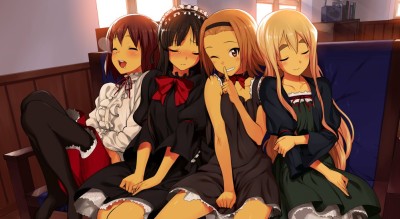 It’s like reading about what Toyosaki blogged after the K-ON S2 live a couple months ago. It’s something pretty special for the tens of thousands who went, but in the end it’s just yet another anime-made-for-hire (albeit in the KyoAni way, which may not be the standard committee style, I don’t know). A piece of plastic or limited edition concert good is not going to love you back, although in this case a continuation of the manga (and inevitably, more anime) is probably as close as it gets to that.
Maybe this is when mining for sequels becomes a celebration rather than the milking of the loyal handful. It’s all in the little things, the details, that you can feel the love, or not.
Feinting sincerity aside, for some reason I feel the creators or some of the core people who had a hand in making K-ON the thing that it is also enjoyed that connection. It’s just that the way we interact with each other and with the franchise material is through the same bloodless machine of capitalism as one would with anything else that required you paying money. To that, the perhaps equally soulless doujin products that the wall booths sell at Comiket at least contain some traces of life despite the shallow, pornographic content (for those who fits the description). I guess we can do better if we look toward truly like-minded expressions in fandom, rather than the usual “let’s just draw what’s popular for a quick buck” kind of thing that prevails much too much these days.
Doujinshi aside (and its implications, worthy of further examination for sure), the only other thing over the years that I’ve settled on as worthy of keeping is to make some great memories. And I guess that meant I should have tried to go to the “Come With Me” live or at least, hope for a home video release. Well, making memories is not always possible, and often infrequent. Perhaps that’s why I value them?
I might have sounded unappreciative about the state of the anime fan overseas when it comes to at least paying for anime locally that I can enjoy, but I do appreciate all the work and passion that went into the stuff now that I own (legit or otherwise). I even appreciate those expensive imports with English subs (and dubs at times) on them nowadays. It’s just that compared to fans in the ’80s and ’90s, the aspects of fandom that went beyond the buying and selling of anime hasn’t really improved by a whole lot. If anything the biggest change is how we’re approaching a saturation point in terms of anime cons (at least in North America) that are big enough to provide another way to connect creators, creations and fans. It’s still one (and more) layer of crud, of drama, and what have you. But that might be more “human” than the well-oiled marketing machine that the Japanese deal with, because at least “they’re here because we love them.”
It’s kind of funny to look at K-ON S2 in this context. I bring my baggage to the show (don’t we all?) and look at it from that angle: what are concerts, right? Aren’t they just yet another venue, another framework in terms of interactions between the band and the audience? It’s been way too long since recorded music has changed the way we experience music, that this human element of simply playing a song adds so much more impact to someone who didn’t grow up with that kind of lo-tech intimacy with music. And I grew up with some experience with music in a live setting (albeit in a typical Asian-American way). But it’s not just me of course. It’s the same reason why Azusa cries when the girls played Tenshi ni Fureta yo! It’s the same reason why some teared up when they watch that. It’s the same reason why it is actually so powerful, that it has already transcended the context of music.
Which is probably why people make novels and movies about friendship and memories in high school, and not (so much) about the nature of music and the evolution of it and the context in which it alters lives, flow of money, and the way people view the world. But that’s just one drop in a large bucket of human relationships and experiences, in the way we relate to each other and the things around us. It’s just that in K-ON’s case, there’s a really gorgeous view from the cliffs of meta, and it’s too bad so few of us get to enjoy this animated adventure from this vantage point.
 Hanasaku Iroha episode 3:
Fanservice, that bathhouse thing, bondage. Is this true? Maybe. But here goes my sensibilities again. I’m glad some kids have stepped up to the plate. Surprise me!
What I can say about HanaIro at this point is that it’s formulaic, but it doesn’t feel that way. It’s well-executed but it’s still like a rough gem. What I can say is I like all of that about HanaIro. Some of my recent favorites are exactly this sort of a flawed existence. I also have to say whoever that works at PA Works for this and True Tears really knows how to do fanservice (classic style) correctly.
But you really ought not to listen to me as a metric of what measures with what anime. I’m digging AnoHana too, but so far the fact that Menma reminds me of Index is like trying to enjoy a bowl of tonkotsu ramen with a few ice cubes in it. I’m like, whyyyyyyy. And that whole dead childhood friend thing is also kind of Japanese-y. I’m not sure if I like where it’s going, but at least there’s promise.
It’s like interviewing and selecting HRs by picking those who have promise, and not just whose spec sheet has the bigger numbers and counts. It’s like in Episode One when Chancellor Palpatine talks about Skywalker’s future career “with great interest.” Dirty old people, we are.
Lastly, RIP Osamu Dezaki, we may not know you well but you were one of the good guys.
 So the other day I read some translated financial report from Ko who was seemingly doing it for practice. I was like, hey, cool, stuff about production committees and their puppet companies that manage rights. It is basically this document, or a report from GDH to the public/investors. Unsurprisingly, most of that information is stuff you probably already know if you follow this stuff, in which different stakes holders create these committees and pitch them like investment portfolios. What’s probably more telling is the amount of money these things are, most of them in the 7-digit-USD range. This is notable because we’re talking about total outlay and not just production costs. It includes the money that goes around to pay for TV spots, marketing, and all that good stuff.
Well, that’s Gonzo for you: their hybrid horizontal/vertical integration method aims to change the funding structure for animation production houses. Its success is arguable, but it may be both an example of how it could be done, and what not to do. Curious minds should poke you-know-who for a copy, but since it’s mostly a document for general investors, you probably won’t learn too much besides some potential vectors where things can bottom out, and almost all of them are basically things that are almost boilerplate in terms of insightfulness (ie., hurr we may not be able to execute this strategy if the core fan base do not welcome our products derp). Of course, like any system this complicated, there were a series of good and bad things GDH did over time that contributed to its demise (and subsequent restructuring). The fun part is piecing it together with the help of hindsight.
Reading it also makes me want to dig up some financial docs in terms of how big of a dividend they were issuing in ’05… Yahoo finance probably has it.
The stuff you do stuck on a 4-hour train ride…
I also had an opportunity to read a draft of an academic paper about the doujinshi scene from Alex L. and Andrea. It’s a fairly standard academic paper about social trends and talking about forums of political discourse (parapolitical ones?). I think this paper is being published in some law journal somewhere, so maybe you can even ILL a copy when it goes to print if it isn’t online somewhere eventually. There are a bunch of online law journals now…
The paper itself outlines a straightforward analysis of the role of that protest doujinshi by Takeshi Nogami (that Strike Witches dude), and some vocaloid/NND stuff done in protest or in satire of the now-law Bill 156 out of Tokyo Prefectural government. With the ACE and TIAF rendered irrelevant no thanks to the Tohoku earthquake, we could never really tell what would have happened. It’s like, stating the things you know very well, and then seeing if it fits certain modes of descriptions as per other people’s descriptive framework.
To critique, I would just say that it is a precarious thing to characterize the doujinshi scene in some way that is meaningful. It is like saying, “blogs are political”; but what is the meaning behind it, what frameworks does that open it up to further analysis, what’s the purpose in the statement? I get it’s about fan discourse but I’m not so sure there’s anything really special in that. To that sense, the Vocaloid thing is much more special because there’s actual hijacking going on, rather than Nogami’s straight-forward political satire using original characters and real-life mockery thereof. I mean the only thing different in that case is the context and the forum Nogami’s doujinshi is operating within. In terms of content how can I distinguish that from, say, some guy passing out fliers (ok so it has to have cute anime characters on it?) at C80 about B156?
That just reminded me, I still need to get a copy of it. Maybe it’s not too late to add it to my Anisama 2010 order.
Lastly, Ko’s been translating more stuff. This time it’s about the manga industry as two guys chat about it during some marathon session over drinks and what have you. And unlike the previous two articles I vaguely talked about, you can read this one publicly. So do give it a read. It is a 5-part report/transcript and it is still being updated as of this writing.
I haven’t had much of an impression between the dialog between Ken Akamatsu and Kentaro Takekuma but let’s just say that I’m on the pessimistic side of things. There are reasons why Japan is a country known to resist changes in its business practices, a country that has draconian copyright protection laws, a country that has problems fostering start-ups (good luck Akamatsu-sensei!), a country with a growing generational inequality in the workplace, and a country that has not truly recovered from its economic bust since the 1990s. These things are not coincidences. The silver lining is simply that, there’s always an opportunity in situations like this.
Anyway, I look forward to the subsequent parts of that round-table-thingy. I’m fairly unschooled when it comes to manga, so anything like that is educational enough to worth my time.