True Tears Is a What?

[Okay, so wordpress just ate the ‘finished’ version of this post and spit back at me the revision prior to completing, so I lost maybe 2-3 paragraphs worth of blargh. Which is disturbing why it happened. Sigh. Anyways, here’s as much of it as I can recollect.]

I think I got True Tears, but I’m not sure. Something didn’t click.

I finished watching it a week ago, and I’ve been thinking about it when I could. Maybe it would be helpful to watch it alongside Simoun’s bonus material (thanks Media Blaster!) where the director,Junji Nishimura, gave some insights into why Simoun was the way it was.

I looked towards Simoun for answers because the two are actually quite complimentary. The key difference between the two is that Simoun did not follow a standard, dramatic formula; True Tears was a straight forward love-triangle. The rest of the two shows, from abstract reads of the mood down to the use of still-frame, traditional illustration stills, are quite similar.

They are also different, of course, but what puzzles me about True Tears is the purpose of the tears allegory. In a nutshell it simply symbolized [and I quote myself] the exchanging feelings, expressing them, and appreciating the other person. Shinichiro even got to appreciate his mom and dad; his mom appreciated what Hiromi is going through; and Hiromi with Shinichiro’s struggle with Noe.

But is that it? What does it mean?

Of course there’s also the Raigomaru/Jibeta story. The problem with that is the story itself is a parallelism for the character development pattern in the show, for the audience, and yet at the same time the characters projected themselves onto the chicken in a conscious manner. Both Noe and Shinichiro looked at Jibeta and Raigomaru similarly and expressed themselves through the chickens, identified with one or the other chicken throughout the course of the show.  It got complicated when you start to think too deep; how did Noe know what Shinichiro drawn in the book before the last episode? Why did she wanted to throw Jibeta into the sea? And if seeing Shinichiro dance is her “Raigomaru sees Jibeta fly” moment, why did she jump afterwards? Or are they switched?

I guess understanding the last couple episodes symbolically will be key to understanding True Tears. Too bad I don’t.

I’ve read elsewhere that Simoun is much like a WW2-era war drama involving airplane pilots and attached love interest pining for their return, looking longingly down the stretched runway and into the skies. I suppose, fittingly so, such was exactly how True Tears ended. Minus the runway.
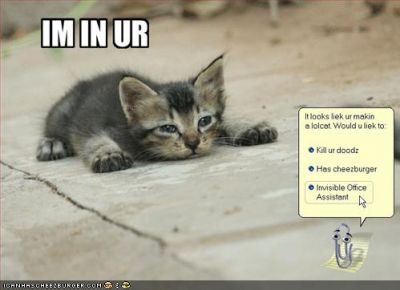

Makoto Shinkai’s LOLCAT

funny-pictures-lolcat-office-assistant1.jpg

It just dawned on me, believe it or not, but Makoto Shinkai’s 60-second tribute for NHK’s Ani*kuri really is a lolcats reference.

Icanhascheezeburger, the premiere site for lolcats pics, shows that generally lolcats fall into two categories of images. I think the picture I posted up there is a good example of what the two common lines are.

Probably more aptly, Neko no Shuukai is, like most lolcat pics, the same nod towards the two-faced nature of our feline masters. It’s either at your domicile being a cat looking for cheezburger, or in your base killing your mans with its gigawatt mekara BEEM! Or hiding your bodies or trying out some bad puns. Whatever.


I Can Fly

(First, a bit of admin: we’ve had some service interruption on Friday and it’s an ongoing issue, hopefully I’ll have time to resolve it this week.)

JAM PROJECT is coming to the United States of America.

Bring it on?

I don’t really care for 90s arena rock music, but the essence of their burning soul is undeniably attractive. I own a few of their CDs but rarely will these albums make the trip to the mp3 player/cd changer/etc simply because it’s not easy listening.

Otakon purposefully tries to reel in different sorts of performers every year because I think they value the diversity that’s within the kind of “visual culture” context that Otakon works within. JAM Project, personally, embodies the heart and soul of a particular subculture of this visual culture nonsense that has been long neglected. Are there any other band that embodies the concept “anime” + “music” in greater perfection? It’s a little ironic but understandably so, that cons will invite pop rock artists and jrockers to perform, because they are just straight-up performers with little agendas otherwise. JAM Project, on the other hand, is much more purposeful, even if they are also just performers not unlike any other at the core.

JAM Project historically is a “supergroup” of ???. ??? as in a lot of people will have some problems make sense of them. Ichiro Mizuki is the original leader of the team, who sort of retired (part-time member status?) not too long ago during a lull of the group’s activity. And interestingly enough, JAM Project’s membership includes an international individual who’s known for his works in Brazil, Ricardo Cruz. The other folks currently a part of JAM Project rocks out anime-style. So you have a few old guys, a few young(er) folks, and a guy from Brazil as an associate. And they rock out and jump around like nuts! Okay…

Still, and again, ultimately JAM Project is true to its namesake–it’s about Japanese Animation songs. If you don’t know the shows they sing for you wouldn’t know who they are. The careers of the men and women of JAM Project is the precise marriage of the two (well, and also tokusatsu). What does it mean as a musician when the works you produce are just half of an interactive relationship? Is it really surprising that hot-blooded arena rock becomes the primary means of expression for them? It’s both why they’re so powerful as performers but also eternally relegated to a very niche audience. They are not a group or performers that we can easily pigeonhole into some kind of categorically familiar thing. JAM Project is its own, unique thing.

Personally, what makes JAM Project interesting is its international perspective. Of course for oversea fans their perception will vary depending how much old school pop anime they’ve swallowed, or if they happened to be a Masami Okui fan or something, but this world tour folds well into the recent effort for the anime industry to export and explore their cultural “cool” globally. Will Americans be too “cool” to receive them? Only time will tell.

Meanwhile, it’s time to get prepared:

1. SKILL karaoke. Simply because it’s pretty awesome the first and second time I’ve done it, I should do this again. For it to be possible, I have to recruit a few helpers to scream along with me. Post or email (click on my name at the bottom of this post) if interested ;).

2. Get in shape. I’m going to jump around a lot. Well, if KOTOKO threw a show at the 1st Mariner Arena that’d be a good way to practice…


A Case for Yumi Hoshino

I think one of the most important thing in Kimikiss is understanding why Kazuki and Kouichi are split in the anime adaptation.

Yumi Hoshino

But before we get to that, I want to talk about Yumi Hoshino in Kimikiss.

She was the pivotal character in Kouichi plot thread. If looking at Mao, Kouichi and Kazuki as co-leads, then Kai would mirror Yumi, and Asuka Sakino as well.

In that end, is it really selfless that Kai let Yumi do the things she does? One would say probably not, since Mao made it pretty clear what he is getting into (and out of). Still, Kai somewhat surprised her with his own version of kindness. He does have a stake in the relationship–his genuine affection for her.

One could say the same thing for Yumi. But why would people call Yumi selfless or saint-like? Considering her circumstances, if Yumi’s affection for Kouichi was genuine, she would learn to move on and let the two love birds flock to their preordained destiny. Love is not war, after all. Kouichi, nor the type of relationship she has with Kouichi, is not a thing to possess. Yumi recognizes that the relationship between them is not based on selfish gains–it’s a relationship with mutual gains that recognizes mutual interests that may be selfish and selfless at the same time.

In fact, this theme of giving up for the one you lovelike is really the jist of Kimikiss. Just don’t ask me what it actually tries to say about giving up…

You can make a table, fer crying out loud:

  • Mao: Giving up Kouichi (which didn’t work, especially since Kouichi didn’t let her) because of Yumi and Kouichi’s present feelings for Yumi, and later on giving up on Kai because she knows she can’t keep him dangling.
  • Yumi: Giving up on Kouichi, as in the ending, because she knew it wouldn’t work otherwise.
  • Asuka: Giving up on Kazuki, going so far as to help him with Eriko, because she came to see how Kazuki sees Eriko.
  • Eriko: Giving up on Kazuki, because she repeatedly hurts him and she is afraid of what might happen.
  • Kai: Giving up on Mao because he knows she doesn’t return and can’t return his affection; rather supports her.

But what’s interesting is that people, in general, don’t see giving up in Kimikiss as equally selfless. It is probably a reasonable observation because love is both a selfish and selfless act.

The Good Book has it right: you can’t truly love others until you have learned how to love yourself. In their growing affection Kazuki and Kouichi both find their way, in romance and otherwise–one kicked butt in sports and the other wrote a successful film script. It’s through this interactive exercise where puppy love becomes a healthy exchange of transparent souls, rather than an destructive war between egos and insecure self-worths. People are affirmed not because of the labels of their relationships but by the affections of others. And Yumi recognized what she was a part of was something much more precious than her wavering boyfriend.

So I don’t think Yumi was selfless. She definitely had class, in spades, but at the same time she was just not your stereotypical maiden in love. Her emotions are in check and she made a good choice both for her and for him. She was no saint, either, and that’s the part I want to drive home. I believe no matter how the show spotlight each girl and boy, they are all doing the best they can because they all truly care for the object of their respective affections.

And it is that sense of care that elevates Kimikiss beyond a mere tango with romance and into a tale about growing up. How we are the same and how we are different.

Kind of like Honey and Clover.

So, why the split for Kazuki and Kouichi? I think you can get what I was going to say.


The Real Pillows

So instead of Anime Boston I spent most of my Friday and Saturday in NYC doing anime-related things, and eating at Mitsuwa across the river.

I heard there was a line there or something at AB? Hope I didn’t miss much.

Ikuno, Ayumi, Yoko (L to R)

I caught the Pillows and Noodles on the NY leg of their “Delicious Bump Tour in USA 08”. It was Friday night. The day after, the Pillows would have headed north to AB and Noodles to their Brooklyn show. The venue was few blocks north of Union Square, at Blender Theater at Gramercy. Unlike their last hole-in-the-wall show in 2006, this venue was much nicer complete with a sloping pit and stadium seats in the back. The place had a pretty cramped downstair-lounge area though.

I want to talk about the Noodles a bit. They’re a band made of 3 Japanese girls. Between I last saw them in ’06 I’ve finally gotten to watch Linda Linda Linda, and the way Ikuno (bassist) goes at her base on Friday night totally reminded me that movie… I think the consensus was that Ayumi (drummer) was the cutest and had the best English to boot, if you are curious. But it doesn’t stop there; it’s pretty interesting to see the same band 2 years later and observe what has changed. I think overall their playing style has gotten better, but at the same time their song selection was slightly grungier for some reason. Not a bad thing, but it’s not exactly what I expected.

And was it just me or Ikuno seemed feeling a bit under the weather?

Jun, Drummer?, Sawao, Yoshi

The Pillows, on the other hand, brought their veteran showsmanship to their show. They are fun, energetic and generally very solid at jumping around while hitting those lol riffs. The two guitarists know what they’re doing. Yoshi was very cool. Shin the drummer was sort of lol-looking.

I guess if there’s anything to say about their live, it was a little too much pandering. Compared to their last US tour, they played a lot more of their FLCL songs. That’s what most people know, and they got into it. Their newer stuff was notably less well-received even if they are just as good. It’s a little sad.

But it’s always great to hear them play their older songs as they totally change stuff around. I was particularly impressed with Little Busters and (again) Hybrid Rainbow. They are not exactly rocking songs but they managed to turn out that way. They’ve also changed a few small things to some of the other songs and generally the band had a nice grip on the mood and flow of their set.

I really wish they’d play some of the songs they did last time. It just seemed…more fun.

But then again I busted out laughing when they encored with Advice. So it works either way.