Category Archives: Franchises

Nice School Days

PARRY > DODGE

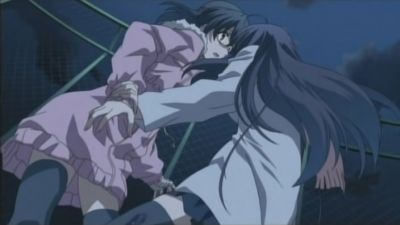
Trying to make sense of School Days is easy. I think the guys doing this adaptation already knew they have a winning case of source material on their hands. Ignoring the whines of people who thought “the game was better” I think the anime is probably as good as it could come while incorporating as much as possible, of the bombs of joy and LULZ that the game was renowned for.

But I think I feel like talking about how it relates to Elfen Lied and Higurashi a lot more, because those shows apply similar plot mechanics to evoke emotional responses, and both achieved (or failed to achieve) those goals in ways that shed light as to why School Days was so good.

For time’s sake I’ll make this short. Two main points.

Sympathy. For a lot of people it’s much easier to sympathize with a bunch of high school sluts sleeping around and a guy who knows not love but only of the mire of selfish desires he is stuck in. That’s something counter-cultural folks have been preaching for decades since the 70s, religious or otherwise. But seeing it in anime is a bit of a refresher simply because, hey, you’d think this wouldn’t appeal to the otaku segment. But sure enough, we are all human and we can sympathize with Makoto, Sekai, and Kotonoha, in their foolishness. Needless to say, that’s already a case for the win when you compare settings: a couple youngsters living in an abandoned shrine-like mansion taking in random naked people who NYUUS? Or being transferred to the boondocks, going to a school with 1 classroom from grades K to 12, and having your life terminated every 5 episodes then reset?

Believability. The gruesome death quotient for Americans is probably higher than most other viewer demographic. American entertainment glorifies violence, but that’s not to say no one else does; it’s just a matter of making a point with said violence versus mere glorifying it, as a societal norm. In all three cases, violence is NOT glorified. In fact, in Higurashi one can make a case about the violence being a device for parody. It certainly seems comical, at times, for Elfen Lied and School Days. Instead, violence is, in turn, to draw emotional response from people either who deserves the wrong end of a sharp, pointy object or to demonstrate some kind of plot-oriented balance in terms of theme, or to illustrate or symbolize some thematic concept (like lost innocence). I guess that doesn’t speak so much as to why it’s funny, but it certainly can be if you’re in the inappropriate state of mind (ie. one that is more in tune of watching for violence per se–what’s usually required in enjoying violence, rather than extracting the reason behind it). The absurdity in all three cases is astronomically high, but School Days spend a good 11 episodes to set that up for you, so it is, at least, the least incredible of the three. Elfen Lied would likewise be well-served with violence if the show’s main schtik–that slice-of-life/slice-of-death tension–wasn’t so abused to oblivion so early on. Or maybe alien with invisible, stretch hands just seems a little too weird for suspension of belief. You pick.

So, yeah, School Days is a job well done, although it is definitely not something you want to recommend to people who watch anime purely for cutesy harems OR lol blood gore violence vampires.

The Nice Boat thing is just bonus material, thank you Japan!


On This Rock, Kamina Builds His Church

Simon from Gurren Lagann shares similarities with Simon Peter of the Way. YA RLY.

You can read about Saint Peter here. Shimon indeed.

So it’s not a surprise that on this rock (does the term Cathedral Terra make sense to you now?) Simon builds Kamina’s church? But before people jump to conclusion about Jesus, let’s talk about Simon Peter some more.

For many scholars Peter is one of the most interesting disciples Jesus had out of the original 12. Some of them consider Peter being the spokesperson for the 12, and at least in the New Testament he was a leader of the early Church. We see him most notably when he gave the sermon at Pentecost with the baptism of the three thousand.

But he was not that sort of a man as we could possibly imagine with the brand of Christianity as you and I experience today. Much like Gureen Lagann’s Simon, Peter fished and lived humbly as a fisherman off the Sea of Galilee. He was a little rush-headed and oddly shy at times. Unlike Simon he wasn’t really a great fisher either (as Simon was a driller). But like Simon, Peter had a brother who told him of the good news.

In contrast, Gurren Lagann’s Simon isn’t likely one who would jump to cut the ear off someone; decidedly he was much matured after 7 years since he parted with Kamina. The transformation is also seen with Simon Peter from his moment of denial with the reconfirmation with Christ after the resurrection.

Am I stepping out a little too far with this bit of analogy? Maybe, but far from it be Gainax’s bag of tricks to pull punches from Christian lore. There are quite a few of the superficialities that make sense once you connect the dots. Much of the Gurren-dan can be paralleled with Jesus’ disciples. The transformation of Kamina City under Rossiu’s rule and his eventual redemption may be a little bit out there, but talking with the evangelicals today that might resound a little louder with them.

But is Kamina Jesus? I don’t think I’ll go that far, especially because there are just too many key dissimilarities. But his death was much less meaningful than his resurrection, even if only in spirit.


Well Done, Mikan; the Mystery Continues?

Mikan loses to Konoka by 6 votes in round 2 of Saimoe 2007. She joins her crew in the heaven of lost moeliciousness, having an beerice cream.

Goodbye!

According to this post on 2ch, foreign votes affected the outcome since Konoka got an extra 59 votes, sealing the deal.

And I bet most of those 59 votes are cast by people who speak English. Or not? At first glance, that data just concludes how foreign votes (IP not originating from Japan) pan out to, as I’ll cut and paste below:
0543 0400 0143 41.17% 37.59% 56.08% 26.34% 近衛木乃香@ネギま!?
0537 0453 0084 40.71% 42.58% 32.94% 15.64% 稲森光香(みかん)@がくえんゆーとぴあ まなびストレート!
0239 0211 0028 18.12% 19.83% 10.98% 11.72% 沙英@ひだまりスケッチ
In other words, out of the total 543 votes, 143 of Konoka’s votes originates outside of Japan. That could simply means people in Japan are voting from non-Japanese IPs, so it is inconclusive merely through that as to which demographic contributed to :3-chan’s loss.

A look at the by-the-hour chart of vote allocation, we get a better picture–Mikan held a comfortable lead at first, but it slowly went away until the end of polls, where she was upset. If we take the presumption of average internet usage–that Saimoe and its kin of tomfoolery take place during the night (8pm-2am) rather than during the day, we can see that Japan (and maybe Korea and Singapore and China and other locations with people interested in Saimoe) is still chiefly to blame for the downfall. It’s curious, as well, because Mikan had a demanding lead right off the bat, and it’s unlikely the same demographic had two different sways so drastically different.

Perhaps that means there are two divisive faction on 2ch when it comes to Saimoe–the people who keeps up with anime and people who do not? The latter is likely who votes early in the day (but near the end of the contest) and the former can stay up and watch those late-night shows, and vote on Saimoe as it begins the next day. But we don’t have to go that far…

The western fanbase failed–the shrinking lead during the eek hours would suggest as much. In the 12-hour gap between 5am Japan time and 5pm Japan time we see Mikan’s lead erode from 70 to 42, and that would’ve been peak hours for Europeans, all the Americans, and more.

It still smells suspicious, however. Ah well. It just means today the sun shines a little dimmer compared to tomorrow.


Women Don’t Have A Thousand Faces in Anime

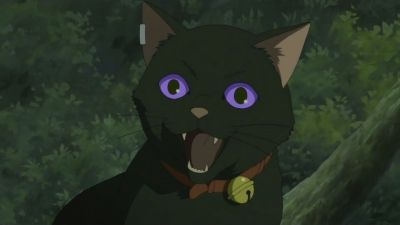
Sorry Yumi-chan, but a cat has even more.

What's the matter, cat got your tongue?

Or in this week’s case, an alien bent on destruction of the Human race.

OMG NERF BELLCROSS!

That must’ve been one of the most satisfying moment in anime that I ran in to for some time. It’s definitely one of the more satisfying thing to happen to a persistent pain-in-the-butt character (and Heroic Age‘s got its share) that I’ve seen. It’s not even karmic, because to be fair Peato Ou does have the right idea (killing DNAra will lead to the end of the Human race), even if he’s blind about the end result. (It’s like knowing not to hit a tagged rogue in Area 52 on a PvE server, but you do it anyways because you are dumb.)

In the introspection of the nature of men and women, there are some anime that take it seriously, and there are some anime that don’t. For everything else, there are high quality key animation frames that captures the essence of the human spirit expressed through the art of body language translated into pictures. The exaggerated nature of anime art style only enhances the enjoyment of its audience when we see the actors on stage, normally being serious, break out in a show-and-tell of how badass something that may have just happened to them.

And this treatment is gender-neutral! Dropping your jaw is not a sexist behavior in anime.


The Last Generation of Haruhi Suzumiya

Back in ’95-96 Akiyuki Shinbo directed a project called Soreyuke! Uchuusenkan Yamamoto Yohko. It was an adaptation of a series of teenage-level science fiction novels written by Takashi Shouji. The project resulted in two OAV series, and later in 1997 a 26-episode TV series retelling the expanded novel story was aired.

Perhaps it’s just how people looked at TV shows and movies back in the 90s, but Yamamoto Yohko didn’t make a big splash. Unavoidably, Akiyuki Shinbo’s … signature directorial style is somewhat hit-and-miss with the crowd, and I think the Yamamoto Yohko TV series is one of the earliest example of this signature style.

(In some ways looking at Sayonara Zetsubo Sensei, you can tell that its rather-two-dimensional look works much more successfully with the punches Shinbo pulls–in fact I believe that’s why Pani Poni Dash did so much better with the fans yet Soul Taker was just way out in the left field with a cold but critically acclaimed reception. Yamamoto Yohko shared that 3D feel. All to stretch the animation budget?)

Well the point here, I hope, is to remind or introduce you –I sure do need to rewatch it–to this actually really above average but rarely-heard-of anime series to you. Yamamoto Yohko is twelve years old now, but its faded-out color palette and seeing kids hanging out at arcades are the only things showing its age. The direction is sublime (and resourceful), the OAV episodes are fun, energetic, and charming. The TV series suffers, I think, from being 26 episodes long, but it delivers a solid story about someone much like Suzumiya Haruhi…sans the romantic/Kyon angle.

Maybe that’s where the magic is missing? I don’t know. (Is that just the difference between 90s TV shows and today’s?) But I do know that it’s a fairly timeless TV anime, and is worth watching beyond mere sentimentality. It’s smart, humorous, it keeps you surprised, and the voice acting is top notch.

It’s even got time travelers, aliens, and ESPer-like computers. It is even licensed–at least the two OAV series. The TV series is in limbo–RightStuf has an option which they have not exercised because the sales were subpar. The US release was back in 2001, and it was on both DVD and VHS. You can probably find the DVD super cheap now, if at all.