Category Archives: Franchises

For the Pursuit of the Perfect Union

I think subs are a crutch.

Crutchless

I mean, closed captioning…that’s what it’s for, right? If you are deaf, you can read and find out what they’re saying. If you can’t speak the right language, you can find out what they’re saying. It’s a crutch.

It also went beyond merely a crutch. Liner notes? Maybe. It’s not a matter of a dub versus sub argument; that’s like trying to choose Al Gore over GWB; many think neither would do a good job. But yes, they can cram 2 lines, maybe 3, at font 24 or 30 or something, adding up to maybe 80 characters total or so. Those of us who are accustomed to reading subtitles can handle it. Subbing Ghost in the Shell: Stand Alone Complex necessarily means you need to cram a ton of technobabble in a small space. That we have done and have seen.

We also have done liner notes as liner notes, live subs. Excel Saga’s ADVidnotes, for instance. Drop-down liner note boxes in fansubs are not unheard of, even if generally they suck as far as having to read them on top of whatever conversation that is going on, having to pause playback half the time. Not-so-live liner notes as subs can be bumpers and trailers to an actual episode. I remember reading Silverwynd’s liner notes, commonly referred to as excessively long yet educational and stuff you use the FF buttons for.

I think in the great divide between dub and sub lovers, subbers have grown dependent of subtitles. In as much as I admit in the greater scheme of things, subtitles are my personal preferred method of translation for an audiovisual work, there are little reasons to have them when I don’t need them. Even as some sickly twisted people who prefer super-literal translations and only really subs can deliver them live, there are plenty of other ways to translate the same things word-by-word, sentence-by-sentence, thought-by-thought, or anything by anything else.

What do I mean dependent? It’s a kind of dogmatic comfort. A psychological force of habit. Irrational only to the degree that it is empirically unsubstantiated because it made logical sense. In some respect it is like the child, learning to ride a bicycle, but is more comfortable with the training wheels on than off. In as much as they would never watch anime raw as a result–it feels unnatural, impossible to understand to a satisfactory level.

But is that really the case? In my own experience of letting go the edge of the swimming pool, I realized by far that it isn’t nearly as scary as it could have been. I also realized over the years that as someone who doesn’t speak Japanese there is much to learn, and more often than not I have to run to a translation aid anyways.

The worse of it all was in two folds. The first way it sucked was in how sometimes, as ignorant as I am, I get the wrong first impression. This was the case with a couple shows–like Soul Taker–in that without the visual familiarity I was drowning in a sea of exorbant colors and …Italian direction? The result was me being turned off and not watching it ever again until a friend persuaded me otherwise, which I now end up having them on DVD as I enjoyed it so much.

But the second fold is this: there are so many shows that I enjoyed, watching them raw, that I couldn’t share with my friends because they are left untranslated. My friends either lacked the werewithal to actually being able to understand the show, or they’re stuck on their crutches–and I think in some respects it might be better off to let these unpopular, untranslated beasts lie.

Well, I am kind of kidding about the second part. But no matter how you couch the term–preference, aid, necessity, “how else am I going to understand it,” or whatever, remember anime isn’t meant to be watched subtitled (unless you’re Pedro’s son or watching Crest of the Stars). A perfect dub is still better than a perfect sub in every single way unless you’re a sick person who wants extra-literal translations like me ordering at KFC. Or if you’re a sick person in as one who is deaf and cannot hear my words of reason…

I mean, there is freedom in Christ. You can download your raw anime, watch and fast forward to the action bit if you want, and consult the internet for translations and notes or even manga translations. You can even rewatch it. Time is a problem, sure, but it doesn’t have to if you don’t let it. If you’re still stumped, there’s always that fansub at the end of the day, maybe.

In retrospect today I think over the years I accumulated so much anime-watching “skills” that raw anime don’t seem as opaque as they first did when I started it years ago. Maybe my Japanese comprehension went up; maybe my Japanese cultural comprehension went up too. Maybe I understood the artform better today than before. Or maybe I just watch really-easy-to-understand shows. But regardless of what and why, I am still a Japanese illiterate weaboo not unlike many of you. I just came to appreciate how viceral, visual, and vivid anime is as a storyteller. It really does transcend language boundaries and appeal to us beyond merely words. Maybe it doesn’t present to us a whole range of human emotion and experiences, which is partly why it’s not all so hard to understand (well, a large % of them do take place in high schools…), but I’m sure once you include shows that are opaque to me there’s something of a whole range.

Simoun Wars I – The Attack of Adolescent Themes

I take back what I said about yuri and Simoun, because it has the most pure kiss scene in anime ever (at least this past year).

The Best Kiss Ever

Positively, this show reminds me of Utena in how wry it transitions. A little bit of a bait and switch, really. Originally I pinned my hopes on Ouran Host Club, but that left me in the cold when it spent a good part of its first 12 episodes making fun of shoujo manga and doing the cliche stuff shounen anime has been doing the past few years. It’s not until episode 13 where I got served. And I sure did. Even then, however, all that mysterious vibe has disappeared somewhere between the light bulbs of episode 1 to the starfield of banana peels in episode 13.

Simoun, on the other hand, cracked its unforgiving whip almost like Glass no Kantai. I don’t know what to say about it because just like Glass no Kantai, I am totally at the mercy of the translation. That’s my first gripe, really: there has been only one “good” translated fansub for this show out there, that I can find. And even then, it reads kind of poorly. In a lot of ways, doing a translation for Simoun is like doing one for 12 Kingdoms, but you don’t have the books for reference. We don’t have that kind of neck-breaking pace, but so much has already happened in the first 8 episodes that if you can’t get a grip, you’re going to get dropped. In that sense I think that is my problem with the show. At first, so much was going on that you have no clue about, it became boring to watch. It’s not until each characters’ introspectiveness grabs you that you can then starting to care.

Staring to care why Nevile was so troubled? Starting to care for the big question about the differences between Mikos and Galaxy Angels? And starting to care who is who? Of course, if you’re like me, the first thing that grabs you is its fantastic setting–a world where everyone is born genderless (not quite female) and people can then “choose” which gender, or have their local deity or doctor do so for them. Oh, that’s the second thing: this is not just a theocracy. Tempuspatium is amongst us.

Yeah, 12K indeed.

The second sin Simoun committed is its odd visuals. I suppose I am not in a good position to complain, but given what else is vying for my attention it really only made sense when I’m done with my HOOOhis and LagOOOs, I can stand to watch this average-looking animation.

To its merit, Simoun is still the story about a bunch of youthful girls, even if they aren’t technically. It’s hard to hate an entire harem of 12, and that’s just those on active duty. Well, it might also be a merit that large amount of Simoun’s adult populations also look like girls…as in fememine guys with boobs. I’m not sure to who these may be meritutous, but I am glad they explain that stuff up front. And as a result, too, its neck-breaking pace made good use of the first half of episodes, and I’m looking forward to see more. It would be pretty hard to call it a day at 13.

But why am I actually blogging about Simoun? Because of its wonderful delivery of its themes. To me, that is the heart of this show. Once you grasp them, you get it. If you don’t, you’ll be eternally wondering what the hell everyone is doing, why they are so emo, and why don’t get just get it over with, whatever it is. That is partly what made 12K so wonderful for me too, but that’s probably another rant.

And Simoun makes it easy. At one point Nevile stated it up front. People’s motivations are clear as a book and as diverse as the harem itself. How can I hate a collage of themes about growing up, about overcoming difficult rejections, betrayals, obstacles, brokenness, heartache, adversity, and finding of one’s self? The innocent lost? The lost innocent? Indecision propelled by circumstances? It’s a bit of a cheat to have such a big cast, and each of them are matched neatly in pairs (at least for now). There are some other nitpicks as far as personalities go, and I was kind of bothered by episode 12 in some ways…

But I’m on board to see how these kids turn out. Even (and especially) Dominura. Seeing Aeru grow up and how Nevile deals with Paraietta would be nice, but so much surrounds our key triangle that even the least of these girls will be of some interest. Maybe it’ll strike out. Maybe not.


The Spilling Ink Pit of Fanservice Looks Like a Black Lagoon

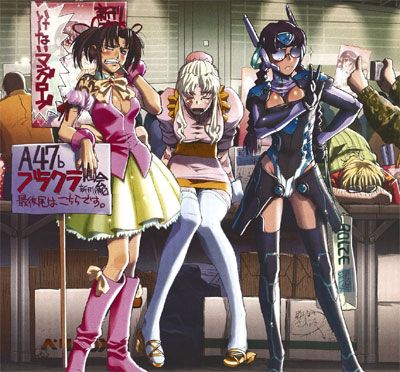
Comiket Is Ground Zero For Cosplay Indeed

I sort of went over services in general, so I hope you understand how I use the same idea here is rational, in that it is rational to pander. It is a no brainer that there is a maid bloom over at Akiba, and it is not really news–it’s just an obvious trend. People squirm, either in displeasure or euphoria, for whatever reason, at the obviousness of it all. In the grand scheme of things, it’s very Japanese.

Looking back at Black Lagoon, it is a rather Hellsing-esqe series where the key difference is only in the original concept. As much as it doesn’t look it, Black Lagoon has some kind of core, character-driven story idea behind it; Hellsing only gives us that initial setup which carries it until the mangaka figures out something better and more interesting later on.

What do I mean by Helling-esqe anyways? Cool action, old school wetworking? Maybe. Badasses, girls with guns? Lots of other stuff have that too. In as much as ink is black and most manga are inked, the paintbrush of what is cool and what are services to the audience is really broad, after you’ve been at it for a while.

In that sense, it makes Black Lagoon the anime so much sharper and powerful than Hellsing the anime. Re-scrambling, we now have the Hellsing OAV which recaptures what was euphoric about that delightful coolness which surrounds the manga series. I am guessing that was the difference.

Perhaps it is good to step back and realize that a good story is still the bedrock foundation of good telling of stories? I’m not a big fan of calligraphy, but to me that’s high art; yet the same ink, the same words, the same people use the same tools to communicate the most mundane things. No matter if you’re a doujinshi artist, a race queen, or MAKO doing a sitcom skit over the internet, it’s the same rationale going forth. Without that bedrock, it’s just spilling ink in vain.

Where fanservice intersects with narrative, there is hope, love, faith for the genre and goodness. Anime is now Japanese, omo gets excited, money exchanges hands, blog posts written. Lesser is when a story exist in vacuum–it becomes something you google up, and maybe read once, or hear others retell it better. Worse is when fanservice exists in a vacuum: it’s pornographic, cheap, boring, and beneath notice.


A Collision of Snarks

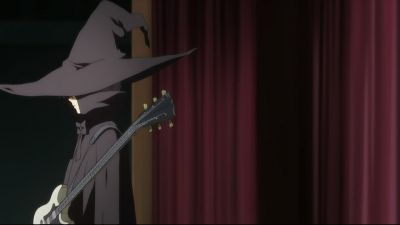
It comes to me as no surprise that these three people are going to Animelo to perform. The intersection between anime, music, and idol personalities has always been one of my most liked aspect about Japanese Visual Culture. My favorite jpop personality is probably one of those people spearheading this thing from the beginning a few years ago…probably also not by accident, both ways.

Oh, actually what really tipped me off was watching Suzumiya Haruhi 12. Somehow things worked out that I watched Nana 10 right after, and double-stacking the band-ness really created this strange chasm of feelings. I guess that’s what Haruko Haruhara means when she pulled Kanti out of Naota’s head.

But this impromptu announcement matched the plot within episode 12. It’s probably a coincidence in as far as a contractual obligation (such as MUCC’s announcement with Otakon, if you’re familiar with that story), but it may be the same obligation I’m talking about. If that is the case, whoever did it is snarky to a deranged degree.

A Tribute to Lordi

Then again, Suzumiya Haruhi and its production generally have been rather sharp. It comes from both the fans, as well as individuals with KyoAni. Intelligence and a high level of coordination are generally seen so far both within the show as well as with what people are doing with it. Will the sequence of smart things continue for this soon-slotted-away TV series? It’s not going to run silent, but will it run deep?


Fight the Loli

Higurashi no Naku Koro ni, a world of horror.

In a lot of ways Higurashi’s tricks are nothing special. The unassuming loli doing a crazy psychological horror twist to haunt the consciousness of a male-protagonist-harem-lead-ero-game-player is probably the most straight-forward incantation of this narrative spell. But like any good mystery, there are some elements that are worth watching for, even if they are the mundane, everyday elements that every mystery story shares. The start, the setup, the final collapse of the scheme, the unraveling of the charade spiraling to the end of the story, the 4th-wall self-satire, all of that, I say, is what make a mystery story any good.

In some ways Higurashi anime cheats, too. Its nonlinear, nonsequential-parallel, alternate approach to the narrative gives us at least 3 different way to look at the same setup and that’s like having the Luftwaffe doing 3 hit-and-run passes at Allied bombers than the single pass. Unfair. But it does work out very well to diffuse those inevitable problems with other adaptations that did not share the same format–lack of traction after a time, poor pacing, and the ability to stick with the source material while maintaining enjoyment as a different medium.

In the end, however, does it really matter? We’re treated to a show that is all about form and the form is so unique that I can’t remember any show like it. Elfen Lied? Not even close. It doesn’t quite drive you to apathy; rather it drives you to amusement because in a very close-by perspective to “ZOMG that is actually creepy” is “HAHAHA this is so ridiculous.” I suppose that is good, too, because it does keep you guessing to a degree. And to that, it’s kudos to the source material.

Maybe if it wasn’t a show about harem-like loli killing each other, it might actually be taken for serious. Even if it won’t be half as funny as is.