Category Archives: Franchises

Smashing Nyarko

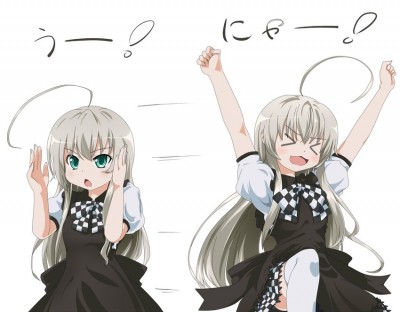
Nyarlko. Or Nyaruko. Whatever.

“Gaijin Smash” is a term I jokingly use with other friends to describe what happens to a foreigner visiting Japan. Unfamiliar with local customs and practices, sometimes foreigners get what they want by breaking these unwritten rules. Thus, the “smashing” part.

This is kind of how I feel about Nyaruko-san. First off, the official translation is “Nyarko” where it swallows up the “u.” For some reason I cannot spell it that way for my life, so I will use it interchangeably.

Second, the general character dynamics in Nyaruko-san’s two full-length TV series runs is something like Nyarko bothers Mahiru about getting into his pants, others join in, and while doing all that some kind of lukewarm and pun-infested adventure happens. To Mahiru, Nyarko (and Kuuko and Hausta etc) are monsters. Old Ones. I recently reviewed Natsume Yuujinchou, so in those terms they’re like youkai folks. Except unlike Japanese ghosts and wraiths and fairies that exist and behave under philosophies and rules familiar to Japanese sensibilities, Nyarko’s Space CQC literally smashes any expectation that behooves proper Japanese behavior. You know, basic things like let’s not be a “meiwaku.”

Except, when being told on explicitly, Nyaruko etc., repents. Because we gaijins are nice people at heart and are just oblivious to what subtle but superior and proper upbringing looks like.

Looking at it from the whole meiwaku concept, the fact that Nyarko &c are foreigners, and the show is loaded to the gills with not only Japanese pop culture but also many American/western ones as well, just makes me just think of Nyaruko-san as a metaphor of the story where a bunch of gaijins came to call on a Japanese guy.

I mean, even the setup of the story feels that way–a bunch of aliens lands in Japan to raid its bounty of modern cultural goods. All that Cool Japan ™ junk is the loot in which Nyarko and company came to seek, if we recall season one’s introduction and the raison d’etre of some of these inexplicable plot generators. Although I don’t know, which non-Japanese country got taken over with Kamen Rider? I mean Power Rangers was a huge deal internationally, but that’s not really the same thing.

And in some ways,  Mahiru reflects a kind of, I don’t know, aggressive passive aggressiveness, lacking a better term, that ultimately says that while the foreigners are a bunch of barbaric trouble-makers, they are powerful, sexy, unreserved, energetic, and saves the day. We can even make an except for Hausta, who all of that minus the obnoxiousness, but also sexually liberated? But really, what sex/gender is Hausta anyway? Because while he represents himself as a male human being, god knows what lies beneath? It’s certainly the case for Kuuko. Can’t trust these gaijins, really.

And I guess the complete construction of the banshin (or maybe, how Nyaruko confuses its construction times) is akin to the ever confusing status of people’s visas? And how it’s nigh impossible to become a naturalized citizen of Japan? Am I sufficiently overreaching here?

What I don’t understand is what the forks are suppose to represent. If I had to guess, it’s probably some kind of pun I am not getting.


Season Ending Blog Anthology

A chain of short blog posts about their subjects. The last one is a run-on about Moenovel. The rest are about currently-ending or airing anime.

Waiting for a Levia-sama joke

Continue reading


OreImo Radio Update: The World Is All Sisucon

From Chiba to the World

Your OreImo web radio efforts have paid off in the form of this kinda-heart-warming message from the producer of the show, Shinichiro Kashiwada. The full message can be read on the JP home page for OreImo S2 but here’s the key excerpt:

Every staff and cast member who has been involved in this series has put their hearts and souls into these last 3 episodes of “Oreimo 2,” and we have all been hoping to share these final episodes with as many fans as possible. When we saw so many dedicated fan submissions to the “Oreimo 2 Web Radio Show” from our international fans who watch every week through various streaming services, we knew we had to provide an environment where every fan can watch and experience these final episodes simultaneously.

And yeah, it was written bilingually in English and Japanese. Oh, of course, the bigger news is that OreImo OAV streaming for everyone without the time lag. I don’t know, does this obvious acknowledgment of the episodic bubble, the “watch every week” water cooler-style chatter (except it happens mostly online) in which drives this particular niche fandom, mean something after all?

And of course, last Thursday was when the latest OreImo S2 radio came up and the hosts did mention the large volume of English-language submissions. I think during the foreign mail segment, there was a letter from Singapore who pretty much dissed Ayachi outright (but he did apologize). There was definitely some internet-tard-y guy who referenced Hanazawa as “Hanakana-chan.” It’s kind of funny I GUESS? There was some Californian-tiger dude with an unique greeting. There was a letter from a Canadian sisters doing real talk about the difference between fujoshi and otaku-ko. Finally (or initially?) there’s this pretty much incomprehensible letter that makes no sense? Can TKTT pronounce “Commander Riker?” The world will never know.

Kind of like this simulcast announcement, I think people realize foreign otaku knows their stuff as much as slick Aniplex-types know about the foreign market. At ~5 hours post-tweet, there are about ~1000 RTs for the ep16-18 tweet announcement in Japanese, and about a quarter that for the English version of the same tweet. Does this mean we’re about 1/5? Should I check back in a day? Is it fair to assume our oversea comrades not in Japan would rather RT in Japanese? Does pointless speculations make any sense? But yeah, throw us a bone, even if it’s full of crap like this, we’ll slurp it up gladly.

Regardless, it’s always a good time with Hanazawa and Taketatsu. Hopefully next week they will do more foreign viewer mail! Read more about it here and listen to it here!

PS. We should all submit tongue twisters in English or something. You know.

PPS. Updated count on RT at time of publish is still about the same, 284 to 1180


Gargantia Metanarrative

Going on a limb to interpret the latest episode of Gargantia, I draw from the form of despair and sense of stress that NEETs have to deal with. Since talking about that episode of Gargantia invariably means spoilers, I’ll talk about what I mean by despair and stress first.

Well, first, read this post and get on the same page, if you haven’t already. I’m just going to take a shot at the next stage of the NEET stimulus package.

The average NEET probably wants a reasonably paying and steady job. I say this because the demand for those jobs are always pretty high; that’s why they are relatively hard to land in today’s economy (Japan and elsewhere). The societal pressure is, as understood by the NEET or freeter, a form of reinforcement of these kinds of cultural norms. And of course if you do have a steady job that brings in good money, staying single means you can go to all the offkais you want, cons, wait in line for goods, whatever. Living the single life, instead of living-with-parents-and-waking-at-odd-hours life.

In 2013 terms, it’s no longer clear if becoming a NEET is really socially unacceptable, because people understand the truth that it’s hard to get a salary job as a young person in Japan, even if it’s one of those “success” indicator. The subsequent problem with NEET-ness is well documented in terms of getting that late start in life, being able to plan for retirement, etc. Not sure if that has much of a bearing on Gargantia’s narrative, but it’s worth noting.

And the way I see it, it’s all in the head anyway. Much like Ledo’s understanding of his predicament by the end of episode 10, being a NEET/freeter can feel stifling, as if you are cornered with no way out. Getting a job NOT as a fresh grad is harder than getting one as someone who’s just out of college. Companies naturally would wonder why you didn’t get a job the first time around, at least in the NEET’s head that’s what goes on. Settling into a strange pace of life trying to make part-time jobs can make it harder, just like doing anything else while working the graveyard shift or simply having to deal with a normal workday. Worst of all, you can fall into a habit, develop a rhythm living the NEET or freeter life, assuming your situation is stable enough. And the longer you fly in that standby pattern, the harder it is to land a permanent job or break out of that funk.

Invariably, unless it’s a planned period of NEET-ness, NEET status tends to continue for a while. Truth is, I think most people, eventually, get back on their feet. And in truth, there’s nothing Gargantia can do to solve the root problems–unemployment, societal expectations, the way employment works in Japan, all that jazz. All it can do is encourage people to feel better about themselves, and show that while they may be victims of the situation, they can do something about it.

(Mild) SPOILERS.

Mayta is that mechanics girl last episode...

Continue reading


The Garden of Rainy-day Sinners

Awkward pose for an awkward couple

It took me 3 tries for Hoshi o ou Kodomo, so if it takes 3 times for Kotonoha no Niwa then at least I can do that in nearly a third of the time. It’s at least gorgeous enough to warrant watching it three times.

But yes, I’m still not sure how to react to the film. My initial feelings are both somewhat moved and yet slightly enraged at the odd composition of the romantic relationship. It all came together in a way that just felt a little wrong. It doesn’t, thankfully, take away the underlying emotions and the way The Garden of Words wraps around you and moves you.

I think you really have to go into this show without knowing what it is. The revelation later on int he film is a little disruptive and even if you’re a big fan of indie Japanese cinema you might not quite have it all planned out. And if you’re not, then this is probably not the kind of anime you expect.

It is the kind of anime Shinkai fans expect however. Visually it is beautiful. Tokyo has never been this gorgeous. Short of flooding this post with caps let’s just say that the Blu-ray can’t come to my house soon enough. [Especially since it’s in an order with the Festiv@l of Winter blargh, which means it’ll probably get here when I’m not home @ AX.]

First contact

So many rainy sunshine cuts, so few rainbows. It’s not Shinkai to do rainbows, I guess.