Category Archives: Franchises

Tari Tari

To me, Tari Tari is not a finished experience. Some people who really enjoyed it might prefer to have it keep going and slowly savor it. Similarly, I can’t put it away until I rewatch the show from the beginning. There are a lot of little things, here and there, that I still haven’t made sense of. As I try to write this post I find myself lacking the language to express it, and I haven’t seen any other reviews or posts on Tari Tari that satisfies.

For example, fans early on already caught on the name well before the anime even aired. The name “Tari Tari,” in the promo shots, are spelled out using English alphabet. It’s kind of a play on True Tears (which was also spelled out similarly). The episode 1 homage to Reflectia makes it even a stronger case. I mention this, because, did you realize one of the five main characters also share the same T-T moniker? And what was his role in the story? If you think Anohana’s referential web is a trout, maybe TT’s “hidden dragon” approach might be more to your liking.

I hate to bang on this sort of thing but the typical review, picking on Fandompost for example, does that bat-for-averages impression. That’s a solid but fundamentally inadequate way to evaluate Tari Tari, because it doesn’t tease out any of the in-your-face aspects that makes the show attractive via its marketing. It’s like making red wine versus white wine. On the other hand I guess well-filtered opinion is exactly what people are looking for, but that’s not what I‘m looking for.

The funny thing is, I mostly agree with the consensus that Tari Tari is average for its appeal to the average anime viewer. Rather, this is an anime that is very targeted; it’s out with its calling card right from the beginning, and delivers a tactical payload that is proverbially hit or miss, because, well, it’s so targeted. At its core, Tari Tari is a kuuki-kei anime that, like True Tears, exploits using the virtues of emotional warmth. It’s iyashikei; the Manabi Straight-esqe plot towards the end is almost a no-brainer up-lifter, if at least in form. But it’s different in that Tari Tari does everything it does by being itself, and not by being some kind of messy emotional wank material. It, too, is somewhat of a self-contradiction where people would find things they don’t expect to see in there. To some extent, it’s the next step from Hanasaku Iroha–a story that walks the well-established path of dramatic pathos but with a few screws loose. For Tari Tari, it’s busting out the machetes and forging a new path entirely. It does not feel like live action acting; it feels closer to real life.

Tari Tari, like its name sake, is also all over the place. If you come into the show looking for drama along the lines of that Noe-Hiromi triangle, you won’t really find it. It’s not even really about freedom, rebelling, and standing up for yourself and what is right, even if that is a part of the story. In fact, who is the main character? Wakana, right? Just because Ayahime gets top billing? To use Dai Sato’s language again, it’s like a sekai-kei anime that isn’t exactly about relationships.

I think Tari Tari is very noteworthy on that alone: this is a show that defies a bunch of genre conventions. Perhaps that’s why it’s all over the place. The first two episode spanned almost as much time chronologically as the rest of the series. There is not much of a “rail” to guide viewers besides the chronology of Shirosai and the Choir Club & Sometimes Badminton Club’s activities. The characters came at us as they are, and introspection, like those cold lead-ins, hangs in the ether, contextualized only by the ongoing and concurrent dramatic focus. Despite the Power-Ranger-esque distribution of plot and screen time, Wien, Tanaka and Konatsu never get to really shine. Here you are–the leader of the club isn’t even the main character. The last time I enjoyed a show where the leader is not the main character was probably K-ON–if we can admit there is a main character (Yui?) at all. But Tari Tari is even more off-balanced than K-ON. I’m not sure if it is a bad thing, but it certainly seems confusing for some people.

Thankfully, that off-balance nature makes Tari Tari kind of fun to watch. It’s definitely a mood-lifting experience, both for its solid dramatic filling (namely, Wakana’s story) and its butt-slap-tastic antics. Do we really have anything to say in the face of this? Will anyone’s argument work?

The way the three girls made fun of their male club members is both endearing and amusing. It’s easily one of the best part of the show. Sawa’s plight was pretty amusing, once we get past the forced drama. The singing and dancing was a lot of fun in the meta sense in how they held back Ayahime completely until that moment of clarity in Wakana’s life.

TL;DR: It’s easy to call Tari Tari boring because it’s hard to get in to, but for some of us we were in since even before the series started. But even if you weren’t, you could do much worse in the high school drama anime category.

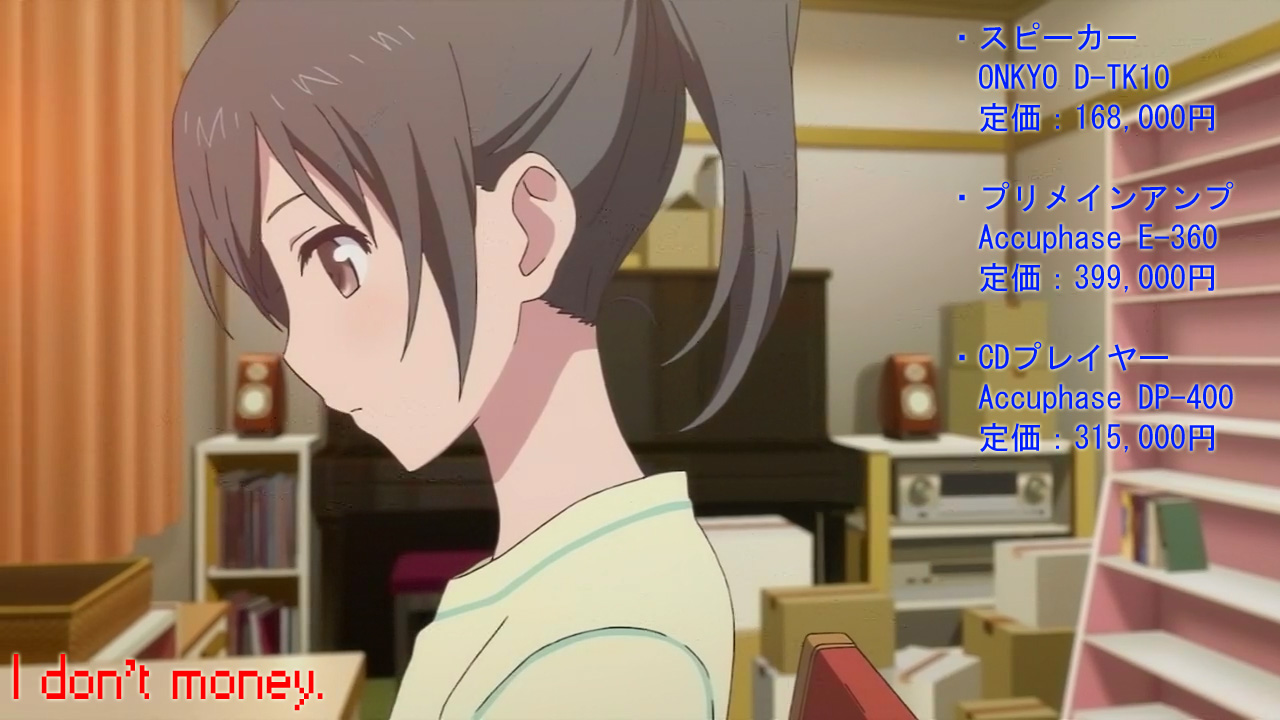
I like to think of  Tari Tari, at least at this point, as a second-hand, expensive piece of audiophile equipment–full of plugs and holes and hooks and missing the manual. All this stuff probably fits somehow, but it’ll take at least another go-through to figure it out.

PS. Are we suppose to fault a show that is “all over the place” because it’s “tari tari”? Next time I try to thought dump on this topic I will probably talk about its formula for what I perceive as life-likedness.


Oh the Humanity

I sort of dispute SDS’s claim that this anime is unique. I think the undercurrent that Jintai rides on is no rarer than the sort of jokes you find in Kometa’s manga adaptations or even in Welcome to the NHK. To wit, after 3 seasons of SZS and now with Joshiraku running along, Jinrui wa Suitai Shimashita is not some sore thumb standing out in a sea of not-satires. One of my favorite anime adaptation of satire comes alive in season 2 of Seitokai no Ichizon, so this is not something that I would call a rare occurance, at any rate.

What makes Jintai unique, I think, has more to do with the straightforward western style of satire that you find in contemporary British literature. Dry wit, satire as fine as piano wires that cut just as deep; or something resembling the opposite spectrum, like a large aquatic animal. Or bread, in this case. But this made-in-Japan slash, I think, cuts so finely that so many probably don’t quite realize that they’ve been made fun of in the very show they enjoy to watch. To me, it’s very fun because the show portraits exactly what I am thinking of, which is a great testament of the way the story is adopted and written. I mean, it’s less ham-handed than me saying “hey guys, great minds think alike.”

But also along this line of thought, this is why I think there are people who watch Jintai for the fairies, just like there are people who watch Joshiraku for the cute girls. It captures well that spirit of decontexualized otaku thing that, indeed, leads to our decline. It is no surprise that bullying and how the protagonist and her cohort retreat to their own little project in which makes up a relatively mainstream response to the cruelty of human societies and ills that has plagued us since time immortal, even if it means resorting to becoming the queen of fairies.

Lastly, we do have to look at ourselves. Just how meta is it to enjoy escapism via media that is about escapism through critiques of escapist media using media? Can I say I enjoyed Jintai for Mai Nakahara’s resurgence? At first I thought the role was relatively straightforward and narrator-like. I did not expect the role of the protagonist to show enough of a range, from earnest deadpan, slightly vulnerable, to coyly manipulating and mildly annoyed. It’s safe to say this model seiyuu elevator school graduate passed with flying colors.


The Flower of Rinne

Think of this post as a last-episode impression. Naturally, there are spoilers.

Continue reading


It’s Football Season

This is how I feel when Shannon Sharpe (Hall-of-Fame NFL pro and now commentator) this morning mentioned that the “Ravens will be better served with a little less Flacco, and a little more Rice”:

daisuki!
KOTOKOTO nikonda KAREE
SUPAISU futasaji keiken shichae
dakedo genkai  karasugite… mou DAME
BIRIRI  BIRIRI  BIRIRI
Ohnono nono nono no nonono
KAREE CHOPPILI RAISU TAPPULI

OK, yeah, actually I laughed at Sharpe (who’s known to have a mouth, so to speak) for about a minute. Then again, this is how I feel about Ray Rice generally. It has a lot to do with my Rutgers upbringing but he’s the man to electrified a local football program (along with now-NFL coach Schiano).

This post is brought to you by the strange realization that playing Space Chem from 12:30 AM to 3:30 AM makes the sunlight’s glitter just a little off.

Looking forward to MNF, though. And I’ve re-uploaded those “Asadayo~” tones. Help yourselves.


How to Enjoy Chuunibyou Media

Mary sue is a loaded term, which is why when appropriate, chuunibyou seems like a much better alternative when describing TV anime; “chuunibyou” is sufficiently new and foreign enough that most people aren’t quite sure what it is yet. To the point, both terms address fundamental complaints in terms of realism and suspension of disbelief.

Of course, when we deal with anime, certain things are going to be taken as is. Realism in this context has to do with the way the audience engages the material. For instance, most of us attack late-night TV anime as character and drama pieces. We care about character development, and often times you see people try to approach even gag 4koma adaptations from that angle, resulting in a mismatch and the resulting 3rd party chagrin. When I watch Full Metal Alchemist: Brotherhood I watch for what’s happening to who and what plot is being unraveled and realized, and how are the good guys going about to do their thing as far as the hook goes. I don’t really care about the type of ammunition being used in the frozen environs versus the desert, or the type of socks the military issue to soldiers in those environments–but somehow I am suppose to care about the automail people wear, because it’s kind of an plot device. I guess I’m not suppose to sweat the small stuff.

With that in mind, let’s look at choir drama Tari Tari. In a recent episode, a petty thief was subdued by the power of costume play and hot-powered vocals. The marathon bike chase scene where the costumers chased, on foot, the biking thief that leads into the vocal performance probably did not help either the pursuers and the criminal. Still, we are suppose to believe that the guy on the bicycle is some how even more tired than the high school 3rd years in their tokusatsu outfits. When the second bar of the song kicked in, we are to believe the thief was mesmerized by Wien’s brave visage in front of the setting sun, in some way. Perhaps we can swallow that Sawa’s mother somehow had these outfits, that happens to fit these one-size-fits-all Japanese bodies (along with their one-size-fits-all character designs, maybe), along with the opportunity to make some money on the side. This is drama, we can chalk all that stuff up to coincidence, right? Just like how there’s a thief who’s pocketing something in public, during a public event, right? What’s Japan’s crime rate again?

I suppose it is much better to care about petty things like that, than where would Sawa ride Saburo around–there are not a lot of places around there to fit a fine animal like Saburo without running into people. It’s like the scenic shots across Enoshima, with the Choir And Sometimes Badminton Club running up and down the seaside mostly by themselves. It’s strange because it’s probably full of people if you ever visit Enoshima in real life. To Tari Tari’s credit, thankfully we don’t typically ask these kinds of questions, because we are preoccupied with Konatsu’s plight and the characterization of the group. That’s how we engage with Tari Tari.

But why would I ask these questions? Because I was thinking about it. This is the strange tension between going all Chitanda on something, versus checking your brain at the door and just enjoying something without asking too much questions. The former is great if you can get the audience engaged but you probably don’t want them to ask too many questions and poke through the thin veneer–a beautiful production may be reduced to its component gear-works. This is basically what has happened to SAO for me. This is why being too chuunibyou in the story is problematic. It makes the audience ask the wrong kind of questions.

A better example of this is actually Guilty Crown. In that case, the chuunibyou factor was not extreme, but it was enough, that when combined with its convoluted web of messy plot devices, conspiracies, and strange character dynamics, people have no choice but to engage with straight questions that GC’s flimsy web can’t handle. And once we see the underlying mechanics, we can’t help but to point out where it could’ve been better, because we all have seen it done better somewhere else.

On the flip side, you can see how a story like Hyouka can be very engaging without letting people know its ultimately chuunibyou underbelly. After all, it’s just a boy-meets-girl story where the boy feels like he holds all the cards, and the girl is at least kind enough to let him know about how she wants to approach the situation without outright manipulating him. The end result was a less-predictable life for the boy, a knock and a notch down from that specific, middle-school disease. [If you read my blog and you didn’t know Houtarou starts out in Hyouka with a Type A case of chuu2byou, well, now you know.] It’s very Japanese too in how the men have all the face, because the women are great people who save them.

As an aside, this is partly why I have a hard time watching shows like FMA and mainstream shounen stuff, because precisely I think too much, and those shows ultimately reveal their underbellies if you batter it enough for long enough (most things do). From experience, outside of One Piece, it’s probably never pleasant. I think there are shows that also target this specifically, to their benefit: Simoun comes to mind as a great example. I also think of certain meta shows like Seitokai no Ichizon as a way to both celebrate that problem and bring to catharsis that sort of frustration.

Lastly, I don’t have to explain about shows where that do require checking your brain at the door, right?

PS. I think I just used chuunibyou two different ways in my post, I hope you didn’t get confused.