Category Archives: Modern Visual Culture

Year In Review: Lonely in a Sea of a Million Stars

If all I’m going to talk about THE IDOLM@STER this December, there are just two takeaways I want you to get even if you care nothing about them:

1. The mustard seed parable

2. The future, or how I started playing the mobile games.

I already explained the mustard seed thing. So.

Tokugawa Matsuri (Prologue Rouge)

Part of the otaku identity is a sense of self-inflicted loneliness. A lot of people–geek culture stuff–talk about it. This is particularly an amusing thing when I was reading on the GG/game culture stuff and how people found solace and identity through video games. At its extremes, that sort of identity politics can seem cultish, perhaps, but that is nowhere close to idol otaku who’s fell in the deep end, that I can see almost first hand.

But what I have to describe is not like this at all. It’s more like, because I started on the path of THE IDOLM@STER: MILLION LIVE, I begin to walk away from established IM@S fandom, at least in a way. It’s really ironic in a way because back in 2005 or whenever First Vision era started, that’s how people feel about Producers. Before it was cool thanks to Nicom@sPs, Producers meant you sat in dinky, smoky arcades and poured money while sitting down in front of a touch screen. I mean, like, how is that different than those of us who were grinding away at a Stamina Event in ML and had nobody to talk to, because nobody (who speaks English) plays ML? And yet for the past 3 years looking for Ps was what I wanted to do deeply. It was weird, familiar, and almost Ouroboros-ish.

Part of the problem is that the English-language IM@S community…is inadequate to say the least, if not outright a textbook example of the problems with online gamer communities. I mean, much of it is just 4chan, and I just didn’t have the time for that. It’s time I can spent playing the various games. ML was kind of an after thought because oversea scenster kids online are all chasing CG, if they were chasing IM@S at all (well, they all got shipdaughters now).

At any rate, let’s fast forward to today, where at least Derem@s Ps are getting a reprieve from loneliness through the growing player base for the mobage oversea, as well as from the upcoming TV anime. The Milim@s Ps are still a group missing in action in English. Newly engineered away from the tobacco smoke of the dying arcades, forged in the foundries of SNS and the 2.5D media mix school, Million Live is a wholly unique creature even by Japanese standards. But I fear the fandom for IM@S overseas is not ready for this pivot. I’m not even sure if they are ready for Derem@s, the poster child of gambling-like gasha schemes with an impossible-to-collect-them-all roster. After all, these games are no longer games of yore, where things like gameplay and concept can be understood without the meta, without the bizdev concept, where Da-Vo-Vi meant something other than gameplay concepts. There is no incentive for people to take the (possibly expensive) dive into a game where the rewards is just the same as any other gamer group identity–you are a P. Produce an idol (or three or however many). Except the rest of that support infrastructure–starting with the IM@S movie to the player base to the LTP and LTH to the numerous events to the region-locked radio show–is not available for oversea Ps. It is fully turned towards the Japanese 2.5D otaku.

It’s not like you can take these girls and run with them in a doujinshi. There aren’t that many ML doujinshi even, and those who traffic in the categorically pornographic, unauthorized doujinshi scan scenes can attest. This past month was the first Milifest, which is a ML-specific doujinshi event. It was the first doujinshi event I actively wanted to attend, ever.

Where am I going with this? Basically it becomes impossible to be really alone unless you go out of your way to be. Over the course of this year, since I started ML, I met people who play and now we have a small group of people who play the game both casually or seriously, and everything in between. I even started CG. Perhaps I am fortunate. If I am someone who latches onto new trends, then this is the one I did for 2014. If the people planning the IM@S franchise wanted people to play the game because of Moviem@s, well, it worked, at least with me.

But it just means for every whine about how ML were shameless tie-in characters or are underdeveloped fillers that dragged out an otherwise already draggy movie, they have a point and I can only nod and agree to an extent. What posed itself as a negative for some is just an opportunity and eye-opener for me. I’m not going to defend the shameless money-gathering scheme they’ve set it up, because in exchange I had a blast in 2014, in a big part thanks to those profit-driven enterprises!

It’s was a spectacle.  That’s the thing I enjoyed the most about 2014 x IM@S, at least looking back. The spectacle. The advertisement in Japan. The seiyuu lives. The oversea news. The new games and anime. Meeting new people. It’s exciting and fun.
Continue reading


Stupid Eligibility Rules

Production Schedule, Exodus

Just want to vent a little. I Just read that top 2014 anime post from Kotaku, and it’s just the cherry on top of a week of dealing with eligibility rules. Well it’s more like, how do you rank shows that are either split cour, ongoing, or was truncated? I think as a matter of rule it doesn’t really matter.

The long take is that as someone who has spent a lot of time over the years mulling over (although mostly in the saimoe-tournament-style nomination format), there are better ways to do this than others. The question is more like, what is the point behind doing something like that?

Isn’t this the kind of stuff you learn in civics and social sciences? Or even programming? How to write rules that make sense and to affect the outcome so it is desirable? I mean, the rule can be as simple as “only put pegs of the same shape into holes of the same shape” when playing with some toys for toddlers.

But ranking year-end anime series have even less stakes than trying to avoid putting square pegs into round holes (and damage the toy). I’m not sure how it compares to setting selection criteria for waifu wars but if the goal of ranking anime for something like APR or Kotaku is to get people to check out some highlights of the year, why bother with limiting things that are ongoing or split cour? Especially in the APR, it made no sense to me that when the endeavor is to rank anime on an episodic basis every week (and often voters don’t even get to watch everything for that week before submitting their ballots), somehow you now care for the whole shebang?

This eats me in two specific cases. NagiAsu and Shirobako.

By episode 3 I had already declared Shirobako as anime of the year. I don’t think my mind has changed by episode 13. In fact the 10 episodes since had cemented that opinion even further. Does this mean the next 13 episodes can undo my feeling about Shirobako as the best anime in 2014? Maybe, who knows what the future holds? But is it likely? Not by a long shot, and for two reasons. First, who the hell goes back and change ranking for last year for this year’s episodes? I’m sure such persons/things exist, albeit super rare (please link to such a thing if you know) but usually this is not why you set eligibility rules on split cours. It’s more because people feel it is unfair to either give a show 2 shots at AOTY, or that a show should be evaluated completely, or that it should be all available in case someone wants to check it out. However isn’t that just as arbitrary as giving a show 2 shots at AOTY or evaluating a series using any pre-defined length of episodes (1- or 3-episode tests come to mind)? I think it doesn’t really matter either way (and it’s fine to evaluate shows only on the whole; in fact I recommend this), but the second reason makes this worse.

The other reason is because these end-of-period rankings seek to capture a moment of time and preserve it as so. 2014 is coming to a close. These posts are more about what happened in 2014 than the anime these posts seek to rank. I mean why are we writing these posts anyway? Omitting something that happened in 2014 and say it’s something to be evaluated for 2015 may be kind of neat in that you are watching anime in the future, but it’s also kind of dumb to cut them out when they are completely relevant. This is particularly the case for split-cour shows or shows that are long-running.

This lack-of-the-present problem makes NagiAsu difficult to evaluate if it was pushed as a 2013 show (it’s not to say APR or Kotaku’s methodology is bad, but any fixed methodology based on air dates will have these kinds of problems). As a 2014 show it was awesome, so that’s how I’m looking at it.

The bigger, overarching problem, is that people are just throwing around rules without understanding what they’re doing. What context do air dates make sense? If you publish Newtype and are working on the stats and TV-guide stuff, sure. If you are an anime blogger, who cares? What does your audience care about anyway? If you are the APR, do you realize what the poll/questionnaire format means statistically? How does it skew the data? Does it serve or undermine the model? What is the goal? What’s the purpose or vision?

If you are playing it loose, I think most people understand what “this year’s anime” means. You can make exceptions for the Cowboy Bebops out there–to reduce noise on classics/long running shows namely–because the assumption is everyone knows about them. If the purpose is for discovery of shows people (of your readers’ estimated knowledge base) may not know, I think the effort is very straightforward. I mean, if you read comments on Kotaku’s annual posts every year someone talks about Cowboy Bebop. Com’on, your rules are dumb, they don’t even work and causes more problem than it solves, so why not get rid of it or make better ones?


Year In Review 2014: The IDOLM@STER 2014

Not so much introspective as descriptive–what exactly happened to me this year?

Zekki is pretty intense

It’s hard to explain precisely why, but let’s start with a recent Amiami blog article. I quote:

Aspiring producers, take note–The Idolm@ster Movie: Kagayaki no Mukou Gawa he grossed 765 million yen at the box office before moving over 600,000 Blu-ray/DVD disks in the first week. Imas fever is only getting hotter as the series approaches its 10th anniversary. You can bet Japanese fans are hyped for Cinderella Girls this winter season.

Well,  yeah. CG anime will be hype. As a matter of off-handed indication of its popularity, when I was looking up circles for C87 day 3, the CG section on Day 3 had the largest area for IM@S, bigger than even the original group. It’s not an indication of popularity as much as an indication of its whole adaptation by the otakukin, that most of CG is being looked after by somebody. Granted I’m pretty new at doing Comiket planning so I might have missed the large swath of IM@S circles somewhere else, but that’s what it looked like.

What is more interesting about the quoted blurb above is stating that there is, and has been, such a thing as Imas fever. There always have been ardent fans of the IP since the early days. What I observed off the cuff is that many of these ardent fans are no longer ardent fans, and somehow new ardent fans filled in the ranks over time. It’s a little unusual perhaps. Well, if you thought about it, it isn’t all that unexpected, and that’s something that happens regularly to even other franchises.

What’s a little bit different about the IDOLM@STER is that it isn’t old or widely accepted enough to be one of those legendary franchises. I’m not sure if you can say it’s the same level as Nanoha, and that one is not even quit there. It’s, I think, just on the cusp. Maybe in 2014 that is changing, but I don’t know. If you think about Star Wars or Gundam fans, a lot of them have been fans for a very long time. And it’s baked in otaku culture. This is not really the case for IM@S. So in order for the franchise to heat up, it has to get new fans. The key thing is that it is getting new fans.

In 2014 terms, the way Bamco and team are able to do this is by making an anime movie out of 2014. There were some clear objectives they wanted to accomplish. First, it wanted to relight the fire in the fanbase that sort of tapered since Anim@s and Shiny Festa that happened over a year ago. It was also a gateway to hook in the second mobile game, Million Live. It also is a driver to bring around One For All, which is arguably the most important monetary incentive. One For All is ultimately the fully pivoted version of IM@S2 the video game.

One For All, unlike the previous games, has monthly DLC sets that actually adds to the story. The previous DLCs only added assets, not so much the narrative in a direct way. It’s a page taken out of mobile games, but it is straight up PS3. Fans can expect to spend anywhere between 500 to 10000 yen a month to continue the story of their favorite characters. I personally fall somewhere between 3000-7000, although I haven’t had the time to play the last few months’ worth due to the equipment dying on me. IDOLM@STER One For All came out in May, so seven or eight (day 1 DLC LOL) times those numbers on average is what you’re expected to spend for the core fans, on top of the cost of the base game.

As far as the two mobile games go, the paths are similar. Cinderella Girls is actually sufficiently well off on its own (see C87 details above) that it doesn’t really need to get fans via tie-ins today, even if that is still one of the driving engines behind the series. The anime itself will set it to new heights just because there’s enough momentum behind CG and IM@S on the whole. I mean, mobile games are good cash money these days, and CG has been one of the most successful ones from the start. What the crossovers help is in terms of the event-types situations where it helps to provide some cohesiveness and assurance that CG is still part of the family, that there’s this co-laboring thing between the core IP and the mobile games (kind of like a senpai thing). Million Live takes a slightly more direct approach in that it directly grafts into the 765pro setting and sensibilities. If you think of Puchim@s as a show with a different “sekaikan” then Cinderella Girls is also one that’s just a hair different from the original.

But at the same time, if we consider its arcade roots, IDOLM@STER is in some ways more similar to Cinderella Girls than Million Live, which feels like a more polished, by-the-committee approach to the aging franchise. It doesn’t have the same feel, the crunk. (Like when you compare the CG JP UI with the KR UI and it feels like an aging pachinko machine.) At any rate, both offsprings expand the core offering, which in itself has taken a turn since the earlier days, both by necessity and because it’s a form of rehabilitation. A pivot in startup talk, I think. From video game franchise as center to 2D idol franchise as center. From selling games and machines as a focus to selling CDs, toys, merch, and event tickets as focus. Well, both were always something that were available before, and in a way the change to mobile games means a renewing commitment to gaming, but that’s not saying much when I could be playing the Hanayamata cash-in (or similar) on my PSV right now.

In 2014, this rehabilitation probably comes to life best in the IDOLM@STER movie. The idols go to camp to get ready for their big arena live. In real life, the idols probably did spend a lot of time training for their big arena life in the real, too, slated a month after the movie debut. There were a handful of Million Stars and Cinderella Girls performing on a stage that big for the first time. More than a handful were super nervous, now that you can observe them on Blu-ray. There were small dance mistakes and singing mistakes if you are the nitpicker. But that is all well and good, as it is the part and parcel of the idol package. Fans enjoy seeing newbies develop into great people and go on to do great things, to further connect with them. The SSA live was a launching point for the CG and ML franchises and the seiyuu/character that stand behind them. The Movie gave those folks an in.

The powerful thing about the 2014 IDOLM@STER movie is also that it is the climax of the IDOLM@STER experience from the start, as a butt-of-joke among gamers to a force to be reckoned with in the scene, even if we’re no longer dealing with gamers per se. Fans followed the way Namco took the series, and how fans and people involved work with the show like a force of nature. It was a thing that was. Little bits of lore like how Berserk creator Miura would play it, or these days how HaradaP who is a leader on the Tekken series reps Iori, and sort of the thing that builds up over time that adds meaning. Or how people call themselves Ps on Nico from the Nicom@s days, and how that translated into the Vocaloid scene. There was also the seiyuu take, as IDOLM@STER proved to be something that grew up with the likes of Nakamura and Imai, providing them both work (and pay) and a sense of identity, a stable fan base in which both launched moderately successful careers with. As everyone kept at the series, creators and fans alike, over time, naturally a pretty powerful sense of sentiment builds up.

In a way to honor these qualities, the whole PR for Moviem@s felt like a ride. If you followed it from the start it was almost big enough of a subcultural cache for news and happening all by itself. And this isn’t like AKB48, this is a media-mix franchise! And to walk into it with an open mind was simply overwhelming. That’s kind of in a nutshell what happened to me this year. It was both a crash course on 8 years of IDOLM@STER via marketing, the anime, and learning from other fans; and a giant push for the future along with Cinderella Girls and Million Stars. It was like they paid to get us to pay into the next generation, and how can I give that up?

How well the whole Moviem@s push got me to play with Million Live is a different blog post, but I can say for sure that the IDOLM@STER Movie is one hell of a symbol. It is Producers’ holy ground. And I didn’t even really talk about the movie; just the role it plays in the big picture. In my mind however, 2014 is the year of the IDOLM@STER movie, and there’s no getting around this.

Continue reading


Shirobako Explains to Me Why I’m Weak Against Anime

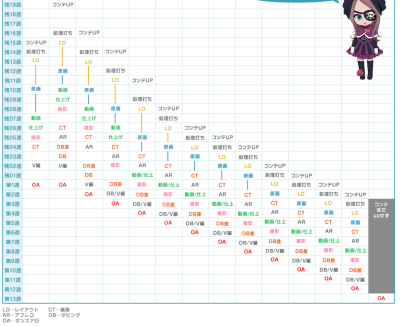
I do this introspective game for show all the time, so it’s almost surprising to me that I haven’t really pitched the idea the way Shirobako did. In its half-way climax, the story of Aoi and her underdog Musashi Animation going to the wire to deliver the final episode of Exodus, an 1-cour moe anime, comes to a conclusive stop. That doesn’t mean Shirobako will end there, but throughout this first half it has taught me things that I thought I knew, but didn’t.

The “Anno saves New Years” thing was so hilarious that I don’t know what to make of it. But what’s really true is that when these men and women pour their heart, soul and sweat into these lines and computer-shaded visuals like nobody’s business, putting together a product for us, I feel it. What Shirobako shows us is in what way does “pouring” work. You have shitennou-class guys like Anno, you have the whole range of craftsmen like Sugie, Iguchi, Ogasawara, and Yasuhara. There’s the Mizushima, Madoka, Segawa, and those guys. And even the whole range of folks from Takanashi to Honda, Ochiai even Watanabe. People might do things for different reasons, but the love is there.

When I watch even some trash-tier shows, I feel it. This is why I even if I don’t find Space Dandy “my bag” I can’t help but to like it. It’s like sometimes I can tell someone is doing their best in a less-than-desirable situation, in a less-than-desirable animation project, and animating things as best as they could. When sakuga otaku sing praises often times you can directly see how that translate into cuts of outstanding animation, but sometimes it’s not even that. It could be just a competently, error-free series of cuts in a production that probably is in dire straits. It could be just a set of cuts that got special attention. It’s those moments that sometimes stay around even if the plot or concept of a show might not be so memorable.

As a focus to the concept Shirobako uses an analogy to a love letter. And in a way animation are animators’ love letters to us. Perhaps not all the time, but sometimes. And that’s probably why I still truck along with 10+ shows a season because I want to read those. Isn’t it great to enjoy what others have put in so much effort to produce for you?

12-104

So yes, I’m easy. Those of you hard to get, though… One out of twelve ED sequences?


It’s Not Comedy

I’m not a huge fan of portmanteau, so consider this a factor of bias.

Dream team

I was reading the APR a few days ago and someone made a comment on how Shirobako is a dramedy. It was like a trigger, in that I thought several things in rapid succession, like, what drug is Mike on? What is dramedy anyway? Is Shirobako a what? What was it again? What does it even mean? I guess he is based in Socal so the language flows a certain way? Is this just me overreacting?

Well, in a specific context, the term dramedy means the same as, and as far as I can google, dramatic-comedy or comedy drama or any combination of those two terms. It also means more or less what it says–a hybrid of sorts specifically in the TV/radio drama sense. In a more rigorous scheme, many dramatic-comedies are probably still just dramas. The term (or the hybrid genre) grew as a factor of mass marketing and a need to distinguish different types of TV shows.

Because, truth is, everything is to a degree comedic. Most sad stories have moments of levity and humor. Most happy stories contain serious themes. It’s not something categorically you want to spin out meaningfully in earnest discussion. And again, really something specific to American mass entertainment (TV/movies) and its subsequent development thereof.

The “triggering” nature of this line of thought stayed with me a while and I ran into a couple pieces which reflects these. For starters, there’s an interview with comedian Chris Rock that might be worth reading for various other reasons, but let me pull one part here. [Bold for interviewer, some formatting removed]

I don’t think people understand how hard it is to write comedy. The gestation period, the trying out of jokes, the whittling them down — a lot of people may not understand that, in some ways, drama may be easier.

It’s not may. It is easier.

Go on.

It just is. Hey, man, I loved Gone Girl. Loved it. But you could probably get other directors — I’m not saying they’d make it as good as Fincher, but you could get it from beginning to end and get a reaction out of it, where you can’t really do that with comedy.

Every moment has to pay off.

In this sense, comedy’s really fair. It’s not like music, where you can hire Timbaland and he gives you a beat and a song, and even though you can’t sing it’s a hit. Comedy, especially stand-up comedy, it’s like: Who’s funny?

It’s a ruthless marketplace.

It’s the only thing that smacks Hollywood out of its inherent racism, sexism, anti-­Semitism. It makes people hire people that they would never hire otherwise. Do they really want to do a show with Roseanne Barr? No, they want a thin blonde girl.

But she’s funny.

She’s just funnier than everybody. I’m not even sure they wanted to do a Seinfeld show, but he’s just funnier than everybody.

He’s not a matinee idol. He’s Jewish, nerdy. And recently he said publicly he was somewhere on the autism spectrum as a comedian.

He bores easily. I bore easily. Not because I’m on some spectrum, but because I hear so many conversations again and again. So many people come up to you, and not enough people try to take into account what you’ve heard already.

Let’s put it this way. Take Anchorman. Now switch the directors of Anchorman and Gone Girl and give them their movies to do. Adam McKay’s going to get closer to Gone Girl than Fincher is going to get to Anchorman.

Absolutely.

It’s not even close.

Okay, but Woody Allen—

I don’t even think Woody does comedy. I think he does dramas with jokes. They’re all sad at their core.

It’s pretty clear, in my opinion, Shirobako (and majority of TV anime) are dramas. Sure, they have jokes and can be funny, but that don’t make a comedy by itself. It’s the Teekyuus and Azazels of the world that are comedy, when I (and others) lament that nobody blogs about comedy. Because it’s friggin hard to write about comedy. It’s friggin hard to make a good comedy, let alone doing this whole Japanese cartoon dance across the Pacific (and Atlantic in some cases).

Which comes back to Shirobako. The director of the show, Tsutomu Mizushima, is known for comedy. His auteur voice honed in Crayon Shin-chan, which is pretty much the home of modern children comedy cartoon in Japan. Long story short, Mizushima brought his comedic touch to the humorous moments of Shirobako. And Chris Rock says as much. [Some formatting removed, Bold for interviewer.]

I would love to be a 60 Minutes correspondent.

What would you want to cover?

I would cover anything. I mean, I’d be in Ferguson right now, and it would be in-depth, and it would be funny.

It’s hard to do funny in journalism.

No, it’s not. It’s all in the cut.

What would you do in Ferguson that a standard reporter wouldn’t?

I’d do a special on race, but I’d have no black people.

Shirobako’s dramatization aside, isn’t it just presenting to us the everyday realities of the anime production desk? Since the 90s there has been a lot of otaku-oriented stories with otaku and people we desire within; but this one is about industry folks, not you and me. It’s not to say racism in America parallels the moe cancer, but the way we tell either story follows the same principles behind telling stories. I can see why someone can think Shirobako is a comedy. It’s in the cut. And Mizushima cuts it a certain way that brings a certain levity. But it is not, say, the Office. Or Wagnaria. I feel that Shirobako can seem light because we are cutting pretty close to the bone and to home; it’s also part of the dramatization package to protect both the show and the people it talks about. Most of all, the humor helps to make a dry topic fun to watch.

I don’t fault Mike (who is a swell guy AFAIK) for dropping the most cromulent, triggering portmanteau (for me) in a random internet comment sort of thing, but that’s just misleading TV gossip language and it makes me sad. Which is to say a lot of people out there probably don’t even know good comedy if it punched them in the face, because they don’t even have the life experiences, the current events, all that current-events wherewithal that Chris Rock referenced, to really get it good. Nothing wrong with that; we all have to start somewhere. So let’s. And in my opinion the first step is to get out of that consumer-oriented mind set, that overly database-minded idea that comedy is just yet another flavor like slice of life or sports, a row in a table. It’s a wholly different animal.

But really, the language, the level of discourse on comedy, on the anime social network stuffs, is so rudimentary that if something stood out it’s not even recognizable. Do we ever get beyond timing and puns?

PS. Wikipedia on dramedy is redirected to comedy drama. If you read the talk pages, dramedy basically gets laughed out into tragicomedy, which is really more than what anyone needs to know.