Category Archives: Modern Visual Culture

Free: Checking the Database Schema

Just thinking through about a few things in Free. Well, one main thing: I don’t feel the characters are believable teenage boys.
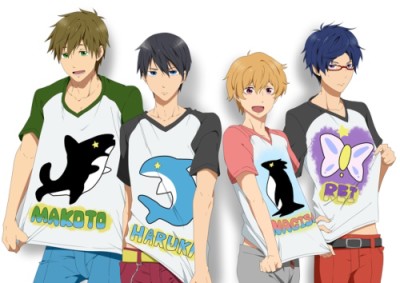
Iwatobi Swimming Club

The way characters assembles in the Database Animal era is the combination of “database” elements. Stories, too, are constructed from archetypal narrative elements. What is new is each and every daring combination of things we know, the cultural remixes that results.

Can we look at Free as just the same constructed elements but with some parts swapped in for the female otaku audience? I think that’s the reasonable take.

While it may be reasonable, I still don’t know if it is really true. I think there are definitely a lot of similarities between Free and past Kyoto Animation works. Maybe a better question would be if we subtract from Free what makes up the similarities between Free and K-ON, what do we have left?

  • Cute girls versus ikemen (let’s ignore Kou for the moment)
  • Athletic rather than culture club; swimming versus “keiongaku”
  • Inclusion of the opposite sex
  • Fanservice

I think none of this is particularly problematic. By problematic I mean if I watch an episode of Haruhi I might coincidentally see all those elements at play there as well, and nobody thinks twice about Haruhi. So it’s not just “genderswapped K-ON.” Rather, it is more like just Haruhi.

What I find difficult about Free, aside from any concerns of the gender-specific fanservice sort of thing, is that the characters don’t behave the way I imagine them to be. For a point of contrast, check out this series that is kind of popular with some fujoshi: Ookiku Furikabutte. Big Windup, as it’s localized, is actually a seinen manga adaptation with a very sports-centric appeal in which happens to feature many database elements that fujoshi and female otaku look for. The anime, coincidentally, is also pretty good. But in that show, despite how touchy feely or at times feminine some of the guys act, these characters come across to me as believable high schoolers, in the “go to koshien” sense (man I haven’t used that term unironically in a while). Yes, even the hand-holding part. [They certainly do some weird stuff.]

That is a lot more than what I can say about Free. Haru, clearly, has a swimming thing going on for him. We can put him in the “eccentric” bin. But how about Makoto, Rin, Rei and Nagisa? Rei and Rin seem like the most masculine of them all in some ways (certainly physically), perhaps because they are a blockhead and a tsundere–both generally gender-neutral traits. I can give Nagisa a pass–these kind of people do exist as high school boys, but I think if such a person exists they are going to be really annoying to deal with, speaking as an average guy. Maybe that’s just how Nagisa is with his close friends, I don’t know. It just seems too much of a copy-paste sort of deal, where you take 50% Mugi and 50% Yui and add a dash of Ritsu. I probably have the most problem with Makoto, who seems just motherly. I know guys who can be motherly, but generally they are portrayed like this. And Makoto does not remind me of that guy whatsoever; Makoto reminds me of a more believable version of 30% her and 70% her. At any rate, the point is none of the main guys exhibit anything particularly masculine as character traits.

Well, I am also making a call with 4 episodes in, so things will likely change. The least I could do to reserve the right to change my mind and say this is more a first impression than some kind of judgment, maybe a bit of a prediction. Perhaps it’s more of an indictment of the problems common to Kyoani works. What I really want to get across is that when I watch Free, I don’t really see a story about some guys swimming, I see some muscle-blobs swimming. Where’s their humanity? I don’t feel this way with K-ON, but that’s probably because K-ON doesn’t get deep enough about character traits to really paint that kind of a picture. We might see flashes of the characters’ worries and inner thoughts in K-ON, but it’s pretty much a story at a very low depth to begin with, and the deepness largely relies on framing a passive sense of melancholy through the passage of time. It’s a lot more lifelike than Free, let’s just say.

So I guess what I have problems with isn’t exactly how girl-pandering opens new ways to reassemble the database; it’s more because Free seems to take the theme and story somewhere different than the characters that it swims with. Well, let’s hope Kyoani proves me wrong.

PS. About Kou… Maybe it’s the reason why some people can handle watching all those cool-girl Houko Kuwashima reverse harem anime, when it really isn’t meant for them. I think if there’s a character worth watching for, people will watch the show, to the degree that they can put off the detracting elements of the show. I know that’s the reason why I can tolerate a lot of anime originally written for girls. And it goes back to simply having quality story, theme, characters, direction, music, acting, whatever. That said, I’m not saying Kou is such a thing.


Gatchaman Crowds: Positivism Trap

Take a break and watch this little youtube video about the criticism of the ideology of positive thinking.

Does it make sense in the context of Gatchaman Crowds?

Babes from the (not) UK

Fundamentally, the crowd-funded, crowdsourced mode of thought differ from traditional heroism in the sense that all of us contributes to resolve problems, versus the heroic effort of one or few individuals. Anime and manga are stable sources of media to draw stories about incredible beings (and perhaps much more so for American comics and its derivatives) with incredible strengths, inner or otherwise, that achieve a great feat or two. Maybe these stories even feature concepts like teamwork, because being a good team player is an ideal inner quality as well. [Maybe I should give SAO a nod here wwwww.]

But that’s just the teeth of positive thinking at work. It’s great to develop and cultivate admirable personal qualities–I am a full believer of this–but we are not called to be superheroes. Maybe just ordinary heroes. And maybe sometimes Hikigaya Hachiman is who this ordinary hero looks like. I say maybe because he is still way too heroic, in the “dark hero” kind of sense that’s pervasive in the 90s and onward–just because you are not Superman doesn’t mean you are not some delusional power fantasy ideal? Of course, I also mention 8man because he’s rather close to who I’m talking about–a realist. A realist that doesn’t have all the answer, and sometimes take a dumb way out of the situation. He will piss some people off, including the audience of Oreguile. So maybe we should aim closer to Moko instead.

To go back to Gatchman Crowds, originally we are following the idea of a sentai team, doing heroic deeds fighting with aliens to save the townsfolk. But here we are, 3-4 episodes later, now confronted with the fact that positive thinking-powered, straight-looking sort of a lifestyle actually is not the optimal solution to the problem. A realistic solution to the problem is precisely one that attempts to solve the problem through trying to understand the problem, and trying something new in light of that. It is not Hajime’s positivism that saves the day, but the quality of her actions.

PS. This is kind of like Genei Taiyou isn’t it, speaking of another Miss Genki having to deal with some horrible situations.


Genshiken Second Generation Episode 4

Jäger Madarame

I just want to talk about the preview segment chatter. For sake of convenience I’ll scribe from Crunchyroll. This also has a little to do with the train of thought passing by in my last blog post.

Madarame: The summer anime shows has already finished four episodes? Time flies.

Tanaka[?]: I’m sure everyone’s talking about which shows they’ve dropped online.

Kuchiki: I always give a series three episodes!

Madarame: So you actually drop shows? That’s nothing to be proud of.

Tanaka: You always get mad when something gets popular after you drop it.

Kuchiki: That’s when I say everyone else on the board is a shill!

Madarame: You’re horrible.

Kuchiki: Viral marketing! Viral marketing!

Kuchiki: Any time that something sells that I don’t like, it’s due to viral marketing!

Kuchiki: The anime I like should sell a lot, and the ones I don’t shouldn’t sell at all!

Madarame & Tanaka: I don’t care!

I think this piece is relevant in a particular sense. There always have been an interest in sales figures among certain fans. I would go as far as to say that there are “industry figure” style otaku that, for example, write rage posts on how to interpret Amazon sales ranks on preorders as indicator for…well not very much. You’d think these are the people made fun of–not quite. It’s the people who understand the importance of sales and such, but don’t grasp the interpretation of this data in the larger scope of things. It’s these kind of people that are being made fun of in the segment. Of course it’s actually just a cross section of a greater range of people, some who don’t really care about sales figures, but creatively interpret them for their own uses to justify their own narratives. Plenty of people who follow sales ranks understand how it fits into the bigger picture in terms of who’s footing the bill and the way anime is produced in Japan. But a lot more people don’t. And in fandom, that’s what sales ranks operates as–some straw validation of one’s belief or ammunition to attack someone else’s.

Thanks to this little skit now whenever someone shills for Redline, I laugh. Good Game, the Kuchiki-kuns of the western otaku-internet-o-polygon. And it brings us back to what makes Genshiken so charming in the first place–it is able to connect with a certain layer of fandom’s doubled-rainbowing layers of meta that few other first-party (in the official/3rd party/doujin sense) animation or manga can.

I suppose it’s asking too much for people to “get over” the whole sales thing. After all the trend is more direct participation by the end consumers, and more  direct funding. Well, maybe that could help people get over the importance of sales ranking and Oricon and stuff like that.


Gatchaman Crowds Is the Tumblr of Social Media Anime

This post contains content up to episode 3.

Rui

I’m not going to get into the whole “SJW” thing but I think there’s a visual aesthetic at work in Gatchaman Crowds. I think it’s not a coincidence that MESS looks like a bunch of tiny, moving single-color cubes of various colors. Nor is that the offkai is a collage party. [I wonder how much of it was inspired by gaijin train hijacking customs.] I guess this is as close as themes can intermix with visuals? It’s about the sort of visuals, the clipart-style of sharing, the unit of information. The way we exchange them today and how they do it in the anime.

Personally, Tumblr and Pinterest remind me of what feels like Gatchaman Crowd’s latest social networking efforts–labor organizational platform can be summed up as a colorful pipe collage-dream. I mean, at least GALAX has shortcomings that are well-recognized. And it’s kind of odd that episode 3 is labeled “Futurism” because the only visible people that call those who don’t believe in altruism as “enemies” are Futurists. I don’t remember if communism is compatible with such principles, but it sure didn’t require a logistical supercomputer powered by Tange Sakura. Well, maybe that’s why communism doesn’t work so well in practice.

I’m exaggerating, of course. Topologically, twitter and live chat-style (think DOLLARS) forums are always the closest realization of these common Web 2.0 fantasies. (And it’s good to pause and credit Eden of the East for something a little more original there.) GALAX, for better or worse, starts out ballsy. If students fighting their teachers (the establishment) to save their friends not symbolic of what GALAX is up to in the big picture, then I quit Kenji Nakamura. DRRR seems comparatively spineless in comparison, in terms of the statements of what it is trying to say. Maybe it’s more tribal-status-quo, rather than something like GALAX that unites people across class and age boundaries. In a more altruistic way.

And it’s this sympathetic backbone–that Hajime and company demonstrated–that the sjw types lack. This is what all the old people complain about. This is why the road to hell is paved with good intentions.

But it’s all too unreal. When that one sketchy lawyer leaned over to talk to that mom, I was like, LOL LOLOLOLOL. I don’t know what that is but pass the pipe please.


A Wall-top View on Reference Humor

So, in Watamote ep2, there’s an elaborate Whisper of the Heart reference. You can see some of it here. I want to look closer at it.

Jerks

The scene starts at around the 13:10 mark. For the unfamiliar let’s just say that our naive protagonist had a run in with a strange boy and she suddenly got into the frame of thought, a frame that becomes possible after several repeated viewings of Whisper of the Heart. The trigger is that Tomoko mouthed off a chain of “jerks” not unlike when Mr. Concrete Road sang along earlier on in Whisper and threw its female protagonist in a similar fit of consternation.

Suddenly, Tomoko realizes that she can make a Whisper of the Heart reference.

Sunrise

Please bear with me if this is obvious to you (in fact, please tell me so in the comments if this is the case). The joke, here, is not so much that Watamote makes a reference to a classic Ghibli flick. Well, that is a big part of it–the animation reproduces the lampoon accordingly. That in itself is humorous. The fact that it is a reference is also humorous, much like those Genshiken Nidaime viewers feel about Sue, assuming they enjoyed Bakemonogatari and Nisemonogatari. Or insert whichever reference of reference humor you prefer.

The funniest thing about this scene, for some, is that how Tomoko is self-aware about the reference in a way similar to how the audience finds such a reference coming across something they’re watching. In reality she is just daydreaming about some idealistic romantic encounter (thanks Ghibli) because of her own disposition. She isn’t actually making a joke (like Sue, again). However the joke-ish daydream Tomoko makes is natural, and the one Sue makes is superfluous to the plot and story.

So to diagram it–you have the joke/reference, you have the level of actualization of the reference, and you have the degree of self-awareness of the reference. It’s rather complicated once you take a serious look. We know reference humor runs the gamut from chalk drawings on a blackboard to shaping an entire episode to match, so in 2013 terms there is a wealth of things we can draw from analyzing these sorts of references. In Watamote’s case, it clearly speaks something about people like Tomoko. But what does it say about people who watch Tomoko enjoy herself? Do I (or anyone) want to think about this?

PS. If you haven’t seen Whisper of the Heart yet, do make time. It’s probably my favorite Ghibli movie, although 18 years might not be long enough of a test of time  yet? It’s neck and neck with Porco, which is my default answer when asked about my favorite Hayao Miyazaki movie. Here goes hoping that Kaze Tachinu topples Porco.