Category Archives: Modern Visual Culture

Maoyu’s Dangerous Fantasy, Or I Want a Story About Coffee Next

A recent Gizmodo story about the first webcam kind of put the final spin on this Maoyu post. Supposedly the first webcam invented (I guess this is subject to some controversy) was made for the purpose to monitor a coffee machine, to see if it runs out before some U of Cambridge guys head to the kitchen. It’s a humorous story, but I think this is not the first time that I heard the dark beans driving technological progress.

Coffee has a hand in a much bigger event–the Renaissance. I suppose this is why Italians still set the standard for this cursed but magical drink (and its derivatives)? But it’s commonly thought that it was no coincidence that Europe’s caffeine intake went up as people switched from drinking stouts and ale to coffee, in correlation with the historic outpouring of cultural and scientific development of Europe in the 15th and 16th century. [Read more here, but it’s still just speculation.]

At the same time, coffee is one of those trade crops that can only be grown in the tropical zones. It’s a part of the economic motivator driving colonialism in the, well, age of colonialism. In some ways, today’s global coffee trade is not all that different than the patterns that were beginning from the 17th and 18th century.

Compare that with Maoyu’s super crop: Potato.

[Or for bonus points, LOL, Hyper Oats. And I’m not even fully joking.]
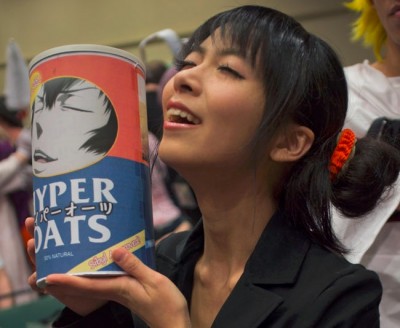
From Sakuracon 2013

In a lot of ways that’s where the magic happens in Maoyu. Simple but fundamentally revolutionary technological advances in agriculture can transform a world, bottom up. Actually the whole bottom-up approach to change is almost heart-warming to see. People no longer starve to death, and can thus spend more time engaging in education, civics, arts and trade. It’s the key formula to prosperity and the starting point of today’s socio-economic baseline.

How Maoyu paints this pretty image is done with a lot of magic, in the literal sense. Maybe that’s well and good. The cover that Maoyu’s magic flies under is that traditional sword and sorcery don’t cure societal ills–those things give a man a fish, but don’t teach him how to fish. The transformation of worlds in Maoyu gets a barometric representation in the life of the Big Sister Maid, who had to start learning from the point that she doesn’t know that she doesn’t know. It’s a convenient way to show us what society needs next.

This is where I kind of wish the story takes a turn and Maid Ane gets romantically hitched or something, in order to illustrate how complicated the sort of socio-economic changes just the Southern Kingdom has to go through to get to where it is at the end of the TV series.

I say this because in a lot of ways, from hindsight, Maoyu is too fantastic. It’s as smooth as the illusion of solutionism but framed in the fantasy of a nonexistent history. Of course it makes sense and everything works–because it’s built from the ground up by reverse engineering popular nerd hypotheticals. That is partly why I think Maoyu is brilliant otaku entertainment.  But mankind’s history is not some neat and bootstrapped magical adventure. Watching Maoyu do the magic pill to solve the problem of “third worlds” feels like it simply fails to tackle all the hard issues, and instead only go for the things nerds are comfortable in talking about.

It’s the things like how open-minded other educated elites in the human worlds are, or that the winter king (and his son) happens to be “good guys.” Or how the role of churches in Maoyu is barely a shadow of the role of churches in Europe during the 12th to 18th century. It’s all just too convenient.

My biggest pet peeve in this game is racism. I actually don’t blame Maoyu for basically sidestepping this issue, because I don’t really expect Japan to be able to handle it at any level of competence. What gets me is how people who actually think racism is a theme in the story. I mean, sure, it kind of is, but they never really deal with it. If there’s anything to take away from Maoyu about racism, is that it’s kind of the awkward, invisible gorilla in the room.

Anyway, being the solutionist nerd that I am, I quite enjoyed Maoyu. It’s definitely a feel-good piece. At the same time I feel it’s exactly the comfortable trap that too many people don’t realize that it can be. Maoyu is a fantasy in a post-modern sense, in every way. I just hope those who enjoy the show know that it’s all an illusion. You can’t have a story about potato revolutionizing the world without a great potato blight (and that’s your Psycho-Pass quiz answer). Just like how you can’t have a story about coffee changing the face of the world forever without talking about colonialism or fair trade or any of the subsequent issues. Until magic can turn villains into heroes, Maoyu’s application to reality is largely novel and questionably practical, much like how the Demon King … stopped being one.
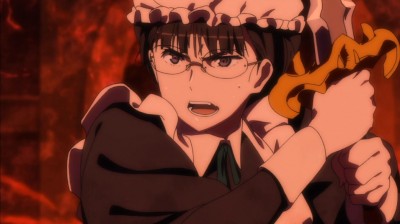
Chief Maid is awesome!

PS. When I saw this scene in Maoyu 11, I felt like the two kids at the end of every Space Bros episode: Kakkoiiiii!

Tamako Market

In a nutshell, it’s two things.

mame_daifuku_pacman

and

Wikipedia

To be fair, it’s also a pretty enjoyable anime about the way of life in a tightly-knit community. It’s also about the adventure of a strange, talking bird. I’m not sure if any of those take away the feeling to crave mame daifuku after watching Tamako and her family crank them out like prideful craft-masters doing what they’ve been doing all their lives.

Tamako Market is also one of those weird things where there’s very little to say the more you include in it. It’s more a microscope into the very small lives of a girl and the people around her. It’s easier for me to talk about episode 9 than episodes one to twelve.

It’s weird, because I can’t say the writing was bad; in fact the writing was excellent. Maybe the concept was just so pedestrian? Was it just managing expectations? Was it yet another example of how Kyoani fails to handle itself despite the source material? Well, it was enjoyable and a good time.

If I had to describe Tamako Market with an inept metaphor, it would be a microscope. It’s one thing to read about Kyoto and see it in an anime, it’s another to live there, to experience the moment. With a show like Tamako Market, it blows up the everyday and put things into perspective as if you were a plucky 16yo mochi maker. Suddenly, you can believe that 7 gods reside in each grain of rice, or that birds can very well talk when sufficiently exotic. Or how hanging out in a quaint espresso bar upstairs across the street make you realize just how everything really is. It is True Tourism IMO, in that it is more real than you being actually there: hyperreality.

By the way, so they do make these in the States. Now just need to figure out how to get a box of these…


Shinsekai Yori Is What It Means to Be Human

[First half of this post will have no real spoilers, but I want to make a point to explain the first half of this post using spoilers, so please watch the bold text indicating so if you are sensitive to it.]

For me, making sense of Shinsekai Yori is a lot of fun. It is the second most enjoyable thing to do with the show, second to enjoying the show’s kuuki-kei take on a twisted, science fictional setting. I think without a doubt the setting to Shinsekai Yori is far and beyond the most awe-inspiring thing in there, simply via its far-eastern marriage of cultural sensibilities, aesthetics and the things that made it warm and humane. Underneath all of that is still this ruthless, cold and calculating pessimism which drives the story forward, similar to most big concept, high science fiction story.

The problems to Shin Sekai Yori, like its strengths, appeared almost immediately as well. The first 4 episodes to the show were some of the most tedious that I had to slog through back in Autumn 2012. The production values were good, but nothing special. What perhaps kept things rolling was the unique art design (best summed by the first ED) and the story promises to be “my bag” so I stuck with it to at least the first major reveal, piercing through the facades that covered the eyes of the then-young protagonists and the viewers alike. From that point on, my imagination took over, less so the characters in the show.

But as we slowly unravel the pieces to the eventual climatic moments across two major time jumps, punctuated by moments of suspense as the kids kept getting into trouble with bakenezumi, it all feels like a chore. The story and plot largely focused on the intercharacter relationship between Saki and everyone around her, as to make a point. And it wasn’t until the very end of the last episode that this point has been pointed out, making a good two-thirds of the show a real bore.

I mean, it was just a pattern of: school, kids, school, people go somewhere, darkness and bakenezumi for a couple episodes, people go home, time skip, repeat. Maybe it makes sense from the POV of the adaptation manuscript, because it was from a book and what have you (well, maybe light novel also fits, in the classic sense of the term) and it can all build up to some pretty cool end-game. But when it’s a TV serialized animation, one episode a week, it’s really hard to do it with 25 episodes while still keeping people’s attention intact.

Some of the high praises of the show are rightfully due, and to its credit the TV animation did a pretty good job getting the messages and themes of the book across to a foreign audience. If I was going to ignore the fact that it was kind of a chore to watch this show until the final arc, I would rate it pretty highly. I suppose unlike Simoun, I guess Shin Sekai Yori’s world all makes sense, and that holds everything together. After all I don’t know how people would react to the character drama. It’s no K-ON for sure, but then again, it’s not K-ON.

While I think the sensible way to look at this show is from a kuuki-kei perspective, people who like this show are most definitely who like heavy and plot-driven crap, who can put up with Mamoru being Mamoru or Maria being a tease or all the gay sexorz. Or maybe not? I’m not sure. Take my opinion with a grain of salt, as you probably already do.

Spoilers.

Tomiko "the cat lady"

Continue reading


Execution Gets Me to Rise to My Feet: Girls und Panzer

There is a spectrum of concept to execution in where on one extreme, we have shows like Robotics;Notes, where it is a very high concept story about robot, how we perceive reality, and how that connects us as a community. On the other end, there’s Girls und Panzer.

Girls und Panzer is not a high concept anime, at least per se. (I mentioned the meta before.) The whole story is about a future/parallel world where competitive tank battles are a varsity sport for high schoolers. It’s not the normal garden variety of tank battle that we witness in, say, WW2 films, but a modified, athletic sport closer to modern kendo than the bloody sword arts practiced by Japan’s dead swordsmen in its violent history. In the same way, the practice tankery (or whatever you prefer to call it) has limits to the age of the tanks, the technology deployed, the tactics allowed, and that whole nine yards to make it something of a competitive sport.

The narrative vehicle is about a lonely girl who makes friends while practicing this sport. Girls und Panzer takes on the shell of a “Go To Koshien” story when the first-time tank battle club members must find themselves to the top in a local tournament, fending off better equipped, better trained rivals, including our lead girl’s former school, lead by her older sister. Everything was on the line as Miho and her new-found friends triumph while championing heart-warming themes like friendship, self-sacrifice, steadfastness, keeping a cool nerve and other various leadership qualities.

With a line like that, when executed well, any story will get most people up on their feet for a standing ovation. And in the case of Girls und Panzer, well, that’s exactly what happened.

That’s actually not even half of the story to Girls und Panzer’s commercial success or strangely far-fetching popularity. It’s not the only reason why I enjoyed the hell out of that quirky anime. But it’s probably the one true reason behind its popularity, and how it’s so accessible even to people who are just curiously interested in either the late-night anime format, interested in competitive sports, or interested in WW2-era military hardware. I think it’s the same phenomenon behind Strike Witches and Saki–“otaku” is a very diverse group and most aren’t into any specific niche, be it the military or mahjong, but somehow they become compatible pack-ins, respectively. [I mean, there’s an engaging Karuta anime currently on the air, let’s set the bar here.]

Of course, good execution itself is a very broad tag. The music, the art direction, the direction, the choices in the pacing and writing, and of course, a lot of the details behind the production all had to line up. While the production is solid, if nothing outstandingly remarkable, on the flip side Girls und Panzer had a major broadcast delay due to the production slipping schedule for various reasons. But maybe that didn’t harm the series nearly as much.

The 2 delay-induced recap episodes might have helped–to stretch out the series without diffusing the tension that the plot as built. In the recaps we revisited Miho and her friends, and while the cast of character steadily ballooned, the repeat viewings and clips somewhat helped to mitigate our short attention spans. By putting the show on hold for its finale, the series also gave the fandom time to drum up interest and anticipation, giving cautions fans an opportunity to catch up and celebrate its finale with everyone. It’s a little Madoka-like, this positive feedback loop.

I'll never see anglerfish the same way again

Still, credits is due where it is due. In the end, Girls und Panzer gave us exactly what was advertised in the OP:

踏み出した空に 走っていく光
一番先へ 目覚めるスピードで
破れそうな鼓動 連れていくんだ
もっと強い 可能\性になれ
Rise to my feet!!

I realized that the show worked when, at the finale, I was pulling for Usagi Team/Team Rabbit. It was a short 12 episodes but it sure did a whole lot.


Boomslank Tees

The guys at Boomslank sent me a couple shirts for review. I don’t do product reviews outside of Jtor because it’s just not something I’m comfortable in doing, but these guys have been on my mind over the past year so when they cold emailed me about it, I figured why not. Call it a delayed favor, because these are the guys I referenced to back in this post (all the way at the end).

I think I first saw their wares in the flesh at Animazement last year. They’ve been sending out some PR-type things and as always they have some pretty striking artwork. Original anime-style apparels is a tough market with a hard sell. Most people who wear that stuff tend to go for the references (which I have a mixed feeling about re: the J-List category of unlicensed clever shirts) and the official licensed goods tend to be kind of, well, boring. (Unless you are Cospa, which then you don’t make any shirts bigger than a L and would cost you $50 a pop.) But maybe that’s what nerds want.

On the other end of the spectrum we have your usual catalog of wearable memes and the stuff you find at shirt.woot.com or Threadless. It passes for either super nerdy or somehow mainstream enough for normal people, and everything in between.

Boomslank

From what I can tell, Boomslank is trying to marry the two.

It’s hard to say if this stuff is fashionable. I think it makes sense in my mind, but I am no trend-setter. Maybe more like a risk-insensitive trend-detector? I’m not sure. But it’s the closest you can get pixiv-style ink spoiled on your shirt short of actual pixiv-style artwork on your shirt. Think vania600’s impeccable landscapes, but toned down so your dryer won’t destroy it after one wash.

Oh, wait, there are no trains. You know what you need to do next, Boomslank guys.

And that kind of sums up my issue with Boomslank’s offerings too. On paper all the artwork you see on their store fit the design profile of stuff I would want to own and even wear. But they all lack just that little something to push it over that I’d fork out the $25-30 to buy. Maybe it needs to be more cheeky, in the case of “Flag” (which is one of the samples they sent me). It’s a nice image but not at all remarkable beyond “cool graphics tee,” at a glance. I guess that’s nice if it’s what you’re going for, but there’s more you can do in terms of the layout to showcase the clever details on it. (For example, it would be pretty neat if they sold 2 companion shirts from the angles of the two characters from the back.)

the shirts have been worn a couple cycles, but the note cards have not

Another example, the “Carwash” one, well, could look just as cool with a bullet train, and it would… anyway. I mean, it’s a slick piece of art and a great idea as is but it lacks that one slant that makes it really stand out. Maybe if it was a retro prop aircraft with high-tech hoses attached to it? The other tee I have for review is the “Soundflow” image which is not listed on their website; it comes printed with the key graphics on an offset, where you see the anime-style girl bust-and-up image from the bottom of the shirt. The headphones are a major plus. Unfortunately given how you have to wear it properly for the full effect, I can’t really quite pull it off during the period I had to test-drive the tee (winter is…cold), so I’ll reserve my judgment on this. I might still have a pair of baggy jeans somewhere (yea it’s not quite my style). I guess I rarely have to cosplay as a homie from the 90s. In retrospect I probably should’ve shot some more photos when I first got them, whoops.

As far as the bread & butter aspect of t-shirts, these Boomslank shirts are cotton, unisex Fine Jersey short sleeves tees (I guess that’s American Apparel’s?) and they’re of good quality and comfort. It looks comfortably worn after 2 dryer cycles. I like it, it’s on the thick side but not too thick. Each of the shirts came with a postcard with the illustration and name on it, so you know what it is. I guess it’s good to note that what they offer on the online store is just a section of their total offering, such as XXL shirts for certain items (at least I can’t find it on their store). One real important thing about these shirts is that they’re really colorful and vibrant looking, so I probably won’t even recommend using a dryer if you want to really maintain the color accuracy on these. Keep them fizz free guys–always wash your printed tees inside out, etc. For a couple of these, like “Gate Keeper“, you might want to wash/dry it especially careful–it’s super colorful for something that isn’t custom made.

(Test notes: I wore the 2 shirts, each at a time (lol) for a whole day at a time, over the course of about 2 laundry cycles. Just in my routines on weekends when I’m out and about doing stuff. Of course being sub-freezing half the time makes testing the T-shirts in public rather difficult but it’s showing when I go indoors, usually. The shirts go through my usual wash routine–nothing fancy, just liquid detergent–after each use. )

I think my favorites are the two flying fish ones, although only “Pieces” is available as a shirt, where as the other, flying-with-Cenco “Blue Serengeti“ is just a print. But it’s always the kind of question where you have to ask yourself, “Do I really want to wear a flying aquarium?” At least, major props to Boomslank for offering phone cases for the Samsung GS3, a welcome break from the iPhone dominated marketplace for graphic phone cases (and they have those too, and for other iProducts). It’s that kind of stuff that will be necessary to push P-shinobi’s guys over the verge of being something worth my monies.