Category Archives: Modern Visual Culture

Magi, Little Busters, Zetsuen no Tempest, Jojo

Thanks to killing aliens, tiresome anime cons, and a need for change, I’m probably going to drop the number of anime I’m following below 20 for the first time in a long time. Oh, you can also blame on Sket Dance ending.

There are three shows I’m kind of interested and a little impressed after one episode, and one show I’m actually really impressed. Can you guess which one?

As a total aside, the fact that we have Kyoto Animation fielding (in their usual straight-faced, laces-out way) a production about chuunibyou, it kind of ruins the way I see all the other dime-a-dozen stories with shounen dream-fuel. I mean, when I watched Psycho-Pass, I am just not impressed (at least, no more impressed than hearing Ling Tosite Sigure in an anime). I hate to say it but Ghost in the Shell? That was much better and highly more preferable, and not because of story or concept reasons. I think at core, otaku enjoy cyberpunk over, say, the endless regurgitated, finely-honed art of Japanese murder/crime mysteries. The methodocal and measured cinematography that comes with no rough spots (except spurts of gore I guess) leads me to believe it takes itself too seriously.

Too seriously is, in a nutshell, the bubble of chuunibyou. But I believe most otaku would rather ask “Y SO SRS,” at least ones overseas.

So, yes, this is why I think Zetsuen no Tempest is impressive–because it has that patented Ando pilot-episode juice and Bones-quality production. Remember Xam’d? This is almost that exciting. I have to admit though it kind of helps to be a fan of David Production’s Book of Bantorra, because the way they throw their setting-building babble around (re: bubble of chuunibyou) is almost the same. I think this is why that show hasn’t been so warmly received.

Speaking of David Pro, isn’t Jojo something? I don’t know why I don’t like to admit it, and I don’t, but I really enjoyed Jojo’s Bizarre Adventure (Phantom Blood). There’s just something really suitably cartoon-y about every David Production work that I really enjoy. And I’m not even a fan of the original material. I suspect this is why I watch so much crap, and have this nagging desire to finish Koichoco and Campione (as low as the odds of that may be). But it’s a lot of fun.

The whole hubbub about Little Busters is tiresome. I get it. I was into Key crap even back in the late 90s. But something is wrong when I’m happy that Kyoto Animation didn’t get to do this, so I wouldn’t have to hear about people wetting their pants about Little Busters both ways. I guess that is definitely more my problem than anyone else’s. Certain the anime looked just fine and hopefully there will be nothing to worry about. Thanks to meeting Tamiyasu at AX, I’m also slightly predisposed to like Rin, so that helps, however much little.

I think I came into Magi predisposed to like it, because, well, it’s the anime adaptation of a manga that adopted the general story to One Thousand and One Nights. How can I dislike it? My very first blue M:TG decks got djinns out the buttholes! I have to like it, right? It also helps that show is, as we know, not so serious. After seeing the first episode, I still kind of like it, but I learned quickly how I can dislike it. Not that I do, but I can see the intersection where the cookie cutter meets the characterization and plot dough. Still, I remain positive…

Conclusion: A large part of my reaction to this season’s offering comes by the way of predisposed expectations and having your opinion influence mine. Not sure if that is good or bad, but I suppose that’s just how the dice roll. But we all know that, right?


In Re: Fan vs. Industry

Over on Twitter, this question was asked and at the time I felt like I wanted to give an answer. I think it might not be the smartest of things but given that I’ve been killing aliens in my spare time and thus running on fumes in terms of Z’s, I made some sense at least.

In short, it’s kind of naive. Mainly because for the longest time, the industry was fans. Things like Otaku no Video exists for a reason. The nature of otaku-targeted anime is extremely cyclic–between fans and creators–and it runs on short cycles. Only a few years ago we just started talking about Chuunibyou (the term was coined not even 5 years ago if I recall correctly) and there’s already an anime where that is the subject today. There are countless examples where creators take notice of what others have created and create something in response, in spirit of someone who appreciates that body of work.

That extends to the industry. Just to focus on the US scene (as it was my context) in this post, the original “industry” here were all because they were fans. Enterprising folks, they were, and there were enterprising Japanese folks who worked in the same, but the scene only exist because we were all fans. And this goes from all aspects of the industry–from people who run cons to people who runs Rightstuf to the dude who remastered Macross. So I think it’s sort of the fundamental baseline we have to work from.

Of course, the history lesson is not common knowledge. People who download anime just so they watch it probably could care less. Still, they are as much of a part of the dialog about industry and fandom as even the biggest fan who is now working for FUNimation or whatever. Or at least, in a perfectly democratic dialog where people value opinions on the basis of their merits, that should be the case.

And I’ve implied to this already: it’s easy to know what fans want. We’ve been serving it to ourselves for the longest time. Just ask some huge fans and big-time consumers what they want–these people are the greediest, lack of a better word–they want the most. And of course, ask the masses of people who don’t really want very much, the types that are only watching a show a season (if that). Because even as hardcore fans, we value their opinions–lest we be unnecessarily elitist. I think a key aspect of dialog between fan and industry is to recognize this–we don’t want to exclude anyone, unless, you know, they are not doing it on good faith.

So how do you tell if they’re doing it on good faith? Because we’ve been doing it already. And this goes beyond free, 0-day (simulcasts that are…simulcasts), subs (perhaps multiple varieties), dubs for later, Blu-ray and DVD, streaming and DTO, and playable on phones and tablets, and home theater extensions (HTPC, Xbox/PS3, Roku/Apple TV etc). We also want merch. Like a Daru figure to go with this Part-time Soldier from Alter. Cospa T-shirts in American sizes (this is why I’m fat) that is less than $40. And paying less than $10 per month for all my anime streaming needs. I’m sure you can add to this list.

Well that is probably just the starting point but you can see it’s easy to list a bunch of very difficult things to achieve. Some might even be impossible, but I’m an optimist. Some, on the other hand, are easy. And to be fair if you dig deep into a lot of these demands, they aren’t so impossible on the surface.

Truth is, if people come into this sort of dialog with good faith, telling the fans how it is, they will understand how it is. To me, words like “support the creator” are just code for words they’re too embarassed to talk about: this stuff cost money and it has to come from somewhere. And it’s the diplomatic thing to say. I think we all realize some money needs to go to the people providing the service, if we’re going to hold them to some kind of standard. Of course, the tradeoff is that the vendors have to stick to some kind of standard and deliver some kind of value against the ever-extending wishlist we all have.

At the same time, I think fans can obviously go overboard and make life miserable for those industry folks who do extend a welcoming hand to people who have honest opinions about the stuff they love. Lots of abuse have flew in the fansub argument or the dub/sub argument. I think it’s all kind of dumb, and perhaps even counterproductive. Actually, the whole Crunchyroll thing has been really counterproductive, but that one is a particularly difficult nut to crack and understand.

Well, that’s not so important in the big picture. To look at it differently, think about the role Crunchyroll has posited itself among people who do watch legit simulcasts. Why would anyone wish that CR simulcasted everything? It’s simple: CR has the best delivery system out of everyone by a long stretch. Its prices are fair and for the most part people have a good experience with them. But this is also a major testament to how they have changed the way people think and how their business model (compete with piracy) has really gotten them somewhere.

And it’s in the space of our collective wishlists that companies (anime or otherwise) have to exert themselves. Five years ago nobody would’ve wished that they can watch all their new shows on Crunchyroll, but people still wanted “0-day fansubs” today as much as they did back then. There are plenty of people who would buy their anime because FUNimation is releasing it, versus Sentai or Media Blaster or whoever, because they trust and like the brand and the way they localize things. In my mind, it’s exactly in those areas where industry has to be, either by words or by action (probably both) in order to add value to our self-sufficient fandom.

TL;DR: fans need to respect the industry’s value. Industry need to respect fandom’s resourcefulness to be self-sufficient. This is the motivation. If your motives are not encompassing or compatible, well, best of luck.

It’s better to think of it as opportunities than some kind of obligation, as there were fans long before there was the R1 industry. Typically demand exists before supply; mother of invention is you-can-fill-in-the-blank. Fans and industry are oddly and ironically, not beholden to each other, but are independently better off if they work together. If your company’s profile does not fit as an entity who adds value to fandom and rather as some kind of gatekeeper to what people want, then you shouldn’t expect people to like you, and you probably should expect your revenue stream to be, as Jeff Bezos would say, disrupted. Maybe it’ll take decades, maybe it’ll take months, but it’ll happen.

So, actually, yes, it doesn’t take a genius to know what fans want. It takes a lot more than a genius to know what fans don’t even know what they want, and bring it to them.


Tari Tari

To me, Tari Tari is not a finished experience. Some people who really enjoyed it might prefer to have it keep going and slowly savor it. Similarly, I can’t put it away until I rewatch the show from the beginning. There are a lot of little things, here and there, that I still haven’t made sense of. As I try to write this post I find myself lacking the language to express it, and I haven’t seen any other reviews or posts on Tari Tari that satisfies.

For example, fans early on already caught on the name well before the anime even aired. The name “Tari Tari,” in the promo shots, are spelled out using English alphabet. It’s kind of a play on True Tears (which was also spelled out similarly). The episode 1 homage to Reflectia makes it even a stronger case. I mention this, because, did you realize one of the five main characters also share the same T-T moniker? And what was his role in the story? If you think Anohana’s referential web is a trout, maybe TT’s “hidden dragon” approach might be more to your liking.

I hate to bang on this sort of thing but the typical review, picking on Fandompost for example, does that bat-for-averages impression. That’s a solid but fundamentally inadequate way to evaluate Tari Tari, because it doesn’t tease out any of the in-your-face aspects that makes the show attractive via its marketing. It’s like making red wine versus white wine. On the other hand I guess well-filtered opinion is exactly what people are looking for, but that’s not what I‘m looking for.

The funny thing is, I mostly agree with the consensus that Tari Tari is average for its appeal to the average anime viewer. Rather, this is an anime that is very targeted; it’s out with its calling card right from the beginning, and delivers a tactical payload that is proverbially hit or miss, because, well, it’s so targeted. At its core, Tari Tari is a kuuki-kei anime that, like True Tears, exploits using the virtues of emotional warmth. It’s iyashikei; the Manabi Straight-esqe plot towards the end is almost a no-brainer up-lifter, if at least in form. But it’s different in that Tari Tari does everything it does by being itself, and not by being some kind of messy emotional wank material. It, too, is somewhat of a self-contradiction where people would find things they don’t expect to see in there. To some extent, it’s the next step from Hanasaku Iroha–a story that walks the well-established path of dramatic pathos but with a few screws loose. For Tari Tari, it’s busting out the machetes and forging a new path entirely. It does not feel like live action acting; it feels closer to real life.

Tari Tari, like its name sake, is also all over the place. If you come into the show looking for drama along the lines of that Noe-Hiromi triangle, you won’t really find it. It’s not even really about freedom, rebelling, and standing up for yourself and what is right, even if that is a part of the story. In fact, who is the main character? Wakana, right? Just because Ayahime gets top billing? To use Dai Sato’s language again, it’s like a sekai-kei anime that isn’t exactly about relationships.

I think Tari Tari is very noteworthy on that alone: this is a show that defies a bunch of genre conventions. Perhaps that’s why it’s all over the place. The first two episode spanned almost as much time chronologically as the rest of the series. There is not much of a “rail” to guide viewers besides the chronology of Shirosai and the Choir Club & Sometimes Badminton Club’s activities. The characters came at us as they are, and introspection, like those cold lead-ins, hangs in the ether, contextualized only by the ongoing and concurrent dramatic focus. Despite the Power-Ranger-esque distribution of plot and screen time, Wien, Tanaka and Konatsu never get to really shine. Here you are–the leader of the club isn’t even the main character. The last time I enjoyed a show where the leader is not the main character was probably K-ON–if we can admit there is a main character (Yui?) at all. But Tari Tari is even more off-balanced than K-ON. I’m not sure if it is a bad thing, but it certainly seems confusing for some people.

Thankfully, that off-balance nature makes Tari Tari kind of fun to watch. It’s definitely a mood-lifting experience, both for its solid dramatic filling (namely, Wakana’s story) and its butt-slap-tastic antics. Do we really have anything to say in the face of this? Will anyone’s argument work?

The way the three girls made fun of their male club members is both endearing and amusing. It’s easily one of the best part of the show. Sawa’s plight was pretty amusing, once we get past the forced drama. The singing and dancing was a lot of fun in the meta sense in how they held back Ayahime completely until that moment of clarity in Wakana’s life.

TL;DR: It’s easy to call Tari Tari boring because it’s hard to get in to, but for some of us we were in since even before the series started. But even if you weren’t, you could do much worse in the high school drama anime category.

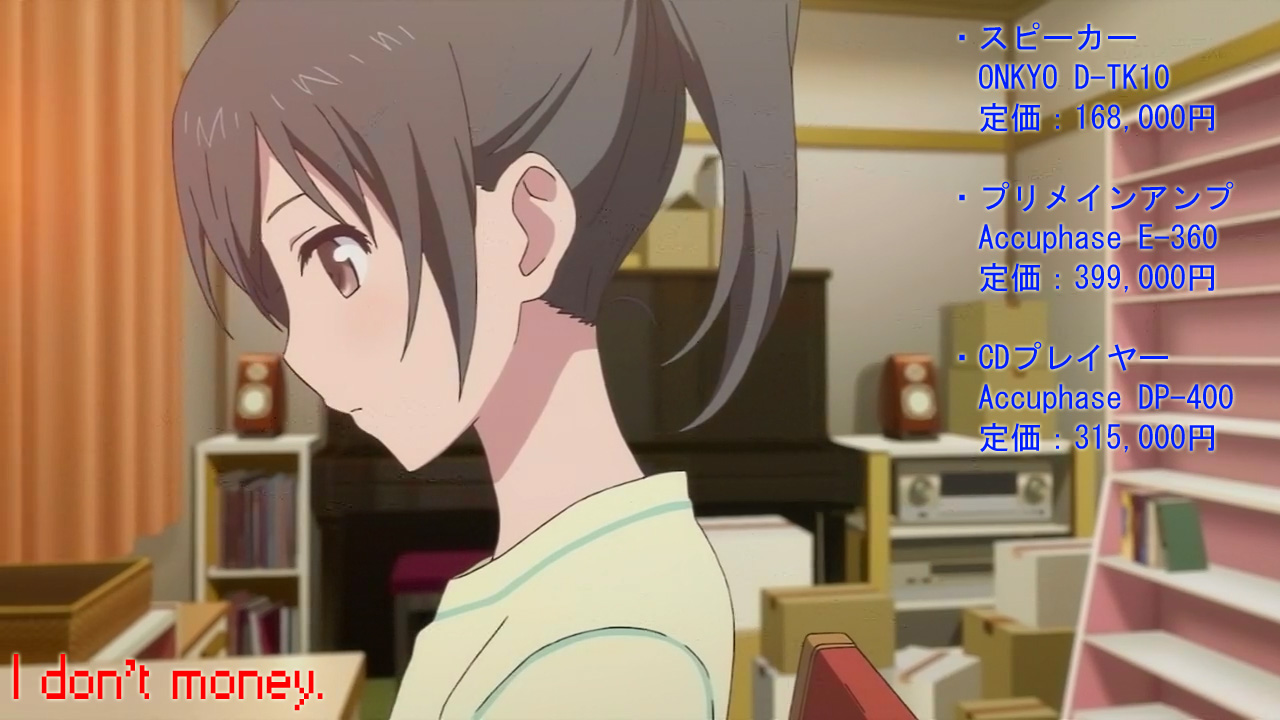
I like to think of  Tari Tari, at least at this point, as a second-hand, expensive piece of audiophile equipment–full of plugs and holes and hooks and missing the manual. All this stuff probably fits somehow, but it’ll take at least another go-through to figure it out.

PS. Are we suppose to fault a show that is “all over the place” because it’s “tari tari”? Next time I try to thought dump on this topic I will probably talk about its formula for what I perceive as life-likedness.


Production IG Kickstarter Offers a Glimpse of What?

Kickstarter is not a thing hidden in some corner of the universe. It’s a major deal, reported in the news worldwide. It was just a matter of time that fine arts project like Japanese animation ends up on one, and a full-blown legit sort of deal. For Masaaki Yuasa’s kickstarter, I think this write-up sums up the general feelings I have for it. But it’s more than just that.

Of course, being the first of its kind, Yuasa’s kickstarter just a high art short film from the acclaimed animator/director. The attempt at the KS is fairly elementary and lacks the sophistication that well-gamed Kickstarts do to back-load backer incentives and incremental updates that encourage people to tell people to back the project. Its conservative Japanese-ness pervades the endeavor. Its “low risk” assessment lends it an air that makes me feel that they would probably bankrolled this anyway, sooner or later.

But that sells shorts of the potential of an anime kickstarter. It’s one thing to say “patronage” but ultimately what Kickstarter (the organization) worries about is turning into a retail outlet, an empty marketing machine on the inside. That’s kind of the mode of backing for most of us, but that concern is a non-factor when it comes to kickstarting anime projects like this…because it is the point. We can talk about risk shifting, but that is besides the point; all established Japanese companies are serious about their customers. It’s more about the interface. Typically, the biggest thing about Kickstarter is giving creators a direct connection to fans and consumers, often around the publisher or distributor. We see a lot of this in the indie game scene (electronic and tabletop (especially tabletop)). But I don’t think anyone thinks it is not Production IG behind Yuasa’s kickstarter, even if they wisely let Yuasa take the spotlight. At least, the copyright notices on the promo images say as much.

The fact that Kickstarter provides an existing framework to allow a worldwide audience to be involved in Yuasa’s project, or any future project, (as an aside, Kickstarter requires a US individual/corporation to process its payments, so IG’s international reach does matter) is what makes Kickstarter valuable to anime, as I see it. That it’s a sliver of light through the muddy cracks of anime’s marketing problem overseas, is how oversea fans can value a Kickstarter anime project. They don’t have to reach around regional licensees at all–this is straight through the magic of the internet, and it’s not some half-baked Japanese attempt at web 2.0, thanks to KS’s hard work. It’s win-win for both us and for them. Kickstarter is an extremely low-cost way to gauge interest, to pitch a marketing spiel without ruffing the wrong feathers (much). It also taps into that highfalutin arthouse market that Japanese anime always had a hand in, in a much more direct way. That’s right, French in the Kickstarter page. (…And before Japanese was put on it.) It gives IG the control to sell as little of it as it can, to market it as weirdly as it can, and not worry about how popular an idea would be to a non-existent mass market–not like anyone would anyways.

Of course, like all art kickstarters, the value proposition is suspect. But at least it’s spelled out here for you. For most of us the mode of consumption for anime video purchases involves first watching the thing, to determine if we like to buy it or not. You get none of that here. Rather than the Sins of A Solar Copyright Empire on our backs as a motivation to “support the industry” we can just, well, support the industry by giving the creators we like money straight up (after KS takes their cuts). But in this case, we don’t get anything (yet).

The unfortunate reality behind anime produced by production companies is not some secret. So if you’re like Dave or Daryl you’re all set. But me? It’s more complicated.

My problem is more about the content. Let me use a concurrent example. There’s this popular Kickstarter going on right now called Project Eternity, which is an isometric PC RPG along the lines of Neverwinter Night, Temple of Elemental Evil, Baulder’s Gate, and Icewind Dale–from some of the same creators, no less. Fundamentally I enjoy these types of games so I backed it. Their reason was that they wanted to make another one of these isometric games, but they couldn’t find a publisher to back them as it is a “dated” sort of game dynamic, so they’re going to Kickstarter. [As an aside, this is kind of a hard-to-swallow reason given how the Firaxis XCOM reboot is.] On day one, the kickstarter had this early bird thing for $20, which is well within how much I want to spend on a game like this, so I was in from the beginning. But as the Kickstarter gain steam (it’s one of the top grossing live Kickstarters right now) they begin to release more info, and the more I read about it the less I like it. To put it to perspective, I really enjoyed the first BG game, and TOEE. Those are my sort of things. I kind of enjoyed Iecwind Dale but after a while it was a pretty dreadful experience because it is repetitive and while it gets slowly more difficult, the difficulty comes more as a test of patience rather than skill or intelligence. And quite frankly I’ve had enough after IWD1. NWN is another series of game that I managed to beat but hated it pretty much all the way, until the 2nd expansion (the first wasn’t a lot better) in which it finally got fun. But by the time NWN2 came out I had already lost any interest in “more of the same.” Of course, what I want is not far from what we all want: another Planescape Torment. And there is zilch coming out of Project Eternity’s teasers that say anything to the extent that they’ll make a game along those lines. If anything, they’re setting things up in the opposite direction.

In the very same way, the more I read about Kick Heart, the more weirded out (okay, delightfully weirded out) I am. I think it’ll be a fun little short to watch, maybe even own (disclosure: I backed the $30 tier). But this is not where I would put my money, compared to, say, a Kaiba localization Kickstarter, where I would offer up a lot more–because it is actually valuable. The bottom line is, Yuasa & Prodution IG still has to earn it by delivering something that has an appropriate value, not just by trying to do something new and perhaps improving the status quo of anime marketing and funding. Like “selling” us a possibly Japanese-produced Blu-ray disc of something (they are), or giving us a chance to have dinner with Mamoru Oshii. That’s value. And because they’re doing stuff like this I think this Kick Heart Kickstarter will really go places.

I guess the Kick Heart Kickstarter is a really a glimpse of meta.


Oh the Humanity

I sort of dispute SDS’s claim that this anime is unique. I think the undercurrent that Jintai rides on is no rarer than the sort of jokes you find in Kometa’s manga adaptations or even in Welcome to the NHK. To wit, after 3 seasons of SZS and now with Joshiraku running along, Jinrui wa Suitai Shimashita is not some sore thumb standing out in a sea of not-satires. One of my favorite anime adaptation of satire comes alive in season 2 of Seitokai no Ichizon, so this is not something that I would call a rare occurance, at any rate.

What makes Jintai unique, I think, has more to do with the straightforward western style of satire that you find in contemporary British literature. Dry wit, satire as fine as piano wires that cut just as deep; or something resembling the opposite spectrum, like a large aquatic animal. Or bread, in this case. But this made-in-Japan slash, I think, cuts so finely that so many probably don’t quite realize that they’ve been made fun of in the very show they enjoy to watch. To me, it’s very fun because the show portraits exactly what I am thinking of, which is a great testament of the way the story is adopted and written. I mean, it’s less ham-handed than me saying “hey guys, great minds think alike.”

But also along this line of thought, this is why I think there are people who watch Jintai for the fairies, just like there are people who watch Joshiraku for the cute girls. It captures well that spirit of decontexualized otaku thing that, indeed, leads to our decline. It is no surprise that bullying and how the protagonist and her cohort retreat to their own little project in which makes up a relatively mainstream response to the cruelty of human societies and ills that has plagued us since time immortal, even if it means resorting to becoming the queen of fairies.

Lastly, we do have to look at ourselves. Just how meta is it to enjoy escapism via media that is about escapism through critiques of escapist media using media? Can I say I enjoyed Jintai for Mai Nakahara’s resurgence? At first I thought the role was relatively straightforward and narrator-like. I did not expect the role of the protagonist to show enough of a range, from earnest deadpan, slightly vulnerable, to coyly manipulating and mildly annoyed. It’s safe to say this model seiyuu elevator school graduate passed with flying colors.