To make up my inability to understand Japanese, hopefully, watching the same film five times (well, more like four and change, because I kind of walked out of the fifth one because I had to be somewhere) hopefully will mitigate some of it. In reality there are a lot of theme and plot hooks that a better understanding of the language will shed light more immediately, but I guess there’s something to be said of a film that generally lines up with modern understanding of complexities in TV anime.
This is the spoiler-free version of the movie overview. It’s also one diluted with sufficient amount of distance–it was really hard to write this back when the memory was fresh. I was way, way too emotionally affected by the material to make any useful observation other than to describe what was happening to me. But that’s the trade-off. Someone just asked me recently about the order of certain scenes during a part of the movie and I can only confirm what corresponded to what I remembered, but not tell him what happened in the gap he forgot. Such is how it goes.
Then again, I still see the IM@S in everything even today so maybe this distance or somewhat more objective perspective means nothing anyways in those terms. It just helps me to write it in a way that isn’t 10000+ words because I can start with a perspective that’s easier to handle, and later on go on from there. [Don’t be surprised there’s a second post on this, that said.]
Anyway, the Idolm@ster feature film celebrates the series in the most meaningful way in that for those people who would honestly go “IM@S LIFE” it will upgrade from zero to one single hankie. The familiar message about overcoming self-doubt and finding encouragement in fellowship, and overcoming life obstacles together is always going to be moving when translated well. It’s stories like these that move us, the otaku. How much access we have to that source of never-ending FEELS simply depends on how deep you are in the IM@S fan pit, in this case.
I’ll save that stuff later, although that seems to be the things people always want to talk about…
Visually, the IM@S movie is all over the place. I mean that in a very basic way–it simply gives you a lot of different looks, and at times it’s enough to jar some people out of their suspension of belief. Depends on how you take your regular dose of cartoon, that might be a thing you like or a thing you dislike, but from a “looks per paid/obtained content” ratio perspective there’s a lot to it. It’s good value.
There’s also these 2 cuts where Haruka and Kana are animated like… different. Like Bahi JD different. I’m not sure who and how that came about, but that might be the biggest case where things look nicely but in a jarring way. It’s not like how I can nitpick endlessly on the way 3D animated backgrounds are composed beneath 2D character animation that makes the final concert scene a little janky too, but that’s a little farther along into the nitpickery than a legitimate concern. It’s just another perspective.

Other visual things…I really like a lot of the design elements in the movie, from the promo poster for the in-show live (which is sold as a separate thing at the theaters) to the way various Sony products are placed in the movie. It’s like everything I like about the TV anime, but better. I can go on here some more but it’s no fun without visual references.
My main criticism to the IM@S movie, perhaps slightly biased here, is that there’s too much of it. The movie can easily be shortened to about a buck and forty-five if they were a little more merciless in the editing room. The middle section drags a little, but that isn’t the problem–it’s the beginning of the middle and the post-resolution bits (before the main climax).
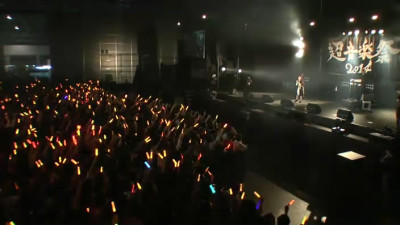
Actually, that’s the thing about this movie that is tough to talk about. In a way the movie feels “all over the place” because it’s kind of two things bounded together. On one end you have the “sparkling” side of things, with the film kicking off with that Nemurihime trailer that you will hear me talk about all the freaking time if you are in an earshot of me speaking about the movie. On the other side of the wire is the concert scene. There are some pretty exciting parts of the film that I would sit up for every time, too.
On the other end, you have this thoughtful, contemplative story about Haruka and Kana. Since I want to avoid spoilers as much as possible, I’m just going to say that when I was watching it the third time, I started to think about the Bible and how the true turning point of the Crucifixion story actually happened in the Garden of Gethsemane. The IM@S movie made it kind of obvious what was happening but it wouldn’t be obvious until you started to watch it with everything you know about Anim@s on the line. Admittedly that is more a handicap on my end because of the language processing issues I had to struggle with, but once I put it all together, the result was that now I have a definite favorite scene from the film.
To that end, let me share this piece of meta with you. Many of the popular Second Vision songs get some playtime in the movie. If you haven’t seen the film yet, play this game–look for the song Jibun Res@art in the movie. That song is pretty much the number one favorite (or second, depends on how you count The IDOLM@STER) among fans. One somewhat remarkable point on IM@S music is that a lot of the songs in the game is vaguely about the game, so this one kind of finds itself in a precious part of the film while others just… Well, I hope we can watch the film and talk more about it, when it gets that home video release.
In other words, it’s about the front-end and the back-end of the idol concept, where in IM@S it comes in terms of the video game concept. (Why are so many IM@S songs about idoling? That’s just way meta.) In episode one of Anim@s we were asked this question. Now we have just the Million Live version of the same answer, from the other side of the shininess.
[And that’s about 5-10% of the thoughts I have on the movie! You see how bad this is…]