This is a pinned/sticky post. It will be updated over time.
[Last update: Oct 11 2013 1800 EST, Sale is basically over~ Nobody got grabbags so uh.]
I’m selling some merch, mostly figures. Click for details!
The Yard Sale
This is a pinned/sticky post. It will be updated over time.
[Last update: Oct 11 2013 1800 EST, Sale is basically over~ Nobody got grabbags so uh.]
I’m selling some merch, mostly figures. Click for details!
It’s about a year since I began the journey through The Idol Master kingdom, where everyone is a producer and Columbia/Bamco makes $ hand over fist. I’m pretty content on the fact that I’ve spent more money on DLCs than on the game, or that I probably spent even more on figures. You wonder why I spend so much on figures? This is kind of why. Speaking of which, I’m working on a figures sale so hopefully I’ll post that stuff soon.
I posted a ranked list last year in my year-end writeups, so you can take a look here. Â So what has been the big changes since then? Seiyuu and music. I have to prop my friends for putting up with all this–both for me borrowing their stuff and subjecting them to bad game/anime idol pop. Overall, my opinion of iM@S music is still not overwhelmingly positive. A main driver to DLC purchases was exactly that many of these songs suck, and those that don’t wear out pretty fast, demanding infusion of new blood. I think my tolerance for them has improved over the past year, but it’s still something I listen to only because I want to laugh at it and to learn the voices, not so much because I like it for what it is. It also helps to get the desire to play the game out of my system, without having to spend the time to play it. Well, it’s entertaining either way.
PS. Seiyuu XCOM is in progress. Nothing really special to report besides that Classic mode is a multitude harder than Normal, which is just what I wanted (normal is way too easy). So far 8 excursions in, five slain voice actresses were recorded in the memorial (plus one from the very first mission that I didn’t get to rename). I decided to use female names for all of them, since it’s what rolls off my head the easiest and I didn’t want to use OnoD or Shiraishi Minoru multiple times. The highest ranked in the memorial is Sq. Yumi Hara with 4 kills, meeting her end when a floater rained death from above. On the opposite end, lowly Sumire Uesuka didn’t even take an alien with her when she got gunned down by a lucky crit on the third mission. On Operation Bloody Giant, the only one who got bloody (on the good guys’ side) was Rk. Hisako Kanemoto, while Rk. Aya Hisakawa and Sq. Aki Toyosaki both died in similar ways: inside a cloud of smoke. These damned smoke grenades must be defective. And I wouldn’t be surprised–Cpl. Yuu Asakawa was hurling them after all.
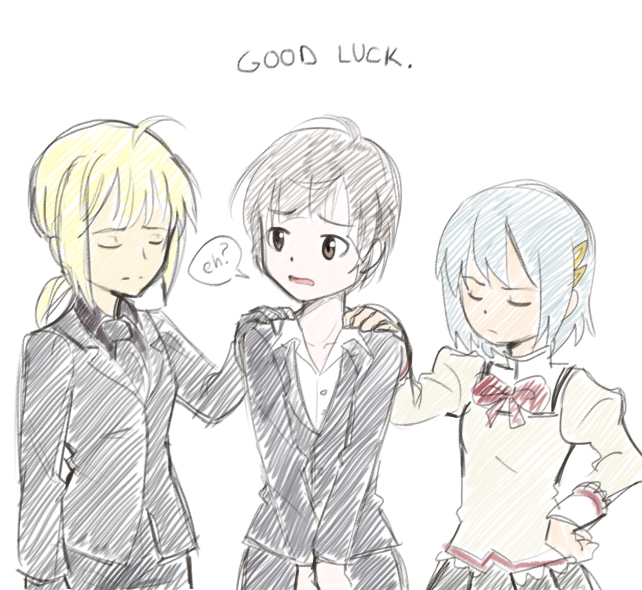
Having watched Madoka the movie after watching the TV series in 2011, can I just say that it’s basically the resonance of the faustian deal as depicted by an ideal, that makes Madoka Magica’s mark in the modern psyche? [Spoilers for the TV series and the first two movies, however light, may be present. Feel free to skip to the next set of bold words if you want to avoid it]
It’s the weird feeling when  you are watching a show and you can tell it is the conglomeration of many different things you’ve seen before. And I don’t even mean it’s some kind of database/trope crap. It’s like channel surfing onto a Tarantino movie and you get the nagging feeling in the back of your head, saying “this must be a Tarantino movie.” In this case, it’s Zetsuen no Tempest, and the feelings I get are Okada, Ando, and a billion other things.
Zetsuen no Tempest, or Blast of Tempest (or what I’d call, WHO IS CIVILIZATION BLASTER) is streaming on Crunchyroll. This shounen-style manga adaptation is tricky to describe, precisely because it is a manga adaptation, and I don’t know what to credit the original manga. I guess I could read it, but guh.
I want to point out Okada because, for some reason, Zetsuen’s brute-ish pace reminds me the way Book of Bantorra was, in terms of throwing you in the middle of a pretty big setting and just let you sink or swim. The style of the fantasy technology/setting is also similar in how it makes very little sense except internally. And I can only really point to Okada as the one link between the two. Well, a Sawashiro character casting spells and talking over long distances might do the trick too. (For that matter, when’s the last time a major character is introduced to the audience by popping out of a barrel?)
The first episode? The non-linear arrangement (Rahxephon, E7, etc)? The standout, melocholilc girls (Star Driver, E7, DTB)? Nana Mizuki as some operative-agent (DTB)? The duo-male leads right out of Soul Eater? Seriously? And that’s not all. I half-expect a bunch of wolf-people to show up in episode 4 and a Chinese mage who uses electrical power, riding on a giant killer wasp to show up towards the end.
Joking aside, it’s good to see Ando’s magic fully at work for this show. I really enjoy his pilot episodes and it is interesting to see it here clashing with the almost senseless arrangement that probably didn’t pique as much as interests as a bunch of half non-sequitors could, as far as figuring out WHO REALLY IS IMOUTO. As in, clearly, this dearly departed sister/girlfriend of theirs play an integral role in all of this, other than being a sad Hanazawa Kana character on the back of a bicycle.
Well, given this story is WHO KILLED IMOUTO so far, we’ll get answers to all this in good time. Maybe we can get a strong finish for once! Hey, at least we already know why “civilization blaster” (and it’s not because they’re big fans of XCOM from the maker of Civilization over at Firaxis). All I know is I enjoyed the first three episodes.
PS. This post is nowhere nearly as funny if you aren’t in on the Who is IMOUTO jokes, truly.
Sket Dance is the longest-running anime that I have been watching in the past year-plus. It’s finishing up just the past season, clocking in at 76 or so episodes. Through it, yet another Shonen Jump title gains a primetime anime adaptation, a band (voted on by popularity contests and auditions) was created as a tie-in. And the girl-guitarist is not only fine looking, she reminds me of the recently-wed Ryoko Shiraishi, who plays the role that the guitarist is suppose to represent.
It’s hardly a coincidence, but in order to talk about Sket Dance from the audience’s level of abstraction, I feel the need to talk about Gintama–a show that I have for the most part never really watched. A set of select episodes of Gintama is suppose to be on my watchlist, but I forget which ones… Anyway, Sket Dance in a lot of ways is viewed as a lesser version of Gintama, because it is also a very gag-centric, character-driven story where a stable ensemble cast runs a situational comedy circus. However, the sort of humor you get out of the two are kind of the two sides of the same awkward coin. You’re probably more one than the other. And if you like both, you probably like Sket Dance for its funny human stories rather than its sense of humor.
It’s a tough thing, because by most calculations, Sket Dance is not really a special show. It celebrates a sort of mediocrity in which is very self-serving: basically, just good enough to get the job done. That idea is paralleled in the setup, where Bossun, Himeko and Switch form the Sket-dan, a club dedicated to be handy around the school and help troubled kids. Each of them may be talented in some areas of expertise, but none of them are experts in everything, so in the end they have to pull together some kind of crossover skillsets in creative ways to solve whatever problem that is the topic of the day.
Sket Dance is also a show that celebrates creative problem-solving. It challenges compromises and encourages collaborations–a very staple mediator paradigm to multi-party problem solving. In other words, it’s a show that can have cake and eat it too. And why not? Or better yet, that is how it celebrates mediocrity, via showing you the challenges of trying to do that, and how reality of the situation still can make things slink back close to zero-sum. Of course, in the end, everyone is still better off. That’s the positive message from a fairly cheeky show.
And Sket Dance is full of cheeky characters. It’s a bit refreshing because even after the main ensemble of characters are established and boiled down to simple tropes, Sket Dance consistently bring back that emotional appeal to the various reoccurring side characters. Well, I guess it depends if you like that.
I think I will miss it. The reason I watch Sket Dance is mainly because its style of humor appeals to me. And now where am I going to get that kind of laughs? Certainly not Gintama.