The OP-ED Op-Ed

KOTOKO! KOTOKO! KOTOKO!

It’s like Zefiris and a Big Piece of Rock, this topic.

Back in the day…like, 1997 or 1998, I was just getting acquainted with the internet and all that it beheld. This was when 8 gigs was a lot of space, folks. I traded clips from anime (of course, the opening and ending clips, amongst others) with people who encoded them and distributed them. Some of the more memorable moments included how I got hooked on Outlaw Star right off the bat because the OP video was so cool. Two-Mix’s music video about their journey (with no sign of anything Gundam) was how I met one of my real-life friend today, only because…I gave a copy of that to him? Or he to me? Something along that line. Finding Himiko-den’s opening from a Japanese FTP was like finding a $20 off the sidewalk. It’s so weird because I think my timing was impeccable; I found that site only a week after Himiko-den aired.

Come to think of it, my early days as an anime media pirate were filled with memories like that. I remember getting the OP and ED to Excel Saga, and then episode 1, and then mailed like $50 to Japan so this Japanese guy I know from IRC can record and mail the VHS tapes back. He did, and with great quality to boot. I think I still have them somewhere–complete with the 30-second weather spots that proceeded after each episode (which was lampooned in episode … 4? IIRC).

It doesn’t stop there, but needless to say when it comes to opening and ending, I have this sentimental attachment to them. Coupled with the fact that anime music consists of 80-90% of my daily aural intake, I can’t help but to go crazy when the topic rolls around.

The long and short of it is this: opening and ending, like every part of a show, serves a purpose at the very least. For the cynic, it is the reuse of stock footage, taking out 3-4 minutes out of 25 minutes each episode. For many it’s just a convention, a tradition; removing it serves little except to alienate. For even more people it is exposition and conclusion. To set mood, explain, to make expectations; to trigger memories, emotion, and to guide the viewers’ imagination.

But for us fans, it’s more than that. It’s a marketing tool to sell Jpop. It’s a marketing tool to sell the show we’re about to watch. It’s a litmus test, or even a part of the hook (if the pilot episode is the hook, the OP and ED are bait?). It can even generate a meme.

It can even be a thing unto itself. Some memorable ones include Excel Saga’s Mechi’s bolero; Honey And Clover’s spinning plates; and the ongoing Parapara routine from Suzumiya Haruhi’s SOS-dan. Some are so powerful, that the music alone set to matching images can crush a viewer. Many more can do the same by triggering emotional release with the ED. Heck, some do it just with music alone, OP or ED.

The music, well, now that we’re on the subject, is something truely of itself to behold. There are great soundtracks that are great to listen to, but I found it distasteful to say those are better than the great soundtracks that aren’t so great to listen to once you lift them outside their BGM context. It’s a personal taste sort of thing, so I’m not going to elaborate it any more than this.

What I will say is that as a marketing tool, the effect will vary. Take Yoko Takahashi’s powerful vocals for example, I think she definitely has a place in all that is pop music of Japan. But for anime themes? I don’t know. It’s not to say the typical seiyuu efforts (remember DoCo?) don’t match, but those are rather weak. The likes of Maaya Sakamoto, Nana Mizuki, and Hekiru Shiina are rare. Takahashi-san is a good example of one aspect of anime OP/ED that makes it so special. Or for that matter, Ryo Kunihiko. Or for me, Makkun (and, for our blog entry’s sake, KOTOKO).

When you’re pouring that much talent (or at least, resources) into these 100-second slots, I hope they make something out of it.

And I didn’t even get into the direction of it. I remember reading from Kyoani’s English blog site about one of the chief animators talking with his friend. His friend recognized the animator’s style during an OP clip. Why did I mention that is beyond me, but it has to do with sanctity of the work? I guess it’s not to dissuade people from skipping the OP/ED, but to me it is something special and sometimes I take special attention to watch them. The ongoing Higurashi no Naku Koro ni is a good example. Of course, there are some OP/ED that contain plot information; either as a synopsis or as actually a part of the show. On top of that there’s even all that funky directoral-fu that reminds you of Daicon V or something.

It’s an understatement that OP/ED are important. Of course, that’s a sweeping generality that ignores the reality that most OP/ED are not that important and perfectly skippable. But when it is, skip na no wa ikenai to omoimasu!

But you can definitely skip the karaoke and the karaoke-ing.


Gospel and Flow – Singing Waters, 2006

Donna and Steve are dear friends to many at my church. The two of them, their families, and several others make up what makes Singing Water Ministries so wonderful. Well, their relationships; with us, each other, and with Jesus.

Personally I know Steve better, even if I never really sat down and got to know him; just through what he preaches and friends that I do know who knows him, it makes some good memories. What doctrine that does get through sounds sound enough. Stepping into a place with God where you surrender your control? Reminds me of Pastor Randy’s preaching from down south.

But ultimately people from my church pigeon-hole the ministry of Singing Waters as “healing and deliverance.” It’s a big part of their ministry; bringing people to terms with their issues both through human means and through the Gospel and Power of God. Their fruits are evident in the people around me. It’s a powerful ministry, and all it is, is exercising simple obedience. It’s the kind of ministry that bears fruit every season. You can see real changes in people’s lives. As usual Steve preached on the fundamentals at one of the sessions this time around, and that is the other kind of doctrine that makes a big difference–the spirit, soul and body divide.

Their latest visit with us was interesting; they did not spend as much time ministering to individuals, but more at imparting ways to teach. Both Donna and Steve employed a very strong narrative in their preaching. It’s definitely different. When it works, it really works.


Caring for Karin

Karin's Grandmother Doing a Haruko Haruhara

Sometimes an old idea just gets played out the right way. Karin is just that.

Macabre was its upbringing on print; yet the somewhat embarrassing interpretation leaves those unfamiliar with its darker shades in a better place. Alas, all of us are familiar of a romance polygon, high school uniforms, and relational trades such as home-made lunches, confessions, and walking home together.

To be fair, Karin’s vampiricism wouldn’t make a dark interview. What it would make is uncertain, but taking its fair blend of traditional ideas about vampires, Karin paints with a smart brush that leaves us with little to ponder in mechanics, and much more in a generic, plot-device sense. The familial vampire is already an oxymoron; the high-schooler vampire with a family is above and beyond.

Karin’s adherence to tradition leaves only the mechanics in the dust and cobwebs of gothic arts, thanking the morning star. Karin deploys the most expectant, comfortable, and clear methods to plot. Parallels, foreshadows, foils, monologues, flashbacks, norms, jesters, and a wonderful pace. There may be few sophistries, if any, but there is no mistake.

Just how did Karin rise above the horizon of mediocrity? One could nod at the direction of its crazy antics; the artistic rendition of the fount of life–the one that comes not from the Throne of Grace but the nose of a grasshopper? Or merely at the fount itself, as earlier alluded; convolution brings the curious much like a freakshow.

Smarter money rests, probably, on just how it channels the macabre without death and decay; a tragic Juliet in the making as opposed to merely yet another flower aside the well-tread path. Karin demonstrates that sometimes it is good to walk that path, when the sun isn’t out.

A fierce Juliet also helps. /MILF/ anyone?


Emerging Trends – Reffing On Haruhi-ism

Renton Reffing

Day in, day out, a stereotypical wage slave minds his own business. He may chat up something with his cube mate, go out to lunch with some buddies in the neighborhood or within the same company. He would probably maximize his commute from home with a nice cellular phone plan or some time to himself and his car stereo.

But for someone who watches anime day in and day out, do we even go that far? Well-off aficionados deck out their dens with HDTVs, walls of shelving, and probably a portable DVD player so they can put in the time on the mill and squeeze in something while at it. Of course, the more deranged of us probably have room full of other stuff too; figures, hugpillows, drawn porn, what have you.

That’s nice and all, but somehow I feel we need to strive beyond that. Month by month? Year by year? How long down the road do our anime sugar daddies like, say, UFOTable, timetable their projects? Long-term corporate strategies? How to become a leader in the industry? Does the various anime companies have their hands on the otaku pulse? Or are they going after the big bucks a.k.a. the Mainstream?

For those of us who feel concerned about things like that, the immediate question is, why? Do we watch American Idol, caring about the slew of reality TV shows modeled after it? What are the implications? I think indeed if I spend so much of my time and attention, it’s gotta be worth the price. After all, that’s what TV ads are paying for. I’m sure some are worried about their wallet, too. There’s also the always artistic tension that exists in a mass media format; would artists be free and get paid? Will the networks and producers get paid?

The fact that Haruhi has taken the fandom by storm is probably one manifestation of some emerging trends. It also reassures me that I’m not alone. It seems that plenty of people, consciously or not, actually do mind emerging trends. They notice how things were, and how things are.

I am not sure just how popular Negima was. I am not sure just how Gundam Seed Destiny was. I am not even aware of all the shows they watch over there. But if they’re like me at all, they’re probably pretty tired of harems. They’re tired of comedy based on the same routine they can see on TV and in hundreds of episodes of other shows in the past. They want fresh. They don’t quite want realism, because that’s everywhere; even on TV. But like everybody we want to be able to sympathize and yet surprised and intrigued. Some things works; tried and true–like team para-para. Some things always work, like top-notch animation quality.

But that’s just scratching the surface of emerging trends. Dilbert, for instance, was a successful harvest of such collage of ideas and forging an identity. While that budding force got snipped when corporate America got nailed from 9/11, Haruhi-Ism is just starting. We’re at the forefront of something, if someone took charge to tend to it; to put a name and face to it.

Someone to ref it!

But that said, it can go either way. I am no oracle and I cannot see this bubbling wave’s eventual apex. It takes a lot of power and money to ride this kind of a wave. Not of water but of otaku mindpower and influence. Not for exhilaration (well, possibly) but for mass profit. But unlike a surfer, if you fall you’re not going to be able to just bounce back up and watch for the next Big One.

Or, rather, the likes of Kyoto Animation has been in the shallows chasing waves for a few years now. It’s just that they’ve finally tapped a new one. It’s not like Ghibli and their own private beach, nor are they Gonzo, who’s got some kind of jet ski thing going. Or Bones…I suppose they’re really reffing after FMA now, huh?

Ultimately I guess all I’m trying to say is…look at the big picture sometimes. Watching your favorite anime is not like watching Holland doing a nice drop back turn, but seeing Talho and the rest of the Gekko State doing an orbital launch. It’s a team effort–some guy out there has to have the IP bit, and everyone pitches in their work product, feeling their way. It marks the difference between an experienced, well-financed, well-managed group with a real good idea, versus anyone else.


Black Horse

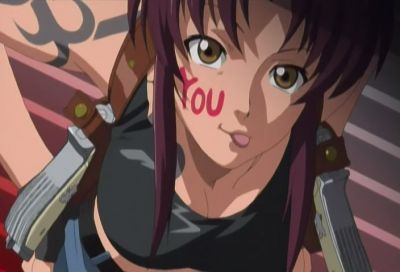
You, yes you.

A curious bit about Black Lagoon is, at this point, the play around with the female archtype. One person so far have found Levi identifiable with Faye Valentine. I am not so sure about the claim’s veracity, but nonetheless it goes to suggest, perhaps, a larger picture of uncertainty and confusion.

I’ve yet to laid eyes to the manga, so I can’t say if this was something originally a part of the show. Still, in painting a realistic approach to today’s open-sea piracy, snubbing character archtypes does go a long way. Just how hot can Tessa get while still being down with the gang without losing respect? Or a mofia boss?
Scarface

It’s an escapist’s ideal for the hot anime babe who is also some kind of leader. It’s no surprise in Frank Miller’s Sin City (for example), that the same idea found itself well-rooted in the arts on this side of the Pacific. Is that it, though? I wanted to find out. But where should I start?

1. The ending sequence. The sorrowful instrumental score heaps in bringing out cheap emotional responses to a, so far, straight-up babes with guns kind of affair. But look at it closely, it really tries to go for something else. Where is Lavi hiding her shotgun? Is it a ploy? Just because a girl may be stripping down, it doesn’t mean she’s packed? “Look up?” It also triggered my memories about other anime ending sequences with a similar motif. Nudity is a common thing, so I probably won’t be surprised if others were expecting “more” from Lavi. Or less.

2. The in-show characterization of Lavi. It seems to be the centerpiece here. She doesn’t get the majority of screen time, lines, or attention from the narrative. She is centerpiece only when there’s action, and oddly enough, when it comes to Rock. Episode 3 dove into a bit of her backstory, but it wasn’t much you wouldn’t expect. I had a hard time all this time, however, taking my mind off of what’s front and center–her ridiculous outfit.

Lavi's Portable Rig
Is that how she holds up her short shorts? QED!

No, really, adding music the same way as Miyamoto Rebecca would, except in a different context–that’s just my kind of fanservice. But still, fanservice? Undeniable sex appeal was something else that’s loaded like Levi’s tools akimbo. She’s a girl with many guns, yes.

3. Which brings us to the OP. It’s to tease. It’s to please. It’s to take your bank account number and make the number it represent decrease. But she’s not like that at all in the show. A laid-back mercenary who knows what she’s good at and knows that’s a big part of what she does. She’s like just another guy. Actually, she’s like the archtypical annoying guy in the team.

Beating around the bush, ultimately, is the question of what exactly is the “babes with gun” archtype? Levi is too masculine to pass for Rally Vincent. Definitely not a Faye, as I presume (but I can see how that could happen). I guess what’s masculine about Rally is true for Levi, but what’s masculine for Levi isn’t what’s true about Rally, who’s actuall a rather through-and-through 80s archtype. The 90s wasn’t too kind to the masculine anime babe all in all. Perhaps we still have Priss, but she’s not really all that masculine IMO… more like Madoka.

I guess what bothers me in the end about Lavi is still just how she can straddle the line; having the appeal, be “dumb” enough to pass for another guy yet still have some of that cuteness showing. Should it even be like that? It’s inconsistent, no? Looking at probably a more well-rounded anime character like The Major, Levi just seems odd.

Odd enough to blog about, fo sure.