Monthly Archives: September 2006

Saiunkoku Summer Ale – Less Filling, More Taste, Equally Patriotic

Hayate Yagami Salutes! (Has nothing to do with Saiunkoku Anything)

If one were to liken story-driven anime series to beer, Saiunkoku Monogatari would make a nice drink under the tepid breeze of summer. To me, however, that’s sort of besides the point. It is either delicious or disgusting. It either goes well with what I am eating and doing, or it doesn’t. It’s either affordable or overpriced.

In as much as I compare anime with beer at all, something like Windy Tales or Mushishi is by all means much more interesting; and dare I say, superior than beer, so the imagery wouldn’t work so well. To cop a line from Bokura ga Ita, those kinds of shows are like either like drinking hot cocoa after spending a turgid December day outdoors, or hearing your favorite song play on the radio on your drive home from work.

But I got nothing against beers. It’s just that since it’s such a prevalently consumed beverage in North America I figured a rather stock-genre show like Saiunkoku Monogotari would fit better as a comparison. When people praise this show for its deep intrigue and complex character relationships and expositions, to me it means simply that the original writer got its job done. It speaks little to the merit of the animated adaptation. That’s what these kinds of show are suppose to do, folks. It’s like NOT able to find an attractive girl in all of Negima: they went out of their way to avoid that problem. An added thing is just that this faux-Chinese historical thing just doesn’t do me any favors. I’ve had enough of it from just the live action stuff my relatives watch alone. Check the wiki, for crying out loud.

So only names like Kunihiko Ryo (my latest favorite anime soundtrack composer), Houko Kuwashima in a very demanding lead female role (I’m sort of torn regarding her performance though), and plus a generally un-hate-able assembly of big guns…NHK knows its conspiracy. It knows production value (for the most part).

And it goes down like a nice cold one. Take it as a warning and a suggestion at the same time. It’s slotted for 39 episodes, so it’s not a light commitment (though the first 7 episodes are self-contained). I’m knee-deep in this crap already, and it only took a day. We’ll see how this pans out.

Continue reading


Fifteen Seconds of Obscurity Is Fifteen Seconds Too Many

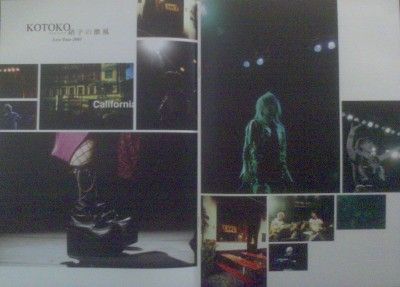
KOTOKO - Glass no Kaze Tour 2005

Ever appeared in a film, TV show, commercial, or a news segment? Or even radio? Ok, yeah, Youtube and its ilk do not count.

Appearently the very first one that featured my ugly mug was a KOTOKO DVD. I kid you not.

What is funnier is how KOTOKO made the comment about American concert types rock however they want to, where as the Japanese do so as if they’re in school, complete with the class prez leading the hand motion, uniformly.

And gah, it’s just so embarrassing seeing yourself cheering like that.

The (other) funny thing is I remember finding out about this late last year, when someone ripped and distributed the said DVD. It isn’t a typical distributed-by-Geneon kind of a deal so it was rather hard to buy. In fact, due to one thing or another, I finally got the physical copy today.

It does feature some big crowd shots at Anime Expo 2005, so a lot of American fanboys and fangirls probably got their arms or legs in! Too bad I’m not sure if you can still get it today, but it definitely warrants a watch. It’s just me, but I’d like to have a copy of all the commercially produced material that has me in it, so.

Continue reading


Backlog Eternal, Across Space, Time, and Medium; Good Practices

When people talk about “LOL I have a HEEUG backlog of downloaded anime” I smile and nod and roll my eyes. To me, that’s like saying you breathe air and eat cake; and sometimes you like to look up at the sky and you sometimes see some explosions there.

You should be like her when you watch anime

I suppose it is only fair if you react the same way to my backlog problem; my backlog is nothing unusual; 3-4 series that I want to watch, and countless DVDs shrinkwrapped sitting on my shelf, ready to be loaned to friends. The only real difference I’d like to point out is that I actively AVOID watching series that I know I cannot finish. This means shows like I’ll probably miss out on Saiunkoku Monogatari because people hyping it up are all using the wrong words (calling it josei or shoujo, or strong female characters, or that historic China motif, or that it’s purely story driven with drama in the middle). Oddly enough because I did catch an episode of it and I found out it has 1) Ryo Kunihiko 2) Houko Kuwashima 3) Tomokazu Seki and Hikaru Midorikawa, so that might get added to the queue of stuff to watch.

But I’m not here to talk about my backlog. I’m here to stand on an illusory box and tell you to get rid of (or lessen otherwise) your backlog by not watching them, and by reducing it by limiting of what you watch and download or obtain otherwise. Of course, the only real reason I have a huge DVD backlog is because I want to have those DVDs, not so much because I want to rewatch them (although all of them probably stand up to being re-watched), so that’s unavoidable. If you’re like that when it comes to your backlog, then you can just stop reading.

I think there is a value to be selective of what you watch. Anime is a hobby that can burn people out. And I think underlying it all is that the majority of anime are rather similar and what is original for many shows are only in the superficial. What I mean by that is if you just watch 2-3 episodes of a show, often you can have a very good idea what the show is about, and learn many of the defining characteristics of a show. It’s a big reason why I think I quit watching shounen fight type shows ever since I’ve had my fill of my first “favorite.”

OTOH, what’s unique about certain shows is the way it progresses, or how the characters build themselves up into a huge ball of unstoppable milk & pandering. I’m thinking about Initial D and One Piece; the former is a rollercoaster, the latter is like the Marvel Universe of characters and things. But those are not really “backlogs.” You can just read synopsis and talk to people and you’ll actually miss out on almost nothing, condensing your backlogs of 10+ or more episodes to virtually nil in the matter of 10 minutes. It’s probably not as enjoyable than the rollercoaster by following one cliffhanger after another, but you deal with it how you can. Well, if you’re the type of person who would rather marathon things, then it’ll affect you even less. One of my friends would just liberally use the fast-forward feature. It’s no big deal if you’re watching subs, anyways.

With these methods you can probably “deconstruct” or “skim” about half of the anime on the air at any given time. What’s even worse, is that you can guess about what goes on in those shows with reasonable accuracy even without watching the particular episode, as long as you have enough input to work with.

That leaves us with about half of the anime on the air that cannot be easily reconstructed. I hope maybe 2/3 of what’s left are shows that you don’t want to watch in the first place? That it would narrow things down to a manageable level? If you find yourself watching half of what’s on the air anyways, that might not be very comforting: let’s all remember that if you enjoy watching everything, you have no taste. And having no taste isn’t a bad thing, but it’s a curse. Don’t. Be selective. It builds character.

There is also the copy infringement aspect to it. The fewer fansubs you watch, sometimes, the better. Today we treat them as if we deserve these things, but we need to realize even the local Japanese often don’t get the treatment we do, since a lot of the anime on the scene are available only on cable or satellite, or airs later than the first air date in many parts of the country. Having your favorite fansubbed anime available 2 days after its first air date is a type of entitlement that we will never get legitimately.

That’s not a very rational reason, however. An even better one is that having a “fansub” backlog necessarily means I am filling all my free time, that I can afford to spent watching anime, by watching anime. Where does it leave, then, the incentive to buy and support your local anime efforts? It isn’t so much that you even keep the fansubs you downloaded as a substitute for what you may have to otherwise pay for (I delete my fansubs after I’m done with a handful of exceptions, for example). It is letting “oh I saw this so I’m going to think twice about buying” get in the way. I think invariably this is not a major problem as long as the commercial interests are ready to pander to the fansub fans the subsequent things they need.

However, there is a growing gap between those who do not dabble in the various local, domestic anime scenes at all, and the majority of fans cultivated by the domestic labor; one that can be better characterized as an elitist divide. Granted, today this is only really a problem in North America, but who knows how it will pan out. And while this is only a problem from a generalized perspective and really doesn’t apply to a lot of individuals, but the thinking is there.

As much as it makes no sense to tell people to watch less anime, I sort of am. I think people knows their limits, and it’s good to find out where yours are and don’t go past what is enjoyable. Certainly there’s no reason to worry about your backlog. Maybe that’s all I am saying. Fine things should be taken with moderation.


Of Gaiman and McFarlane, Posner and Me.

Angela in ... Nekomimimoodo!

If you cared for English-language comics, you might have heard of the long, strange, and fantastical mess of things behind the ownership of Marvelman. It is just odd, and somewhat irrelevant. So, here’s a bit of exposition behind all this: Marvelman is some comic franchise/character Neil Gaiman, famous comic artist and scriptwriter, tries to revive, for some reason. At one point Todd McFarlene thought he had the rights, and it happened that Gaiman is a co-owner of some of the key Spawn characters, namely Angela, Cogliostro, and Medieval Spawn. Anyways, at one point Gaiman and McFarlene decided to trade the rights to Cogliostro and Medieval Spawn with Marvelman (as it was worth pretty close to nothing at that point, compared to having a piece of the Spawn empire at the time). This was 1997.

However things didn’t work out between them, and they had to call in the lawyers. And there were judges. I’m going to come clean: I’m totally interested in this case because of Posner, and how he deals with this topical matter, and the topical matter itself. I care for Gaiman a tiny bit and definitely do not care about McFarlane at all; which is probably more than how much I care for Spawn or Angela or Marvelman (as a character).

But when I read this, I just can’t imagine someone like Posner (or one of his clerks, more likely) that would pour over the general concepts of Spawn. I suppose by the time that he authored the opinion he would have had the chance to see the movie. Yeah, I’m a bit of a Posner fanboy.

Ah well, I’ll let his writing do the work:

We need to do some stage setting. Gaiman and McFarlane are both celebrated figures in the world of comic books, but they play different though overlapping roles. Gaiman just writes scripts; McFarlane writes scripts too, but he also illustrates and publishes the comic books. In 1992, shortly after forming his own publishing house, McFarlane began publishing a series of comic books entitled Spawn, which at first he wrote and illustrated himself. “Spawn,” more precisely “Hellspawn,” are officers in an army of the damned commanded by a devil named Malebolgia, who hopes one day to launch his army against Heaven. The leading character in the series is a man named Al Simmons, who is dead but has returned to the world of the living as a Hellspawn.

Al’s story is an affecting one. Born in a quiet neighborhood outside of Pittsburgh, he was recruited by the CIA and eventually became a member of an elite military unit that guards the President. He saved the President from an assassin’s bullet and was rewarded with a promotion to lieutenant colonel. He was placed under the command of Jason Wynn, who became his mentor and inducted him into the sinister inner recesses of the intelligence community. When Al began to question Wynn’s motives, Wynn sent two agents, significantly named Chapel and Priest, to kill Al with laser weapons, and they did, burning him beyond recognition. Al was buried with great fanfare in Arlington National Cemetery.

Now Al had always had an Achilles’ heel, namely that he loved his wife beyond bearing and so, dying, he vowed that he would do anything to see her again. Malebolgia took him at his word (“would do anything” and returned Al to Earth. But a deal with the devil is always a Faustian pact. Al discovered that he was now one of Malebolgia’s handpicked Hellspawn and had been remade (a full makeover, as we’ll see) and infused with Hell-born energy.

Returned to Earth in his new persona, Al discovers that his wife has remarried his best friend, who was able to give her the child he never could. He absorbs the blow but thirsts for revenge against Jason Wynn. He bides his time, living with homeless people and pondering the unhappy fact that once he exhausts his Hell-born energy he will be returned to Malebolgia’s domain and become a slave in an army of the damned with no hope of redemption. He must try somehow to break his pact with the devil.

Even better is when he goes on and describes Angela and the other Gaiman contributions regarding Spawn issue #9:

McFarlane’s original Spawn, Al Simmons, was a tall figure clad in what looks like spandex (it is actually “a neural parasite”) beneath a huge blood-red cloak, making him a kind of malevolent Superman figure, although actually rather weak and stupid. His face is a shiny plastic oval with eyeholes but no other features. Gaiman decided to begin Spawn No. 9 with a different Spawn, whom he called “Olden Days Spawn.” He explained to McFarlane that “[Olden Days] Spawn rides up on a huge horse. He’s wearing a kind of Spawn suit and mask, although the actual costume under the cloak is reminiscent of a suit of armour.” McFarlane drew “Olden Days Spawn” as (in the words of his brief) “essentially Spawn, only he dressed him as a knight from the Middle Ages with a shield bearing the Spawn logo.” To make him credibly medieval, Gaiman in his script has Olden Days Spawn say to a damsel in apparent distress, “Good day, sweet maiden.” The “damsel” is none other than Angela, a “maiden” only in the sense of making her maiden appearance in Spawn No. 9. Angela is in fact a “warrior angel and villain” who, scantily clad in a dominatrix outfit, quickly dispatches the unsuspecting Olden Days Spawn with her lance.

We learn that this event occurred in the thirteenth century, and the scene now shifts to the present day. Angela is dressed as a modern professional woman. The Al Simmons Spawn is lurking about in an alley and it is here that we meet Count Cogliostro for the first time. McFarlane had wanted a character who would be “basically. . . the wisened [sic] sage that could sort of come down and give all the information and assimilate it.” Gaiman interpreted this as an instruction to create “a character who can talk to Spawn and tell him a little bit more about what’s going on in the background and can move the story along. ” So he created an “old man, who starts talking to Spawn and then telling him all these sort of things about Spawn’s super powers that Spawn couldn’t have known. And when you first meet him [Cogliostro] in the alley you think he’s a drunken bum with the rest of them, and then we realize no, he’s not. He’s some kind of mysterious stranger who knows things.”

Gaiman further described Cogliostro in a draft of Spawn No. 9 as “a really old bum, a skinny, balding old man, with a grubby greyish-yellow beard, like a skinny santa claus. He calls himself Count Nicholas Cagliostro” (later spelled Cogliostro). In a brief scene, Cogliostro, drawn by McFarlane as an old man with a long grey beard who faintly resembles Moses–McFarlane had been dissatisfied with Gaiman’s verbal description, which made Cogliostro sound like a wino–explains to Simmons-Spawn some of the powers of Hellspawn of which Simmons is unaware. Cogliostro displays his mysterious wisdom by calling him “Simmons,” to the latter’s bafflement–how could Cogliostro have known? Angela then appears in her dominatrix costume, there is another duel, and she vanquishes Simmons (whose powers are in fact unimpressive), but does not kill him. He then blows himself up by accidentally pushing the wrong button on Angela’s lance, which she had left behind. Happily he is not killed–merely (it seems) translated into another dimension–and will reappear in subsequent issues of Spawn.

I mean, this is just brilliant. I don’t think many fans can even write and grasp the concept of Spawn so cleanly as Posner did. Granted back in 2004 when this was news, I wasn’t a Posner fanboy and I was equally ignorant of copyright law, so this didn’t ring a bell. Now I revisit the same material for class and I go all LOLOL over it. Sigh. At least you now know how it has to do with me. It does serve an important lesson for you fancy pants creative types, so know who you collaborate with!

Ahh, curiousities of American law and business methods.


What Music Means to Me?

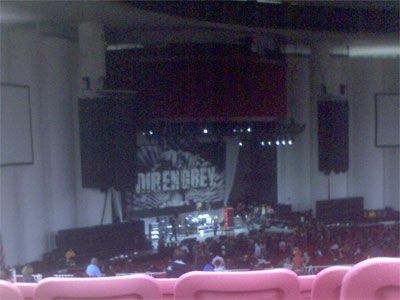
Dir En Grey, 9/1/2006

I was trying to figure out a way to do some housekeeping without just blatantly pouring out a list of unconnected things aside from a glorified version of “what I did this past weekend.” TJ was an inspiration to this solution, so props to his strange list. The irony is here that I’m going to get way more intimate than his little list will ever do to tell us about TJ_han.

Continue reading