Category Archives: English Language Modern Visual Fandom

Free: Checking the Database Schema

Just thinking through about a few things in Free. Well, one main thing: I don’t feel the characters are believable teenage boys.
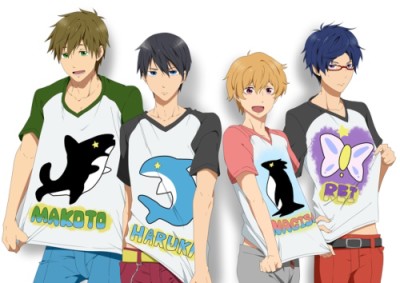
Iwatobi Swimming Club

The way characters assembles in the Database Animal era is the combination of “database” elements. Stories, too, are constructed from archetypal narrative elements. What is new is each and every daring combination of things we know, the cultural remixes that results.

Can we look at Free as just the same constructed elements but with some parts swapped in for the female otaku audience? I think that’s the reasonable take.

While it may be reasonable, I still don’t know if it is really true. I think there are definitely a lot of similarities between Free and past Kyoto Animation works. Maybe a better question would be if we subtract from Free what makes up the similarities between Free and K-ON, what do we have left?

  • Cute girls versus ikemen (let’s ignore Kou for the moment)
  • Athletic rather than culture club; swimming versus “keiongaku”
  • Inclusion of the opposite sex
  • Fanservice

I think none of this is particularly problematic. By problematic I mean if I watch an episode of Haruhi I might coincidentally see all those elements at play there as well, and nobody thinks twice about Haruhi. So it’s not just “genderswapped K-ON.” Rather, it is more like just Haruhi.

What I find difficult about Free, aside from any concerns of the gender-specific fanservice sort of thing, is that the characters don’t behave the way I imagine them to be. For a point of contrast, check out this series that is kind of popular with some fujoshi: Ookiku Furikabutte. Big Windup, as it’s localized, is actually a seinen manga adaptation with a very sports-centric appeal in which happens to feature many database elements that fujoshi and female otaku look for. The anime, coincidentally, is also pretty good. But in that show, despite how touchy feely or at times feminine some of the guys act, these characters come across to me as believable high schoolers, in the “go to koshien” sense (man I haven’t used that term unironically in a while). Yes, even the hand-holding part. [They certainly do some weird stuff.]

That is a lot more than what I can say about Free. Haru, clearly, has a swimming thing going on for him. We can put him in the “eccentric” bin. But how about Makoto, Rin, Rei and Nagisa? Rei and Rin seem like the most masculine of them all in some ways (certainly physically), perhaps because they are a blockhead and a tsundere–both generally gender-neutral traits. I can give Nagisa a pass–these kind of people do exist as high school boys, but I think if such a person exists they are going to be really annoying to deal with, speaking as an average guy. Maybe that’s just how Nagisa is with his close friends, I don’t know. It just seems too much of a copy-paste sort of deal, where you take 50% Mugi and 50% Yui and add a dash of Ritsu. I probably have the most problem with Makoto, who seems just motherly. I know guys who can be motherly, but generally they are portrayed like this. And Makoto does not remind me of that guy whatsoever; Makoto reminds me of a more believable version of 30% her and 70% her. At any rate, the point is none of the main guys exhibit anything particularly masculine as character traits.

Well, I am also making a call with 4 episodes in, so things will likely change. The least I could do to reserve the right to change my mind and say this is more a first impression than some kind of judgment, maybe a bit of a prediction. Perhaps it’s more of an indictment of the problems common to Kyoani works. What I really want to get across is that when I watch Free, I don’t really see a story about some guys swimming, I see some muscle-blobs swimming. Where’s their humanity? I don’t feel this way with K-ON, but that’s probably because K-ON doesn’t get deep enough about character traits to really paint that kind of a picture. We might see flashes of the characters’ worries and inner thoughts in K-ON, but it’s pretty much a story at a very low depth to begin with, and the deepness largely relies on framing a passive sense of melancholy through the passage of time. It’s a lot more lifelike than Free, let’s just say.

So I guess what I have problems with isn’t exactly how girl-pandering opens new ways to reassemble the database; it’s more because Free seems to take the theme and story somewhere different than the characters that it swims with. Well, let’s hope Kyoani proves me wrong.

PS. About Kou… Maybe it’s the reason why some people can handle watching all those cool-girl Houko Kuwashima reverse harem anime, when it really isn’t meant for them. I think if there’s a character worth watching for, people will watch the show, to the degree that they can put off the detracting elements of the show. I know that’s the reason why I can tolerate a lot of anime originally written for girls. And it goes back to simply having quality story, theme, characters, direction, music, acting, whatever. That said, I’m not saying Kou is such a thing.


Otakon Uprising, Manga

Author discovers manga. I’m not very different from him, except I probably gave it a lot more thought. You really can’t talk about TV anime in the 21st century without talking about manga, after all. The problem for me is that there are too much stuff I enjoy about anime that’s absent in manga. My main gateway into anime has been seiyuu idols, OP/ED themes and soundtrack music. I still remember the one summer where I listened to Macross Plus soundtracks like a bijillion times. Direction and cinematography may overlap with paneling and framing the shot in manga but it’s not exactly enough to “get” it on from one format to another, even if a sharp-eyed critic can probably appreciate one going to the other. And of course, I adore animation in itself. These are not exactly why people read manga for. Maaaaybe you can say they’re in motion manga type things, but who wants to read manga in a guided mode…?

That said, it isn’t like I don’t read manga. My collection is a few times bigger than Author’s but that’s not saying much. I just can’t really call myself a fan of the categorical format, genre or medium. That said, I highly prefer reading on a portrait-mode monitor. At home, I read it using a Dell U2412m–basically that was the only way I can tolerate JManga while they were around. I just can’t stand reading manga on a tablet. The resolution is crap, either because of the display or the source files (all non-high-quality scans should DIAF). Maybe it’s okay on a Nexus 10 or the latest iPad for some, but it’s no substitute for the paper version in my opinion. Maybe this is because I do the manual “zoom” by holding it to my face, which doesn’t really work on manga on a tablet.

Because I’m not the kind of person who just want to read about “what happens next” on average. I like to appreciate the medium. Which is probably why I would rather subject myself to crap-tier light novels than high-quality, near-artbook, manga tanks that Ed is peddling.

===

From Chiba to the World

Otakon finally has a public schedule, and that announcement brought the website down. Pretty telling about Otakon this year–it’s a little uncharacteristically late, and it’s going to be crowded. On the other hand when AX brought up theirs, it was just a PDF and it was running off of AWS. Hah. Otakon’s schedule is more like an account-based thing where…obviously some backend sharing was happening. It happened last year too but I didn’t think it was this bad.

I’m going to be there, of course. I have these iDOLM@STER tags that are burning a hole in my wallet and I would love to give them away. If you see me there, let me know if you want one. I’m probably going to ask you a couple questions in exchange, though.

More importantly, I’ll be running a panel with Wah. So if you want to catch me at Otakon you can surely find me there ;) The Panel is Tokyo Otaku Hotspots, scheduled currently for Saturday night at 7:30pm, Panel 4 (which IIRC is in the Hilton). COME ON GUYS DON’T BE SHY. (I am assuming the average reader of this blog is not the con-going type, but tell your con-going friends!) Mainly because there will be prizes.

Here goes hoping the scheduling masters of Otakon (as a press attendee that means several groups of people!) don’t swap things on me to make things difficult.


Cool Japan: Criticism?

Here’s my impression of Cool Japan.

The basic economic policy in the post-bubble Japan is one that generally conforms to what was hotly debated during the latter part of the last decade, and well into the 2012–the economics of government spending (in both actual spending and tax cuts) and its impact on the greater economy. Cool Japan, in spirit, is just another form of government spending aimed to develop or rehabilitate a specific industry sector.

And then, there’s this.

A refreshing image (made in Korea w)

I think here’s the problem. What makes Japan “cool” will vary from person to person. But what made Japanese pop cultural product profitable to the Japanese is not necessarily cool, and it doesn’t vary from person to person at all–it’s factual. It’s even translated into English. Cool Japan is kind of a misnomer–it’s more like “We-used-to-make-money-selling-cartoon-characters Japan.” But maybe some consider sending children to the hospital because your cartoons are too crazy psychedelic, a cool thing. In other words, Cool Japan, as the otaku know it, really started and ended with Pokemon. Akira, Ghost in the Shell and Ninja Scroll are not much more than an appetizer, a place mat. They are just more examples of Redline–cool and acclaimed stuff that makes relatively little amounts of money (Although over the years all three titles raked in good money, by some metrics). All that stuff made maybe a drop in the bucket in the larger scope of thing. You don’t have to take my word for it. In the US, we are talking about 4, 5 billions of dollars. Referencing back to the JETRO report, I think most of that “character good” bar graphs is just Pokemon money. And maybe some Yugioh stuff.

https://twitter.com/kransomwastaken/status/361860898714947584

What bothered me with Surat’s story wasn’t that it lacks any kind of numbers to back up his claims. Or that it’s awfully US-centric (as I am often). Well, actually what bothered me the most is that the term Pokemon didn’t appear once. He kind of mentioned Power Rangers, which was a big deal in terms of Japanese profits and is a driver of a lot of early Cool Japan literature in the US, but he didn’t really talk about that in such contexts (It’s one of the biggest cultural export from Japan in the 90s I thought). He didn’t have to quote any numbers. He only omitted the potentially most important stuff.

Well, that may be okay. None of it really matter to the heart of his argument, which is that Cool Japan might be something some people parroted, a fabricated narrative in which promoted certain interests in light of this capital spending trend by the government. I would think that’s what all the Japanese kids are saying anyway. And as much as I cast lots of my own concerns with the reports and numbers I linked in this post thus far, I got nothing to prove it the other way. There are no indication whatsoever that Nintendo did not make a bijillion bux on Pokemon, or why Konami or whoever was in court with Upper Deck for a couple years. That’s where “Cool Japan” really lives. It’s about China/rest of Asia. It’s about Japan’s strange fashion industry. It’s about sushi. It’s really not about Akira. It’s actually about video games, right? I mean, the cultural cache value, if such a thing is defined, of FF7, is maybe 10 times larger than Cowboy Bebop.

With all that said, I think it’s good to criticize Cool Japan in the sense that it’s tax money going into certain industries that may very well not going to put that money into good use. After all, it’s a form of export, not exactly domestic spending. And Japanese politics is not quite that shining image of “acting for the public benefit.” But then again this money is the kind of money that footed the bills of things like Little Witch Academia and Death Billiards, so as beneficiaries of Cool Japan, it might not be in our place to really say much about that.

Well, no, we can still not like Cool Japan. Because until they solve this problem…well, I guess they are trying? It is a face thing isn’t it. I wonder if that ever crosses Koike’s mind.

PS. And here is Roland Kelts on Cool Japan 2013. You tell me what his take is.

PPS. Hello Kitty is a pretty cool story.

PPPS. This post is brought to you by XKCD.


An Intro to the Animusic Tourney, Bracketology

A few years ago (2009?) some tweeters and bloggers got together on MyAnimeList and started a club talking about anime music. It was a good time–we talked about all kinds of anime music, specifically there weren’t any particular bias towards OP/ED themes and we treated random tracks from Hisaishi masterpieces on equal grounds as any guitar anthem marking the climax of your average late-night otaku fare. In the process not only all of us discovered all kinds of things–from how to work large spreadsheets to what BGM tracks people like, but we found new favorites and make new assessments on old flames. We complained together about how, for example, how hard it is to buy certain bundled OSTs or we all want to listen to more Suwano. We traded anime soundtrack opinions and tips. It was a place where it is possible to criticize and praise Yuki Kajiura and not sound like a troll or fanboy, usually.

Being able to do this with theme and background music is somewhat unique to Japanese animation, after all. It’s not to say there are no emotive or expansive list of songs and music for other types of animation, or TV and cinema, but given the volume of output for anime and the way that business works, a lot of different composition hits the floor than what you would expect. Everything is pretty low profile, and tie-in marketing is rather limited. More over a lot of this music is actually available for purchase (and thus is generally available thanks to rampant piracy of kind-of obscure music).

The main drive behind what we used to affectionately call #MALKeionbu (the whole endeavor overlapped with K-ON’s run, after all) is this guy. Zz-chan is soon going to move on into a phase of his life where spending hours crunching spreadsheets about anison is no longer something feasible, so says it here. But yeah, #MALKeionbu was a good time and this is a great way to put a ribbon on that.

In the spirit of MALKeionbu’s DIY nature, I’ll try to do something too. There are already some pretty cool entries covering the Tournament, as the nomination phase of the tournament is completed. A full list of nominated tracks (and the ones nominated but got cut) is available here. Thanks to that, we have some number-pushing blog posts:

I hope there will be more to come. For now, there’s a twitter you can bother. And of course, the main site where it’ll be happening.

The most fabulous Alice

And look at what I found:

http://challonge.com/omochallenge

Presenting the Animusic Tourney Prediction Challenge!

Between now and uh… I guess Sunday morning US Eastern time (let’s actually say 2PM EDT, or July 28th, 6PM UTC), enter your predictions.

The scoring system is by a factor of two. A correct round 1 prediction scores 1 point, a correct round 2 prediction scores 2 points, round 3 scores 4 points, round 4 scores 8 points, etc (I think it goes like 2^(round number -1)).

To input your predictions, follow the link on top of the site about entering predictions, create an account if necessary, and drag-drop the choices you would like. If you have a question about a particular entry, your best bet is to google it if you have no clue, and then search for a video of it on youtube or some such. If not, leave a comment on twitter and I can probably help you.

This is mostly for fun and game and lulz, so there is a chance that the bracket input time frame may be extended to include more people. And winner might get a prize from me–this is something we’ll talk about later on once things are in full swing.

PS. I heard Saimoe 2013 is gonna be terribad, so it says.


Summer 2013, < Three Episodes After

The anime blogging ritual continues.

whitecats

Overall I thought this season yet again features a lot of solid shows. Even questionable entries like Fantasista Dolls or Inuhasa (for different reasons) give me reasons to want to watch it week after week, even when I wish just the opposite. The problem, if there is one, is that the shows with the most potential, the ones I like best, can only be engaged at an arm’s length.

By that I mean it’s hard to cheer for them. Let’s take Genshiken Niidame or Watamoe or the Monogatari series as a counterexample. These are pure otaku fodder. I can sleep with them in bed, carry it with me and read it on the train, what have you. That’s the typical case for late-night style anime. But entries like Gatchaman Crowds and Uchoten Kazoku, both fascinating pieces of work, require a level of rigor in order to engage them fully. It feels wrong, for example, to indulge in making dirty doujinshi of, say, Benten (but maybe not Utsutsu). Not that it won’t be done, of course, but there’s just something off kilter about theses two works. Maybe it’s the visuals? Maybe it’s just me? Probably it’s just me. It makes me want to watch them in theaters, or talk about it at cons with like-minded people. Or blog about them in a way to distinguish them.

I can’t say how it feels to engage all these works from a distance further than that, though. It must feel kind of ordinary and boring when, at a large enough distance, invariably everything seems to be the same thing, day in and out.

Continue reading