Category Archives: Franchises

A Data with a Kindred Spirit

I like Ryoko Asakura.

Nagato Has A Backside

Only because I like Nagato too.

To be fair, I think both character archtypes are worth looking into because they represent a very odd stereotype by something that ought to be stereotypical. Normality is rather astereotypical–reality is often stranger than fiction in my own experience. The thought goes, how about alien entities’ perception of human reality? Or even, a writer’s decision in the perception of this alien entity? Ryoko and Yuki presents us with two personalty extremes, maybe.

But it’s one of those detracting factors about Suzumiya Haruhi no Yuutsu. There are few like-minded people in this show. Perhaps some can be said of Itsuki and Kyon, and maybe Kyon and Mikuru. We can explain away Ryoko’s socially-pure persona and Yuki’s detachment with human society as a demonstration of how well these aliens grasp the human condition. We can even explain away why Ryoko has a charmingly igorant thing for death, as well as why Yuki forgot her glasses. KyoAni is no stranger to moe. But are Yuki and Ryoko so stereotypical? Maybe. They are rather colorfully played out I think, so they seemed also a little less stereotypical than other archtypes in other anime.

But Itsuki? Is he also stepped deep into the conspiracy? His commonsensical normalcy is all that’s left attaching him to this show. That, plus as a plot device.
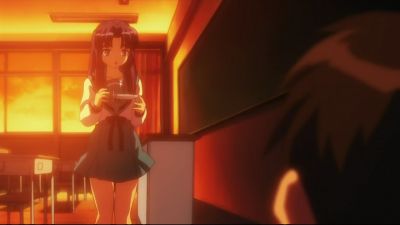
Asakura Ryoko Is A Plot Device

Well, Ryoko is fairly just also a plot device too. I can only imagine her impact in the novel was way greater than how she gets second-handed here in the anime.

I don’t know enough about Mikuru to say much besides her personality likewise may represent (same with Itsuki, too) the perspective of the faction that sent her into this mess. It’s a well-thought-out literary parallel.

Which leaves us no surprise that Kyon is our amusing straight-man. He is us.

But what does that leave Tsuruya? We all like her too!

Maid to Thrill

The age old debate between ninjas and pirates ends with Black Lagoon. Maid wins.

Roberta 2000

Words were barely sufficient to describe how it feel to watch Desperado or Terminator 2 the first time for me. Little more can be said about this masterpiece of an episode that is Black Lagoon episode 9. I really had little to share aside from awe and “I wanna … watch this again and again and again!” It’s all I can do to keep that image of Roberta’s humble-looking shoes rotating counterclockwise along with the regular-pattern lace trims of her uniform from replaying itself to burnout in my brain. Oh, it would also fast forward to the rotating umbrella and when she does a “peek-a-boom!” Or I could replay, in my head, how she forms into a rigid, flat-fisted running style while whipping out that combat knife. Well, actually what I did immediately was make Terminator 2 jokes first, then to relish the goodness that was this piece of animation.

You can feel the love brimming from this episode. The people who worked on those scenes must have loved what they were doing. It is the only logical explanation.

To be fair, I was seriously bugged about Roberta at first. I read the manga for Black Lagoon after realizing I would be digging this show seriously. I stopped at volume one because I get the feeling that this manga is going to do what I thought it’s going to do exactly, for better or worse. Sure, the series is about outrageous mercenary action with a bent towards a realistic-feeling grittiness. Thematically it deals with the scummy real life of criminals versus the somewhat crummy real life that we know. It does escapism well; the action scenes are smart but unfortunately the manga falls to mediocrity when it tries too hard to pander to conventions (maybe on purpose).

Remember Noir? I’m one of those people who thought that he liked what he saw in Noir, only to be totally bugged by the fact that it turns into this weird lesiban slide show with secret societies. To be honest, it could have worked out if not for Chloe. Roberta, as a result, reminded me of Chloe–both in their outlandishness but also, heh, they are SOLDATS! Oh, of course, they’re both badasses in a fight.

Hmm. Noir would have been a better show if Chloe was a maid, don’t you think? Thankfully we wouldn’t have to ask the same about Black Lagoon. It’s Maid to win.

Actually, there’s also a part-2 to this entry… It started with Gunslinger Girls.

Hi Jose!

There’s nothing wrong with killer maids, nor is it such a novel concept. The dichotomy was probably best explored in an anime context through GSG, so it’s no surprise Roberta reminded me of it. But in light of our other girls in Black Lagoon, what sort of concoction would Roberta be? Just another daily special at the Yellowflag?

Certainly if Rebecca was Suzumiya Haruhi, Balalaika would act a bit like Nagato Yuki and stop and save…Rock (and Dutch and Benny) from their certain death? It explains why I rather was taken by Asakura Ryoko.


Partly Passionate Past

It is hard to part with the past.

Robin Sena

Especially when it makes a great story that others enjoy hearing. This is the story of Robin Sena for me. Often times when it’s playing on the screen, I just look blankly and smile. Thankfully I rarely see her on TV.

Oldies are goodies sometimes, when what the old stuff evoke isn’t some higher power brain function but a simple emotional response. It makes us turn into little kids. It’s quite different than what I think is “moe” or what is plainly attractive or sexy. This feeling is layered, seasoned emotion. You taste euphoria by remembering how it was euphoric. It’s like ABC gum, but the flavor never goes away. Or Star Wars: A New Hope. Or lazying around with some old friends doing nothing.

Or is it? I think when I rewatched Witch Hunter Robin last week as it was being rewatched by someone else (does that make me a mere by-stander?) I realized this show, vintage 2002, is really well done even by today’s standards. Maybe that’s just me watching my own DVDs for the first time (at least, the first time I remember it) and all I can mostly remember is my first impression from the off-air digisubs that made me a believer, but aside from the awkward lines here and there by the animator team trying to do Shokou Murase’s designs justice…it looked really nice.

I think all fans have memories like these that make them the type of fan that they are. Come to think of it, the gothloli fad was making its way just about then in Japan in force. Maybe I have this show to blame for my strange, elegant slant. In a way this is really the kind of idol-effect that I really need to be aware of. Naturally what I adore, I praise and follow…

It all makes sense. Genres are pioneered by massivly popular hits into the mainstream. Gateway drugs-type experiments open the door to greater differentiation and diversity (and more gateways) when they’re successful. We all have to thank Astro Boy? What and who is responsible for all the lolicon in anime? If we can trace it, that is.

Sitting Pretty & Slacking

Yurika Doujima: …
Robin Sena: …
Yurika Doujima:


Ai wa Bubble Bubble Trouble

Magipokan Surprise!

Love is trouble
Love is trouble
Priced like truffle
We are baffled
Makes me babble

Love is a bubble
A growing puzzle
Poetry, a riddle
or bloggable hassle
Almost predictable

Love is trouble
A harem debacle
Male leads fumble
the romance polygonal.
Totally serviceable

Love is bubble
Just like a bubble
Pops like a bubble
Realizations subtle
We all roffle (anyways)

Love is trouble
A big trouble
Vampires cackle
Lycanthropable
A Hamster troubled?

Love is bubble
Plagerizable
Shoujofiable
All adorable
Loli? Certifiable!

Love is trouble
Love in a bubble
Expectation shatterable
Anime cliché-able
Call the blog constable!

Love is a bubble
Full of trouble
Ideals Romancible
All in a fable
Archtypical

Because, after all…

Love a riddle
A poetic riddle
Cryptic trouble
Magipokan babble
Totally blog-able

Love is Trouble
Copyrightable
And Parodi-able
Like Love a Riddle
An aural miracle


The Harem Fallout

I tried so hard, and got so far. But in the end, it didn’t really matter.

Honey & Clover Movie Cast

We all long for a harem. Men, women, children. The young and the old. We form societies in which the purpose is to allow for harems. Religions that purport the inner desires justified by divine social order. Philosophical restructure of social order that recognizes the good things harem can bring to humanity.

The reality is today, harems have fallen out. It is the subject of mockery and hatred. Something innocent and tender, that young children dream of, has become excuse for sexual abuse, emotional harm, and physical trauma. The spirit of harem broken on the rock of commoditizing people’s fantasy and in term twisted into cheap print matter and late-night animation. Yet in disillusionment, people are still slaves to their dreams and fantasies. People pay to see harems. To experience harems. To relive them vicariously from one franchise to another. The weather is nice, the girls/boys are fine, it’s just as you like it. They pay for their fantasies. The commoditization continues–a vicious cycle.

Has the harem changed so far from what it used to be, as some elusive ideal to some concrete representation on ink or on the tube? Maybe. Invariably differences and space to innovate and differentiate occurs. The protagonist-focused narrative, for example, is a key distinction in our selection of harem-like traits–but is it even necessary? Isn’t that just a by-product of limitations in storytelling? A real harem may be seen as several girls on one guy, or several guys on one girl, but it doesn’t have to be. The harem itself is an organization where everyone plays a role. You just can’t have a harem with the same kind of people; diversity is important, for example. And just like solar systems, you can have harems with a bunch of girls over two guys, for example. Perhaps another key distinction we forget about harem as a result of the limitation on narrative is exactly, the alternate perspective. A romantic harem is still a romance story with more than one party doing their thing. While it is important to tell a story involving empathy of the protagonist to another–we all need to do this in real life–the story is a lot more complex than that. Very few harem anime goes beyond merely telling the story from the characters’ perspectives, for instance.

What is a harem is a question that will have different answers depending on who you ask, and in the end I don’t believe it’s important to answer that question. It’s probably more important to understand what makes a harem attractive and how to make use of those elements. It’s easy to see the sensual/pornographic element of a harem and it’s no surprise many anime capitalize on that aspect. But there is a lot more than that. The relationship is easily the second tier, but even then a relational web alone isn’t enough….or is it? Character driven versus story driven? Or both? How about external factors? Tension? Acting? Dialogue and mood? Not only I don’t know if they matter as elements that makes a harem desirable, I don’t know if they are a part of a harem fantasy or just something else extra.

In some ways I am thankful of the harem concept because it put a name and face to something rather elusive. It has always been there as well as the despised pandering that goes on. Maybe it can all be solved simply by stopping just that.