Category Archives: Franchises

Ano Taiga de Matteru

The only thing that reminds me of Toradora, from chara designer Tanaka and director Nagai’s Ano Natsu de Matteru, is the ever-present Remon Yamano. Or as I sometimes call her Lemon Ichigo–she is sweet-sour and ever-refreshing. She also looks like Taiga from Toradora, shedding just a little of her blonde-ish sheen from OneTi and OneTwi.

I think in a nutshell that is the problem I have with Ano Natsu–there’s just not enough of the pin-pointed hooks that distinguished Toradora from many other light novel romance drivel for boys. Let’s get it on the record that I definitely adore the show thus far, and find it entertaining enough to watch it twice a week, once fansubbed and a second time on CR (not to mention the exercise is a good way to hammer out the nuances in the translations; there’s a fair amount of word play in the script). In terms of my time commitment I’m spending 2x more time on this show than any other this season. Well, maybe except Mouretsu Pirates.

Oh, right, my problem: the show is lacking a lot of key things that catch people’s attention. Granted at episode 6 we’re still half way in the climatic vacation arc. If you think Taiga and Yuusaku Kitamura’s confession in episode 2 of Toradora was pretty neat, remember that a couple has already got together and done it by episode 7 of OneTi. That’s the kind of things I’m looking for. (No, not the “doing it” part although I’m all about Mio dialing up her game, coincidentally. Go for it!) Of course, none of this stuff happened yet. Yet. Is it yet too late?

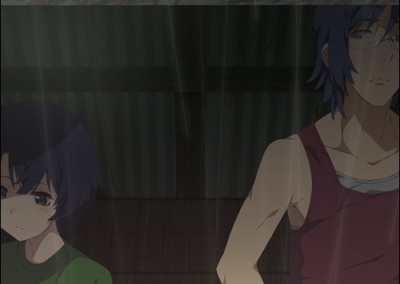
In a nutshell, it’s fair to say that Kuroda’s writing has improved by this much since Onegai Teacher. One could say the handling of romantic frustration in AnoNatsu is pretty slick. I’m not here to disagree with any of that. I’m just waiting on the payoff. The Minori Kushieda moment. The Ami-awakening moment. The cut of Yamada sulking in the rain. None of that has much to do with Kuroda I think.

Oh right, Nagai also worked on Honey & Clover, in case you didn’t read about it in the links earlier. So then, when will it happen? It has to, right?

I’m patient, however. I think it would be ironic to say the least that I can handle 5 episodes of Marika getting to learn the ropes of being a pirate, versus six episodes of romantic frustration build up like a bottle rocket, waiting to shoot into the skies. But I think I can only take so much of this sophomoric teasing for so long. [Nagi’s vocals is excellent aural sex, by the way; fits a dirty label like I’ve Sounds to a tee.]

I remember Onegai Twins. There was something similar–more like a bottle rocket of awkwardness in which results in that cute, dark-hared girl with glasses taking the short end of the stick. She was a champ, I thought, but it brought only short-term relief and a messy out for that character. It’s just like Herikawa’s post-confession wet-rag status. Well, it’s more like she became a defined, determined being and I ended up cheering for them even more. Is this what pushes the buttons for me? Is this moe? At any rate, the confession was just the midway point. The problem maybe is just that.

This is the school of adolescence through hard break hearts, folks. There are already enough tigers (and cougars?) on earth that when you’re orbital bombarding bombshells, the good girls do not stand a chance.

Mouretsu Pirates Are Like Maid Cafe Maids

I mentioned it elsewhere but let’s drill down on the maid cafe aspect of Mouretsu Pirates. Yes, the maid cafe. I think it’s important to realize why it exists, why it plays a role in Marika’s life, and what it really means so far. For sure, it is beyond merely fanservice.

I think it’s important to go to episode 1 and understand why the two spying Bentenmaru members went on a discussion on anachronism. To be sure, the maid cafe is a fad-sort of thing. It is costume play. The best maid cafe in Japan actually provides that sort of European-y high class atmosphere for your dining pleasure. But 99.9% of maid cafes are just normal cafe with a cosplay theme, and the stuff we do at a maid cafe different is pretty much unique to them. It’s closer to a host club than a cafe sometimes.

To say that something like a maid cafe survives in to the distant future, hundreds of years later, and then in a civilization light years away from Earth? It’s close to text book anachronism.

The same can be said of piracy; or perhaps better put, privateering. If you subscribe to a Star Trek-ish view of the future, well-managed societies, even space-faring, probably would not need to take up arms to plunder luxury space cruiser-liners. Spaceships are still expensive, it makes little logical sense to jostle billion-dollar wares and putting your life on the line to rob what may be carried on persons, unless everyone is hauling millions of dollars worth of gear on them. I mean, of course, space travel may be something very inexpensive in Marika’s world. I don’t know. But it seems unlikely given how big of a deal it is to travel to the stars. That is a setting’s leeway.

Certainly it makes even less sense for privateers, who pirate out of some hired-gun contract. Aren’t they technically employed? I would imagine they pirate out of some personal desire to make careers out of it.

Here is the first thing to consider. Maids working at a maid cafe provides the illusion that they are maids hosting their masters and madams or whatever they call their patrons. They aren’t actually maids in the “live in” or “indentured servant” or “slave” sense of the term as it is classically used. Right, they’re just paid to roleplay. In the same manner, Bentenmaru’s brand of piracy is the same kind of put-on show where everyone go through some kind of preconception about space piracy (And…who has these kinds of preconceptions? And more importantly, what are they?). Instead of a maid uniform, Marika wears some ludicrous Harlock-lite thing.

In other words, maid cafe maids aren’t really maids, they just pretend to fit your maid-fitting fantasies and take your money. Likewise Marika’s space piracy is  not really about piracy (they’re privateers to begin with), they just pretend to fit your pirate-themed fantasies and take your money.

To segue to the next point, the Maid Cafe crosses with Piracy, in that both are also jobs. That make money. You know there is some value in having kids take up a part-time job when they are in  high school or college, the whole training in the work place sort of thing. Gone is the concept of a pirate being some kind of romantic Kentucky-born actor. In, is the idea that, at least on the Strip in Vegas, they don’t literally rob those who stand and watch the free show at the Treasure Island hotel. It still beats being a plain robber on the high seas, I suppose, because real pirates don’t last very long. I thought the Maid Cafe thing actually comes around and becomes not only an useful metaphor but also a fitting job for Marika in terms of the career trajectory she’s on.

Anyways, this fake-pirate thing is a nice headtrick. But at the same time it makes you wonder what is going to happen to the actual piracy aspect of it. I suppose by today’s standards, gone are the stories about a maid (eg., Mahoromatic) and in are the stories about people pretending to be maids (eg., … Mahoromatic and every other anime with a pretty girl in it). The same could apply exactly to pirates, if there were enough pirate anime around to make a statement about piracy (if not, just blame One Piece). I mean fictional accounts of pirates are wonderful and all but it would be a whole new adventure when our play-to-pay pirates run into some dangerous situations and still go through the same piracy hijinks. It’s like if your live-in maid was a hamster of epic (erotic) proportions, or if your live-in maid had a thing for breast enlargement and ran on batteries.

I guess, the real question left to ask is, just what about piracy can we expect of Mouretsu Pirates? Because both maid cafes and space privateering, arguably, are anachronisms. What is the spin? Would it involve getting into a dangerous situation and being able to get out of it using Marika’s talents at decision making, while at the end, to never forget ring up a customer? These are important qualities to cultivate at a young age, folks.

Two girls one cup indeed.

PS. What about the Marika in a school uniform? That one is the fun one to talk about.


Ghibli Challenge #END – Arrietty, Graves of the Fireflies

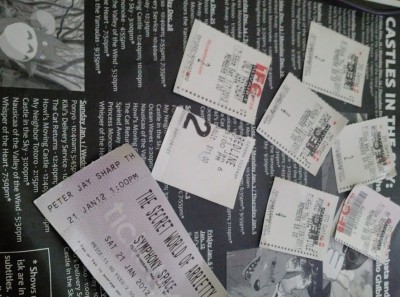
This is it (minus a couple stubs that I lost).

I figured I need to wrap it up sooner or later, and it’s already late.

Because I saw only a screener of Arrietty and I’m not suppose to blog about it until some pre-determined time, I’ll keep my impressions mostly focused on the things you really should know. Well, I guess given it’s due out next week, RIGHT NOW is the time to blog about Arrietty, right, Disney? Never mind that the Japanese Blu-ray has been out for some time.

So I saw Arrietty some time in January. I figured it would be a great way to cap out the 12-days-of-Ghibli thing I’ve had going. And it was. Except it was not the 12th film. More like the 10th film. And I didn’t ever get to number 12. It was on a snowy afternoon that I trained up the west side to Symphony Space. The place was packed, given that it snowed quite a bit the night before. Lots of kids, as it was an 11am showing.

Well, no matter. I made it just in time and the screening was even delayed. I figured it also had to do with the snow.

Walking out of the theater I was actually stoked to find out that the NY International Children’s Film Fest, the #1 destination of new anime films in the city, was hosting A Letter to Momo. That and Shinkai’s Hoshi ou o Kodomo. The latter I’ve seen enough times (thanks Otakon!) and knowing what the former is, I am really excited. You should go see it when you can. Anyway.

Arrietty is awesome in the sense that there’s a real impression of scale and sound and smallness and the oppressiveness of large, vertical archetecture. And there’s some parkour-ish stuff. The dub was solid. For Ghibli, it’s rather intense.

Also, gosh, that hairclip. SO MOE.

Film #11 was Graves of the Fireflies, and I cheated here: It’s just something I saw on home video because it has been way too long since I’ve last seen it, I had to come up with something of an opinion on the film for a feature I’m working on for Jtor. I’m always kind of conflicted counting Graves as a Ghibli film, because it is not–they don’t own it. It is Ghibli-made, so that’s what counts, but as a result of not owning it (or rather, their parent company not owning it), you never get to see it along with the rest of the Ghibli films and they can’t publish it in the same trade dress that Disney is pumping out in Japan for the BD re-releases of Ghibli’s lineup.

I’m not sure what is there to say about it besides that it’s definitely the best Takahata film. I would also like to call it the best slice-of-life anime, motivated because that’s what it is and I want to mock people who group anime by such a label.

The other thing is, as much as it is a quality war flim, Graves was a much better experience for me as a film about poverty–the inability to meet the needs of the neediest in society. Sure, there’s this war context that drives the changes in the lives of the children, but it is a giant decoy. The problem is not so much about the circumstances, but the human relationship that was driven and tested by the circumstances. When you stop and actually think about the story (something I recommend you do with caution, for Ghibli films, unless it is Spirited Away) you might have different opinions based on your context with WW2 in Japan. But that’s not really the focus here. It’s plainly the tragedy as a result of the war and the breaking down of the social structure, that safety web, which normally holds a society and the people in it together. It isn’t that everyone in Japan is a starving war orphans–in fact, plenty of people are doing fine, even if many are strained by the events going on. It is the most vulnerable and unfortunate among society that suffers the sort of fate we see in Graves.

What is truly shocking is that this is something that happens over and over again, across the world. Even today. But if you were stuck on the war context you might not be able to connect the dot. I mean, ever read The Grapes of Wrath? Many different things can drive that sort of unraveling of societal ties. War is just the easy one.

Of course, I think the film can be enjoyable if you just allow yourself to wallow in the pitifulness of it all. And maybe that is its intent. But I think that would be short-changing a fairly powerful portrayal of suffering. Furthermore, it’s really a downer! How can you enjoy something like this without at least contextualizing it a little? It’s like, it feels bad feeling good seeing the way those slick American bombers were illustrated, bringing horrific suffering to innocent civilians. But dude, they’re so shiny!

And thus ends the Ghibli Challenge. GKID’s Ghibli festival has already made landfall in California and some other place I think. It’s going to be Austin this month, so catch it there! Catch it everywhere!


Fate/Extra

There was a reason why I am really behind on my Haikasoru reading. Or at least one of them being Fate/Extra. It is also the first Japanese RPG-type game that I finished to some degree of completion since Valkyria Chronicles 1, which was a long time ago.

Lamenting on lack of time and interests aside, one of the biggest draw for Aksys’s localized version of the thing is (aside from being translated) hearing Tange Sakura as Saber Extra. The Red Saber. The Saber with see-thru skirt. Whatever. I kind of enjoyed that a lot, despite PSP’s built in size limitation in terms of how much voiceover it can possibly hold.

I went for Rin in my only playthrough, on the other hand, and they really need to give her more lines.

The only lure left is to play through the game again using Caster, with Saito Chiwa. I mean, right? I don’t think they were beating around the bush at seiyuu selection.

There’s a little bit of me inside wanting to play it through again just so I can get to Ryogi Shiki, but that would be a spoiler–well, not exactly. She’s one of those optional unlock bosses you can find in the New Game+ scenario.

There are a lot of interesting things to Fate/Extra that nobody talks about. Probably because it really is not important, and those who would probably can’t withstand the tedium of playing rock paper scissors so many times.

I wonder if it sold well enough to warrant Fate/Extra CCC, or at least so I can download it by the time I end up with a Vita (which I assure you is not likely this year). On that note, I should say something about my SIGNIFICANT DISAPPOINTMENT with GameStop with their preorder program. It happened that I preordered the game before I moved, and I forgot to change my address on my preorder when I did. Eventually it came up with GS by the time they wanted to bill me, so there was a back-and-forth. When the issue was resolved with GameStop CS they decided to not ship me the preorder bonus with the game. I sent an email and they said they will ship it to me, except it has not yet happened. And this is about 3 months ago now. Because I totally would not have bought the game physically (or even with them) otherwise!

As for Red Saber, I think her story is kind of sound although I have a hard time buying in. It seems to mimic reality a lot better than normal Saber’s plea to genderswap, which somehow made it easier to question the details?

I guess the only angle I have on Red Saber’s legacy is one that is like Guilty Crown’s Hare’s First Love. Not that it’s like how history paints it. And here ends with answering one spoiler with another. It’s unfortunate that I’m doing a cop-out here, since all the interesting stuff are probably spoiler of some sort.

Speaking of not-spoiler material, at one point in the game I realized there are actually only so many R/P/S patterns to memorize, and they don’t even all show up on the same level. It worked great because you get to run each level of the dungeon maybe 2-3 times per game-week. All I had to do is go through the fights once and it’ll come to mind which moves to guess when it comes down to guessing. It also helped that Saber was very error-tolerant.

Well, it’s a fun diversion, if it took a little longer than I wanted. I probably didn’t have to grind so much near the end. Is it worth it? Only if you like Type-Moon and the voice cast/moe/otaku nature of it. But you probably didn’t need me to tell you that. What you probably didn’t know is, unlike some possible kusoge, the system is smooth and doesn’t try to get in your way. As long as you remember that the square key teleports you and the triangle key skips the dialog, it’s a good time.

I mean if “omg Omo finished a JRPG! It can’t be good” makes sense to you, well, you should be happy that this reaffirms the same.


Nisemonogatari Is All Fanservice, All the Time

Back in the day when I served Google ads on my own blog hosted elsewhere I wrote about the nature of pornography and at some point Google flagged me. Probably because there’s bots for those things. But if you read my posts from back then, I don’t do anything that the word implies on my writing here.

The same can be said of Nisioisin’s animated Nonexistent Youths in Nisemonogatari. Actually we should be talking about Bakemonogatari, because that show is also similar in that there’s all this porn. Maybe not all the time like Nise, but Bake has several moments where I have to wring my brow and consider what I was truly watching.

Unlike people who shy away from the source material, Nisioisin’s treatment of his characters is key to understanding what actually is going on in Bake and Nise from the perspective of the anime adaptation. Granted, all I had was a few books translated into English, but Nisio Isin is pretty much writing like the database animal was living on his sleeves. JP mentions that so far the scenarios and set pieces in Nise are all like what you would find in a doujinshi for Nise, and it’s painfully obvious once we reduce the scenes to what they really are. What you all should know is Nisioisin’s works are all like this, or at least every one that I have looked into. I think the naming scheme he has adopted for the whatever-monogatari stories says as much about the interchangable, mash-up set pieces of his works.

By focusing the plot on these well-understood scenarios, it allows the director to do whatever the hell he wants in the mean time. That allows the story to highlight these quirky characters that live like pixel-perfect, graphed conical equations sharply focuses on the stress points that these well-curated tropes–the word trope seems woefully inadequate here–and their intended effects. It is the difference between showing you a picture of a snake and showing you the word “snake” instead, but both the image and the word behave the same. It’s like, who cares about what the snake is actually? You know what it signifies and you know how it is in your mind, you just want to get to the money shot (which in this case, for readers of Nisioisin, the animated versions of their favorite things).

Oh wait, that’s an actual SHAFT trick isn’t it?

[Next up: SHAFT draws a shark and writes SAME a hundred times in a cut in the same episode.]

When Nadeko went full-frontal in Bake I was pretty uncomfortable. I understood all the stuff that was going on (perhaps too well). But when Shinobu enjoyed her bath with Koyomi I was nowhere nearly as queasy. I think I was suppose to react to it not unlike the way he harassed Hachikuchi. Am I suppose to react to it the same way when Kanbaru got naked and wrestled Araragi? Or when Nadeko tried to seduced the same? What does that say about Karen and Tsukihi?

Well, I don’t really think how we reacted to those things are important. It’s more important to note that we reacted to those things, and not to the fact that 4 episodes in we have barely started on the arc’s main story. To me it says nobody really cares exactly what those plot events are like (unless it accumulates into some awesome fight scene that SHAFT couldn’t animate in time), but we want to see Senjougahara tilt her head or Nadeko play Twister. So here we are, full of it in Nise. That is fanservice. And if you watched Nise episodes 1-4, every episode is full of fanservice, from start to finish. It’s by far the most fanservice-y thing on the air right now.

So when we talk about the discomfort some felt when Shinbo revisits one of his favorite subjects–the aged loli vampire–we have to take that into perspective. Is fanservice expected in a fanservice show? Is this fanservice somehow different than other fanservice? By what measuring sticks are you relying to make that distinction? Is that stick one that retracts or extend upon arousal? Do we even want to know? Can we couch our hard-ons with some, well, context? I really don’t want to go and read people’s valid objections and come away with “man these people are prudes and hypocrites.” Because that’s not who you really are.

I suppose there’s always a lack of dutch angle porn on the internet, and SHAFT works hard to remedy this.