Category Archives: Modern Visual Culture

UFOTable Does Ending Right

The end is the beginning

BYE-BYE!

I can’t say if Manabi Straight! is the best thing since Sliced Bread (and I can’t recommend it to you unless I know a little about you), but it sure finishes well.

I haven’t been more so gratified by an end to a TV anime for as far as I can remember. It isn’t even a matter of expectation–I expected UFOTable to deliver–it’s just so sweet and it hits the spot so squarely on, that I even put off my original post for today just so I can splooge here.


Signs of Trouble

A couple years ago, Otakon had announced a “sign” policy that regulates the use and display of signs within the convention by the con-goers. This is particularly amusing if you read about that without any idea how it was at Otakon, and twice more if you do.

And for the most part, it’s something of just trivial, passing interest.

Said trivial, passing interest came to mind when I read that one US Supreme Court oral argument transcript about signs at a school. It’s in the local news this past week, and the long and short of it is that some student held up a 14-foot banner saying “Bong Hits 4 Jesus” during a school assembly to watch the passing of the Olympic torch in Alaska.

During the oral argument, the various Supreme Court Justices pitched hypothetical to illustrate their points about managing kids in schools, First Amendment issues, and to test the possible ruling they are considering. Expectedly, there were some good ones. I think Justice Scalia’s “bong sign” comment wins them all, but it just occured to me that these signs are, depending on context, possibly very, very funny things. It’s like, a non-computer representation of a funny image, printed on something.

yarly

And then Otakon came to mind. Otakon 2004(?) was when the signs went crazy. Walking through the main exhibit hall corridors at the right time of day on Saturday means you probably saw like a hundred signs, many of them small and crude, plastered on walls or held up by random idling people. Most of them are pretty stupid things telling you the nature of fandom and what it means to be a fangirl or fanboy; who needs no pocky or glomping. Whatever. That year Otakon hit 20000+ in attendees, if I recall correctly, so it was a bit out of hands.

But does that infringes free speech? Naturally the BCC (and most other con hosts) are private locations, so at the very least, US laws allow the private organizations to arrange and manage things like sign usage when it’s on private property, as opposed to public schools.

Nonetheless free speech is an issue. Perhaps not so serious, but most anime cons in the US still screen fansubs; panelists and attendees exhort all kinds of crazy opinions that do not reflect the organizations that host these panels. The expression of people with signs are mostly harmless, but can be a public nuance if they become fire hazards or create litter. Still, if you really want to be glomped, there’s no reason to not let other people know about it, I think. I guess as much as I might regret saying it, signs (when responsibly used) exhibits individuality and personality and adds a lot more to cons, in the same ways cosplayers and live performances in the halls do, and gives it flavor. Perhaps it’s another story as to if signs can be responsibly used, and what that means.

To me anime cons are valuable as a exhibition and expression of fandom. On top of being a consumerist orgy of niche retail products and a giant networking opportunity, it’s a precious expression of freedom of speech and the freedom of people being who they want to be. Retarded kids need be policed by con management, yes, but what’s lost is not insignificant.


Crouching Tiger, Hidden Pumpkins

Valiant

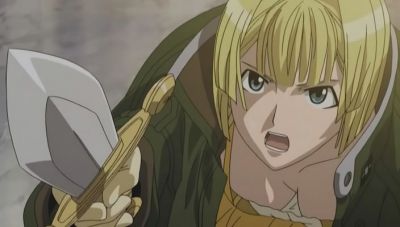
In retrospect, Pumpkin Scissors is a very well-executed concept. Too bad the concept is blah.

If anything at all, the fact that I’m writing about it means that there’s at least something redeeming about the show. I think, to be fair, the show did well as a character-driven series. We really got to know the cast and even the little episodic stuff injected periodically interesting side characters. Loli Chiwa episode was a lot of fun, as with the Stekkin episode. Not sure if the penis jokes were all that effective, though.

Still, that is no excuse for turning the last 7 episodes into a huge DBZ-like affair, with a single scene lasting across 6 episodes.

I think there’s this very enjoyable irony between the work Alice does as a noble (which she slowly discovers across the series) and the work she does for the army (which is well-explained when she describes how “Pumpkin Scissors” came about). Well, figuring out what I mean by that is half the fun, so don’t let me ruin it for you.

The idealized concept of Alice, however, is what is truly enjoyable about this show. Shizuka Itou did a wonderful job. Her character design panders just right (which is to say, very little but a lot at key moments). It’s a very simple idealist position. She challenges the gray ethical and moral areas and come up with some convincing answers, at least enough that you can think about it. She doesn’t back down from a fight, but is also smart enough to know her place.

What’s scary is that I see how much I can identify with the way she thinks and the values she subscribes to. That can’t be a good thing…


Manabi: The Real God Girl

You know the episode is good if you can squeeze 2 or more posts out of it :3 And I didn’t even have to try.

High as a Kite

Haruhi Suzumiya appeals to the earthly notion of God: someone who is powerful to craft reality through sheer power.

But the God I serve works it much more like Manami Amamiya, who makes miracles by putting people together–from friends to buddies–to do things that only buddies can accomplish. Manabi lives in a reality that is a fulfilled future, and she brings her prophetic “vision” of how things could be to inspire and bring people together. This is really what is so “heartful” about Manabi Straight.

What’s probably a little disingenuous is how apparent it all is in the show. They really make it clear with the whole seeing thing. To some end I derive a lot of joy out of watching Manabi Straight just out of my personal perspective alone. And nonetheless I think a fair look at episode 11 would suggest that the animation quality, while isn’t jaw-droppingly gorgeous as Haruhi Suzumiya 12, is well thought-out and fluid when it is necessary. The rocking out scene, to me, was better done because the body movements felt more natural, sans the strange synchronousness of the band. Granted, in a real live people tend NOT to move around as much, but I guess they had to do it to satisfy some notion of “good animation” by serving it up to the fans.

And it’s a dekkai zettai ryouiki jamboree, for real.

Seeing reality for more than what it is–beyond flesh and blood and the physical–is part of the human experience. People relate to each other, and that’s the foundation of society and meaningful human existence. Merely puppeting your surrounding to amuse yourself may be a lot of fun, but it’s a hollow thing at the end. No matter how much of a god Haruhi is she can’t meet her internal, mental, and psychological needs with just her powers alone. In fact her search for aliens and espers and time travelers goes to show that those are the sort of things we look for to fill our needs.

Granted, looking to Mikan to fill your needs is not that different than looking to Kyon to do the same, so well, there’s plenty of reasons to like both shows :)


Canonical Kanon

Wake up girl, time to face the music

To contrast, for some, the dream is finally over.

I think before we even go into things like optimism, open endings, or every other thing that has been said about Kanon over the past 7-8 years, I am glad to see it reanimated. Studio Kyoto Animation has done an admirable job, and it’s opening doors that most thought would have never opened. Bravo to whoever that made it possible.

In fact, I want to talk about more good stuff about Kanon just so you don’t get the wrong idea. Kanon 2006 is very heartful in that it delivered the things that made the game great. It pretty much covered all the basis, I think. If you liked the sentimental aspects of the show, well, awesome, because I did too. It’s sappy, but that’s just a tough-man excuse for “I lack the ability apperciate this.” I enjoy all the “service” bits, basically every moment when Nayuki or Akiko is on the screen, or you hear her cloying alarm, and so much more.

Looking back, a year ago I was writing about Canvas 2, which is another multi-path visual novel / bishoujo game that was adopted into anime form. I wanted to think about it partly because it was one of the first moving anime I’ve blogged here, but also because the similarity it shared with Kanon. I suppose it serves as backdrop for this post.

I wanted to talk about focus.

When I say focus there are two things I mean by that. One is literally what you and I focus on when we watch the show. In that sense, Kanon has a very different focus; one that probably ultimately undermined its anime adaptation. In short, it’s the moe-pandering. Unavoidably there is 7 years worth of fanboy gunk accumulated onto the Kanon franchise. As a late-night otaku slot candidate on the air, it had to home in to popular homages, screen us those precious in-game CG that now has the breath of life, and vibrantly so.

But that’s not what really did Kanon in. It’s in pandering to the more intangible, emotional story aspect of Kanon. Invariably so, the 2002 Kanon rendition recognized this so they did their best to keep the drama tense and break it open at the end. In 2006 Kanon broke open 3 times before episode 18… but what does that leave the viewer and fans of Nayuki and Ayu? A wonderful epilogue?

Alas, that’s no grounds for complaints, in my opinion. What’s sacrificed is the show’s pacing consistency. Pacing sucked for the last third of the series, and while the message and meaning of the last 6 episodes are especially touching, I wonder how many people even gotten it (well, some at least), as we’re all too focused on the strange dramatic crap that went on in the guise of building tension.

The other thing I mean by focus is related to the story. It is what the story wants you to look at. When it comes to fanboy pandering, a lot of it is in the eyes of the beholder. But in Kyoani’s Kanon we are focused, and sometimes I wish less so, on the character drama. In a show like Canvas 2, that was fine because character drama was 80% of what the show was about. In Kanon, however, maybe 80% of Shiori’s story was about character drama, but that’s really it for the most part. Kanon is a story that focuses much, much more so on character motivation (as with a lot of Japanese stories?). Understanding what Shiori, Mai, Makoto, Nayuki, and ultimately Ayu feels and think and the places they came from should be the climax of each of their stories. In Shiori’s case, being mostly an enigma we understood her feelings through her drama and interaction with Shiori and Yuuichi. That is fine. But how are we suppose to understand Mai without that wonderful flashback? Or Nayuki (at all?) and Ayu?

To that end, I think the biggest culprit is the pacing and length. Kanon would have been better if it spent more time after Shiori’s story getting itself back together, and less before Makoto’s arc (although those were some of the more delightful episodes). Yuuichi holds the key to unfold all the stories, and we should be focused more on him than the girls. Perhaps that was all impossible, because ultimately it was enslaved too mechanically to the multi-pathing plot of the game.

The irony, for you to take home, is that Kanon was a revolutionary bishoujo game because it broke rank and file not only with respect to the nature of its pornographic content, but also one that delivered its touching story in a parallel, nonlinear visual novel format in which you don’t have to befriend and solve (and bone) every girl’s problem by the time you get to the end. On the other hand, Kanon anime 2006 was enslaved to that very concept of “freedom” and as a result suffered for being the thing its original version tried hard to avoid.

And somehow, I think this is one strength and flaw Kyoani consistently displayed…