Category Archives: Modern Visual Culture

Bishoujo Senshi Insani Super H

It really is an identity crisis.

Perhaps the best way to look at my fascination in terms of categorical attractions (content, then gameplay), explain why identity is important, and bounce the ball back to you. I apologize if I am going to get kind of down and dirty in this rant, but I might as well come clean.

I mentioned Graduation 2 in my earlier rant on the topic. It isn’t really the start or the finish in making me a “prospective fan” of the genre but an arbitrary midpoint. Being born Chinese means not only I have used or/and pirated software, but maybe I have more of a natural affinity for this kind of gameplay. It is probably the first time I bought a game of this sort, though. I also mentioned Graduation 2 because it rests on a precarious area where the gameplay intersects with content. It is this intersection that pinpoints the games I want to play.

Which, I confess, I’ve played a handful of the more pornographic variety of these games. It feels as if I have played more than I actually did because I have also seen even more ripped images from these porn games (as they are rightfully called). But why am I turning this into a confession? Probably because Japan needs to confess–the majority of games that fall into this genre is pornographic. Some are really, really bad. I hope you know what I mean so I won’t have to describe it.

The sad economic truth is that porn does sell. As a new content delivery system bishoujo gaming (as I use this term as I did in my earlier rant) is driven by this stuff. You can even see the mark it left in the annuals of gaming. What was the date on that? 1992? I think I was playing Knights of Xentar back in 1994? It’s been a while, pardon my poor recollection. The point is, it’s been with us for a long time now.

But just as porn drives delivery systems, delivery systems grow from the ashes of lesser things and into more relevant, interesting material. We have games like Princess Maker 2 (probably one of the most wide-spread English-language bishoujo game, and one of the better ones–now that it’s basically abandonware), Konami’s Tokimeki Memorial games, and many others–like Graduation 2. There were a lot of different types of porn games too, as the genre was in the process of finding itself.

Here is where my story branches. Porn games have been with us for a long time, and what I said about delivery systems just now applies to every kind of game we know–platformers, RPGs, tactical games, etc. All on top of what we usually know such as casino games or some of the more creative flash game type stuff. Well, even as I say this, where is the porno version of FF7? Or Starcraft? Appearently, they kind of exist. Why? Mainly because Japan needs to confess, it manages to have a rather diverse and healthy porn game industry compared to the US.

Honestly, however, I’m talking about porn games only because bishoujo gaming is like that solitary, delicious shiitake growing off a pile of cow dung that we know is the porn game industry. And that analogy applies as to how to make this genre proliferate outside of Japan. Quite simply, for that kind of stuff to sustain itself in the mainstream, it has to either live with its cow-dung underpinning like what these folks have done, or grow it independently. I don’t really want to play porn games, believe it or not; and certainly aside from my copy of Tsukibako I will never spend money on it.

And to that end, I am also honest about these kind of games–I only play ones that are fun. Graduation 2 was pretty fun. Harvest Moon is pretty fun. Tokimemo is pretty amusing, and especially the latter ones like 2 and 3. I suppose I could say the same about Baldr Force but I haven’t had the chance, despite the pornographic stuff. Tsukihime is pretty fun, but my Japanese skills are insufficient. I am all for the growth of the bishoujo gaming genre independent of pornography.

Which is why Insani’s All Together efforts are the bomb–they port not only legally less-grey doujinshi games, they are also not pornographic for the most part. They convey what is fun to play about these kinds of games in the unique gameplay varieties rather than catering to familiar content. Fact is, porno Super Mario is still Super Mario. But a visual novel is a novel; and a dating sim is not at all like any other sim in that Sim City is no more or less different than Sim Tower, for example. I think this definition should please the Ren’ai gaming fans (to me, it just means people who like games with romantic narrative underpinnings)?

So, back to you. What can we do to grow bishoujo gaming? What can we do to resolve its identity crisis? I suppose we should be open-minded. If people want to play their erogee, they should be able to. While that means it is both extra work for the rest of us in trying to differentiate the gaming image (kind of like how anime has to escape the hentai taint categorically), it also probably helps the bottom line of companies and encourage more commercial effort in this area. Certainly, if companies are porting games over that is in that narrow pinnacle within the gameplay axis that intersects with the bishoujo motif, we should support them however we can–both pirating and by buying? Sure.

I think it’s only fair to end this little crisis on a positive note. With things like the demo for Polyphonica available to us for free, and things like Ever 17 for a moderate cost, it is definitely the best time to be a bishoujo gaming fan today than ever before. It doesn’t even matter where you stand on software piracy! Go kick some ass with your moon powers!


The Spilling Ink Pit of Fanservice Looks Like a Black Lagoon

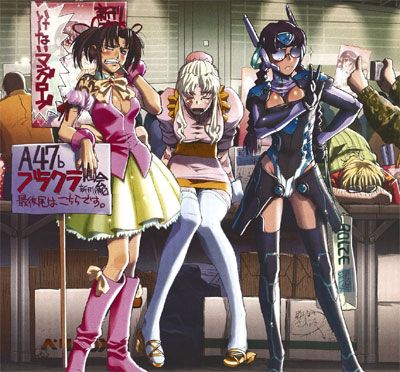
Comiket Is Ground Zero For Cosplay Indeed

I sort of went over services in general, so I hope you understand how I use the same idea here is rational, in that it is rational to pander. It is a no brainer that there is a maid bloom over at Akiba, and it is not really news–it’s just an obvious trend. People squirm, either in displeasure or euphoria, for whatever reason, at the obviousness of it all. In the grand scheme of things, it’s very Japanese.

Looking back at Black Lagoon, it is a rather Hellsing-esqe series where the key difference is only in the original concept. As much as it doesn’t look it, Black Lagoon has some kind of core, character-driven story idea behind it; Hellsing only gives us that initial setup which carries it until the mangaka figures out something better and more interesting later on.

What do I mean by Helling-esqe anyways? Cool action, old school wetworking? Maybe. Badasses, girls with guns? Lots of other stuff have that too. In as much as ink is black and most manga are inked, the paintbrush of what is cool and what are services to the audience is really broad, after you’ve been at it for a while.

In that sense, it makes Black Lagoon the anime so much sharper and powerful than Hellsing the anime. Re-scrambling, we now have the Hellsing OAV which recaptures what was euphoric about that delightful coolness which surrounds the manga series. I am guessing that was the difference.

Perhaps it is good to step back and realize that a good story is still the bedrock foundation of good telling of stories? I’m not a big fan of calligraphy, but to me that’s high art; yet the same ink, the same words, the same people use the same tools to communicate the most mundane things. No matter if you’re a doujinshi artist, a race queen, or MAKO doing a sitcom skit over the internet, it’s the same rationale going forth. Without that bedrock, it’s just spilling ink in vain.

Where fanservice intersects with narrative, there is hope, love, faith for the genre and goodness. Anime is now Japanese, omo gets excited, money exchanges hands, blog posts written. Lesser is when a story exist in vacuum–it becomes something you google up, and maybe read once, or hear others retell it better. Worse is when fanservice exists in a vacuum: it’s pornographic, cheap, boring, and beneath notice.


Bishoujo Senshi Insani

The Original Underground Vampiric Mofo

I am a stranger in a strange land when I talk about “bishoujo gaming” in general. Heck, I probably just used the wrong term there–bishoujo gaming is one of those keyword a RAML geek would use to define … that type of games for the PC. They’re mostly devoid of pornographic content as opposed to “eroge” and “h-games” are more typically known for. They’re the one you click frantically to get to from one sex scene to the next. There are all sorts of different labels to describe the various type of the same category of games–divide it up by gameplay and you get things like visual novels and adventure games and dating sims. Divide it up another way through content and you’ll get renai or horror or … the really nasty stuff that everyone plays? I don’t know.

It’s really a hard thing to grasp conceptually. For starters having all these different names probably is a good clue in that it is hard to define what kind of games I’m talking about–don’t be confused if you don’t know what I’m talking about. Heck, short of actually playing one you probably won’t have a good idea. They also vary a great deal both, as you can guess, in the gameplay axis as well as in the content axis.

It’s kind of like trying to “define” anime, isn’t it.

Yet, when you say anime people know what you’re talking about. I’m just shooting in the dark, but this split-personality problem with the bishoujo gaming (sticking to this one for convenience’s sake) scene may be an exaggerated version of what plagued anime in the early and mid 90s in how it is also intimately tied with pornography and having little mainstream appeal. Of course even today we don’t get anything more kiddy than Yugioh and the like, but is there a mainstream banner where such types of game can run under?

Yeah, and there has been such kinds of games. I think Thousand Arms or Harvest Moon is the first popular one of the bunch. Not popular enough, I guess.

But I digress. I, for one, don’t really want to know if you spent last night playing a game where you are a high school boy bent on raping every girl in your school or vicariously doing so by mentally manipulating every guy in the school, using every sexual fetishism possible, and end in a double suicide with your true love that you found in the process of turning the world into some level of hell. I want to know if you spent last night playing a game worth playing in front of all your friends! Or better yet, it’s a game where it is short (I average about 1.5 “bishoujo games” a year) and sweet and free. In other words: visual novels that are actually good novels; sim games that are actually fun, complex, not too obvious, yet not too mysterious that it is unintuitive; adventure games that have good gameplay elements; games that have good production values; good visual style; replayability; compelling; and a list of other things. That’s not including a list of things they shouldn’t be: clickfests; all porn nothing much else; music that doesn’t drive me crazy; too linear; dumb story; too episodic; etc.

I think back in the late 90s I bought a game, one of the earlier commercial attempt at porting this genre over, called Graduation. It’s Graduation II in Japan, and it is categorically a “raising sim.” I guess you can think of it like Harvest Moon, minus all the farming stuff. It was actually kind of fun, even if each time I finished the game I felt as if I just wasted 3 hours of my life. Heck, you can experience the fun with just $7 on top! It is such an old game, that it is probably easier to buy it than to pirate it.

We need more games like those.

And I’m not the only person who think so. NNL translated a few games, insani some more, and there are others that I just fail to name. They’re fan organizations, so they invariably are shady and their work can be found alongside of their original counterparts, nicely packaged for YARRRRR. Well, that doesn’t do us too much good in the short run. There are also other commercial ventures, but they tend to miss.
Still, we need more games. I think insani and a bunch of other people actually took up taking a few of the Japanese fan originals and porting them for English speakers. Now that’s free for all to begin with, so everyone can rest easy… Except that majority of them have no mainstream appeal, plus they kind of fail even more of my categorical limitations. I appreciate the doujinshi visual novel format a lot in how they can be innovative and go the extra mile to be artsy fartsy, but it really is hit or miss.

Which is why Galaxy Angel still needs your help. Even though that game still fails in a couple areas where I’m kind of a stickler for, such as length and cost, but it’s worth your support in the long haul.

And the long haul is what I am in for. I remember reading an interview of some North American licensing executive. He said he got into the business of licensing and porting anime for North America because he saw bootlegged anime. Why? Because bootleggers would not exist if there is no immediate return; and immediate return is only possible when there is already a system for the long haul in place. I ask the same question about our pirate culture. Would a bootlegger bother to download and repackage, say, Planetarian in English, and sell it? Have you seen it? And more importantly–if not, why not?

There is a whole second part to this rant–actually that’s what I am really itchy to talk about. The problem here is partly because I am, in the end, still in the dark. I don’t have facts nor even solid impressions. More importantly, this is all important background to set up the questions I will ask, which will have no real answers. To be continued, then?


To The Rock Garden

This Is How She Gets All The Way Up On Oricon

Visiting Elements Garden’s website makes me wonder, “are they hiding any more people?” They’re a new bunch of people, relatively, but since I stumbled upon this peculiar organization it made things slightly more clear as to “where did all these songs and music come from?” There are musical threads that links them all together.

But aside from that neat tidbit I have been savoring for a few months, Jal’s revelation was no more shocking to me than how no one likes Hikaru Nanase‘s Scrapped Princess soundtrack besides myself? (I think I have as many CDs from each of them, oddly enough.) And what’s up with all the Mizoguchi fans? Where have you gone? And there is just no push behind, say, Ryo Kunihiko, except spottily glorious reviews about Twelve Kingdom. Sure, we hear about YK and YK and maybe occationally some video game music big-shot, and Kunihiko probably charges just as much…

To me, they are all well-accomplished musicians, and just an excerpt from a short list of many others in the anime score and songwriting industry. Granted not every work they put out is gold, but they score rather high. Marc Mancina’s Blood+ is just as good as any. The disparaging amount of attention is disturbing. Granted I think once people latch on names as labels, the game is over and we don’t listen for quality anymore, but even before then it’s all too often a game about matching–taste or style to anime and its audience.

Back to gardening: Elements Garden is not only behind her HUUEG hit, but behind this as well. ZOMG. Does that explain the picture? I hope so.


A Collision of Snarks

It comes to me as no surprise that these three people are going to Animelo to perform. The intersection between anime, music, and idol personalities has always been one of my most liked aspect about Japanese Visual Culture. My favorite jpop personality is probably one of those people spearheading this thing from the beginning a few years ago…probably also not by accident, both ways.

Oh, actually what really tipped me off was watching Suzumiya Haruhi 12. Somehow things worked out that I watched Nana 10 right after, and double-stacking the band-ness really created this strange chasm of feelings. I guess that’s what Haruko Haruhara means when she pulled Kanti out of Naota’s head.

But this impromptu announcement matched the plot within episode 12. It’s probably a coincidence in as far as a contractual obligation (such as MUCC’s announcement with Otakon, if you’re familiar with that story), but it may be the same obligation I’m talking about. If that is the case, whoever did it is snarky to a deranged degree.

A Tribute to Lordi

Then again, Suzumiya Haruhi and its production generally have been rather sharp. It comes from both the fans, as well as individuals with KyoAni. Intelligence and a high level of coordination are generally seen so far both within the show as well as with what people are doing with it. Will the sequence of smart things continue for this soon-slotted-away TV series? It’s not going to run silent, but will it run deep?