Category Archives: Popular Culture

Your Life as a Sports Manga

This is sort of off-topic, but as with all things building up to a climax, it gets exciting.

Violence and Sex - the Essence of Batting Sports

A bunch of guys I know and regularly run into are playing in a softball tournament. They made into the playoffs (out of 20 some odd teams?) and they have a big game today, which may or may not be rained out (it is suppose to start in half an hour).

Honestly, I don’t really care that much about it. I am interested at all only because I know these guys. But hearing their story it’s exactly the sort of thing that lines up a good, classic shounen (or shoujo, even) baseball manga story. Complete with a prayer-miracle last-half-inning home runs, dramatic relationships between families and lovers (many of them are married), parents and children, friends and rivals, what have you.

The only thing we’re missing is spring training in rural China, swinging under a waterfall in Spain, or seeking legendary pitching techniques in the savanna plains of Mozambique. And even I say this jokingly, some of them might end up at those places doing something softball-related.

And even the rain-out big game.

If I had a pickup truck, I’d be tailgating.

Sometime, when I see some funny Phoneix Wright parody of trial lawyering, I get the same feeling. When drama is bigger than real life, it’s fun to read about it or watch it on TV or even play a game. Learning how to bring that passion into the actual practice, however, is nigh difficult if even possible.

Ah well, I suppose it’s not a matter of being able to enjoy two very different things the same way, but rather as they are? It certainly makes a real-life miracle at-bat all that more miraculous.

Speaking of manga, though–Brocoli Books is looking for bloggers to review their crap. Let them know if you’re interested.


Blogging 311 – Collective and Transformed, Copyrightable Expressions as Memes

Harems are memes

It’s actually a very complex topic and I’m not sure I can give it the right treatment right now, without having done all the research I want to. Treat this as an outline I suppose.

But somewhere between the shuffle of the internet, from one viral marketing tool to another, the evolution of Web 2.0, and attention whoring on YouTube or MySpace, there is something going on. Lessig calls it a war, but I think it’s a lot more subtle than that–although it is pretty serious. However, while the war (or whatever you call it) may wage on, there are some players who are the key to understand why it’s an important conflit. Memes are one of them.

For the sake of simplicity, we’ll define and call this construct a “meme” in that it is a icon, like words in a language, that symbolizes and trigger a set of experiences, ideas, and/or emotions. These are powerful currencies that brings us to laughter, to sadness, to help us remember.

1. Memes are powerful, compact, concise devices to invoke elaborate and complex ideas and shared experiences.

As time become increasingly valuable in certain societies and cultures, and as well as the size of our communication devices for mass media shrink over time (not to mention our attention span), it is increasing important to be able to deliver large amount of content over a small area. A picture is worth a thousand words, so they say–that’s why motion pictures and television are powerful? Memes, audio, audiovisual, visual, slogans, simple words, emoticons, or even body language become common methods to express large amount of data over a short time. It’s got the phat pipes, so to speak. And unlike latin or calculus, it is widely disseminated and fast to learn.

2. Increased mobility and intake demands concise and short informational exchanges

In terms of blogging, memes are both the bait and the hook. In some ways it is just another channel to communication and disseminate. Soap box where people can talk back at you. Slashdot is probably the best example. For me, 2ch, 4ch, SA, Wikipedia, Xanga, MySpace, what have you. However the juicy morsels of entertainment and education that draw us to those sites are what memes are made of. Snakes on a Plane? The online craze is unbelievable. Yet that’s what some of us are looking for–good campy movies–to begin with. It just spread like how a meme does.

3. Memes are useful for blogging, blogs create memes.

But speaking of Snakes on a Plane, the obviously stock concept of dangerous creepers in a confined area with a lot of people who can’t leave is hardly copyrightable. In some ways Samuel L. Jackson’s performance involving the various uses of “motherfucking” has more copyrightability (even if it is also not really copyrightable), which is odd. Of course I say this with the disclaimer that don’t take my word for it–the law on the book is fairly settled when it comes to Scene a Faire. Still, it might take a litigation anyways to find out. Can New Line Cinema take on the countless of parodies and references to this cult hit-in-the-making for ages to come? Probably to some success if the money is there. What’s up with the rather high 8.1 IMDB ratings anyways?

4. Memes may use copyrightable or trademarked expressions to get the job done.

5. Derivative claims on memes–not derivative enough too frequently.

If you recall the original flash video for All Your Base Are Belong To Us, you’ll remember a large amount of use of photochopped image ala Photoshop Friday @ SomethingAwful. Parody? Maybe–they’re definitely not making fun of the cultural icons they were using. And you may also recall that’s the reasoning why PA humbled themselves from the Strawberry Shortcake joke they pulled. All these things makes weak, in the context of a fair use defense against copyright infringement, the fair use defense.

And on the topic of Penny Arcade, they’re not a non-profit use per se. I’m not sure if they’ve gone farther with what they’ve had, including PAX and all, but in many ways they’re a profitable entity–enough to subsist Tycho and Gabe’s gaming habits at least. In as much most relevant memes do carry some kind of social value either as criticism, and are often freely traded, they tend to use commercial, copyrighted content that are not news-worthy. There are some that are, such as ones involving 9/11 or the war in Iraq, depending on subject matter.

6. The context in use of memes: commercial, private/public, social criticism, fact/news/fiction. It can affect the fair use defense.

And even though you can’t call AYBABTU a Budweiser ad, or even an ad for an old NES game, it evokes enough of both. What has been transformed? Certainly the images themselves and their contexts, but each of those individual elements were preserved to a sufficient extent that reminds the viewer what they are, to create the juxtaposition necessary for the meme to stick. It’s like noise music in that sometimes you want to preserve the original identity, but it in itself is not the attraction.

7. Transformative nature of memes

There is one big hurdle I think we need to decide, each for yourself. Do you think in today’s mass media society, the pieces of popular culture created and conformed to feed into our feeble minds, belongs to you? Or does it belong to those who created it? Remember, it’s inside your mind.

8. The Lockean balance

9. Redefining the public domain – who owns culture?

I suppose the last question is one that needs to be answered early on. If a movie like Snake on a Plane can be copyrightable, memes would be generally. However what’s the “meme” in SoaP isn’t the film itself, but the shtick and the hype surrounding it.

This is one of the other emerging area of law that is, for the most part, poorly chartered and thought-out. I trace it from the perspective of copyrightable fictional characters (who are some of the best memes themselves, to me). MGM v. Honda is probably the big turning point for it legally, but where does it end?

10. Are memes copyrightable?

I hope this helps you (and me) to focus a bit where the issues are today, and why it is relevant.

Well, why is it relevant? Fanfiction? Doujinshi? AMVs? Even cute little blog posts like Yuribou’s interviews? Why, what about the vibrant fan art or non-fan art that we use, for granted, as avatars, wallpapers, photochopped jokes and e-cards? It all can matter.

And lastly, this is a part of series of entries:

Comic Cosmology or the Future of Doujinshi

YooriStyle

First, that Wired article really needs responding, thx PPP.

Disclaimer aside, the author of that article, Jennifer Granick, is working for Stanford Law School’s Cyber-Law clinic. Did that get me interested? Heh.

I’ve read pieces about doujinshi’s role in the manga-laiden content industry in Japan. I’ve read people shopping for doujinshi in Japan (check out Shingo’s … loot). Now I’ve read the reactionary nudgenudgewinkwink of a law professor’s yaoi doujinshi shopping trip in Tokyo.

Of course, that’s not all. Wired is considered as mainstream press, to me. Doujinshi, however, is not quite a mainstream item even in Japan. It’s the crowning icon of geek fandom, as the semi-annual Comiket is the holy grail of Japanese visual culture fans everywhere. But for us who cares about things like media content cartels and the rights of derivative use of copyrighted works, it’s an anomaly.

Since Suzumiya Haruhi is the top pick for day 3 of Comiket 70, that would make a fine example: Would you allow your fictional creation, the characters, settings, and concept of a juvenile science fiction series to be pasted all over the internet in various form of sexual deviancy? How about the animators and their drawings? The character designers and their designs? The voice actors’ likeness robbed?

Well, I don’t want to know your answer to having your work’s integrity reduced–how about the fact that Shingo spent over $600 on them and a fifth (I didn’t look at his loot pic closely) of the doujinshi he bought ($120) was pornographic, Suzumiya Haruhi doujinshi? Multiply that by, say, 120000 (a rough estimate of attendees on the third day)? Ok I know the numbers are way off and they’re estimates, but it’s still there to make a point: The reality is that in North America, that kind of profit making is not possible; at least not without a big, fat lawsuit attached.

Yet that is just not the case at Comiket, or the doujinshi scene generally. Creators often turn a blind eye to that. The behavior is reinforced when many of the creators themselves are a part of the doujinshi scene. The top two people for the Comiket committee are both professionals in the field; a manga critic and a manga editor for a major publisher. That’s not to mention the number of circles run by people who are professional mangaka, illustrators, designers, animators, etc.

Or the number of “professional” doujinshi circles, for that matter. People can make a living off this? That would be news to me if it didn’t make way too much sense. Even if for the most part doujinshi is inexpensive–usually size of trade paperback comics, and often with some colored pages, each going for about 1000 yen–it also doesn’t take a whole lot to produce one.

And here is where I totally kudos Granick’s second point: a creative environment fosters creative people when they’re allowed to innovate on other people’s intellectual works. It’s a careful distinction I’m making: it’s not about having the bread-cutter and bread so you can invent sliced bread, but being able to use knives, breads, chicken, widgets, and whatever so you can learn how to invent crap as a skill, and being able to make your creation relevant at least to a significant amount of people.

Indie artists and indie comic artists know how hard it is to break in. It’s kind of a serendipitous event that I’m so familiar with Megatokyo, because that could be considered as one of those webcomics that has kinda made it. And how so? It hitched a ride on roads paved by others. At least, if the road construction crew known as Air, Kanon, Martian Successor Nadesico, Bubble Gum Crisis, the concept of shoujo manga, and many other did pass by you, something like Megatokyo might ring a bell.

Indeed, it’s about harvesting that nexus of popular culture in order to web in an audience. It’s totally undeserving, but on the other hand it’s artistic expression at the edge of everything to fill in a vacuum untouchable by the legalities of copyright law and the common practices of copyright IP licensing. Just how do you make a pornographic version of Super Mario Bros crossed with Final Fantasy 7? Yet I’m sure there’s a significant demand for that, you sickos.

The nodnodwinkwink is really just that: America’s content producers and distributors: drop it already. You’re never going to reap where you are never going to sow, so why not let freedom of speech reign? Why not let culture develop like culture does? It fosters creativity! If you worry about integrity, you can still make a point out of that–Japan’s doujin scene is very good about that kind of ethical codes (unlike English-language fansubbers, sadly)! Besides I think any sensible individual knows to keep their Melfoy x Harry Potter yaoi somewhere where the sun don’t shine, and we can just tar & feather those insensible ones anyways.

Second, the future of Comiket.

Talking to a friend who talked to some of the Comiket committee people makes me understand that Comiket itself is just like any other convention structure that you’d expect. Considering the sheer size and the kind of obsessive behavior they have to combat, they actually have quite a tough time. On one hand, the recent years of Comiket had the local riot squad and FD handy at the event, just in case something breaks out; that’s not to mention the scores of security people they hire and the medical people. On the other hand they have to combat things like crime because the overnighters (people who camps out at the Big Sight from the day before) are usually loaded with cash (well, that goes for all the Comiket shoppers), attracting gangsters. Not to mention it’s just a big pain in the ass to anyone who lives near Tokyo Big Sight and the surrounding transit system.

But troubles aside, it’s still the pinnacle and heart of the Japanese doujinshi scene. While doujinshi and the like are sold all year round, in stores as well as in other cons and market gatherings, there’s already that legendary aura around this event. It’s still the de facto commercial end of operations, drawing clubs, circles, veterans and nubz alike. If someone were to pull a calculator and did a net revenue thing, it would yield an impressive number. Even with the fact that the doujinshi scene gets away with rubbing copyright law, it’s becoming a large enough of a thing to worry some corporate interests.

And of course, there’s just a problem with its sheer size. It’s hard to run a con that huge. Otakon capped its attendence in knowing that to run a con that’s even bigger it would require some significant change in its costs, characteristic, venue, and/or organization. From its humble beginning, Comiket went from 750 attendees to its fire-hazardous mass today. The real attendence is sketchy since they’re tallied on a per-day basis, to form a total of 420000 for C70 this past weekend. Obviously a lot of people went on more than 1 day, so there’s a lot of double or triple counting.

Still, one must contemplate the eventual end of Comiket. I’m in no place to guess how it will end and why, but it can’t go on forever. Has it already gone Red Giant? Will it go dwarf or nova next? These are exciting times indeed.


Ayako Kawasumi Otakon 2006 Redux

Ayako Kawasumi

The least I could do for my fellow seiyuu fans is to do a brief retelling of the Kawasumi panel at Otakon. You probably can find other retellings out there, but I’ll try to add more and flesh it out. Anyways, it has been only 8 days since the panel, so we’ll bound to see more (especially press coverages) in the coming months.

I do have to apologize, though. I spent a good amount of the time at the panel standing really close to the front, where the acoustics sucked. I missed out on some stuff, as a result. In fact, both of Otakon’s 400-level panel rooms had the same problem: it was very difficult to hear what the sound system is piping through if you sit at the very front, or on the panel. Actually in terms of the Kawasumi panel, the result was that the Q&A session was done AX-style–everyone lined up at the mic in front and we fired questions from the front of the line. Basically, we just walked right up to Kawasumi and The Ukulele Translator Guy (“Taka“) and delivered our requests and questions at a close proximity.

Also, since there were no flash photography to be had, pictures were not so easy to come by–good ones at least. The ones you see in this post are all props to Sapphire & Co. with the assist. I didn’t get any good ones….well. Short story which I’ll recite below.

Continue reading


Trap-chan, Fanboy, Tool, Punk’d, and DQ – A Convention Primer

You call this a Roberta cosplay? Shame.

Another way to look at a con, from a top-down framework, is how anime cons serve several purposes across the board. I’m going to try to list the most prominent and attractive reasons here in an archtypical form, but who knows, some people come to cons for very specific things sometimes. Anyways, the follow framework basically categorizes the average con-going crowd into 5 types, and one could describe the population of each con event with these categories. It’s possible that one person exhibit multiple, even all of these traits. However generally there will be one guiding, overpowering tendency–or else how would you know which panel/event to go to?

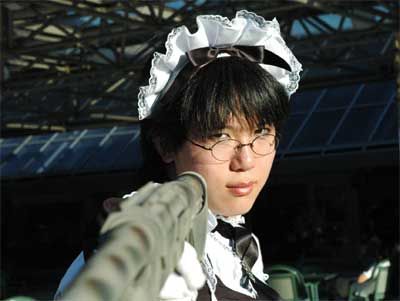
The Cosplayer. The general trend in anime cons in the US is that cosplaying is a necessity. This is actually a divergence with cons in Japan where cosplay is a very distinct activity either as a means or as an end. Today, con cosplay has gotten to the point that anyone can cosplay and go about doing any kind of thing. Crossed with other activities such as doing a skit at the masquerade, a hall costuming contest, LARP, or even just for meetups, the cosplayer is ultimately engrossed with costuming. In as much as race cars are meant to be raced, a con is a race for those well-oiled costumes. Ahem. Of course more traditional use of cosplay as booth-babe-age also happens, even in Artist Alleys type places. Some do it for only the attention whoring aspects. There are also a lot of people cosplaying just for the giggles, but 9 out of 10 of those are crap cosplays or creepy old people.

+: They give anime cons its flavor. They’re dedicated (it takes work to get a costume together!), and generally pleasant.
-: They tend to be attention whores, and prone to drama. Also too many cosplays just suck these days.

The Fanboy. It’s hard to find people who are very much so in this category, but often times these types exhibit signs of obsession. They would line up for a certain event at the expense of other, leisurely fun things to do. They have 1-track minds when it comes to *the thing* they attend a con for. Like the typical fangirl at a Yoshiki autographing session. Or my French friend who’d travel to the US just to see KOTOKO. Honestly, they’re generally a good group and they make cons fun for everyone; on the flip side they can also manifest for the worst, and all it takes is just a couple bad ones to ruin some event.

+: They’re the ones that cons are meant to cater to in the first place. They welcome our guests of honor and gives everyone something to talk about. Also dedicated, but only to their respective fans and whatever they worship.
-: Too much dedication makes a certain event difficult to access for normal people. Need to shower more. Scares normal people.

The Cruiser. I’m probably squarely in this category half of the time. We go to cons for what a con is–its programming. We browse through the cosplayers much like how we go through a stack of promo posters at the dealer’s room. We go from one panel to another. Depending on how hardcore you are about it, you could take it easy and even go visit the local attraction when traveling to a faraway con. Taking time to eat, rest, and even go to bed early if there’s nothing interesting going on at the end of a tired day. Lining up for the masquerade is something we do out of tradition, and we always have a blast at the AMV showing. The sad thing about this group is that they are not too passionate about everything, even when hanging out with friends.

+: They’re the bulk of con goers. Relatively normal.
-: Often conceited and selfish, prone to burn-outs at cons because they’re just here, and not for something specific. Make dealer’s room line really, really long.

The /b/-tard. I use this word not only in the familiar 4chan.org sense, but in general. Cons provides a context that not unlike how 4chan provides a context for anonymous posters of random pictures. With decreased inhibition from peer behavior, lack of sleep, use of certain substances, what have you, they may go around glomping random people, hold up stupid signs, mosh at the wrong time, whatever. Elevated case can involve inappropriate crossplaying and other kind of stuff you don’t want to know.

+: They’re funny.
-: They’re jerks.

The Social Butterfly. This is the type of people who comes to con just to socialize. They could be any of the above categories, but that’s what keeps the coming to cons. Usually also because it’s just a lot of fun to watch /b/-tards make fun of themselves, and it keeps them up to date with what’s going on. These social people are often veteran con-goers, and can resemble late stages of a burnt-out Cruiser or Cosplayer. Sometimes a very dedicated fanboy could also be at a con purely to socialize outside of seeing only 1 event. Sometimes this can describe certain con staffers!

+: They make cons worth coming to year after year, despite the change in programming.
-: They can get in the way if you’re one of the other type of con-goers. Also drama-prone.

To me, ultimately anime cons are giant parties, or a congolmeration of several parties strung together, both chronologically and geographically. Compatible people hang out in each of the party types. For example Saturday night, you have your Cruisers and Cosplayers and Social people at the masquerade, with some /b/-tards. Rest of the Cruisers will be out at dinner with other social people. Some Cruisers with Fanboy leanings will be with other Fanboys at the programming they’re interested in, along with /b/-tards doing whatever they can get away with in the halls hanging out with other Cosplayers not doing the Masquerade. At a panel like 4chan, you get a good mix of Fanboys, /b/-tards, and Cruisers who reads 4chan. At a panel like Geneon After Dark, however, it’ll be mostly just Fanboys and whichever Cruisers are still not tired at that point. The Social Butterflies are probably at various room parties, hanging out at the hotels, or karaoke. It’s party-after-party-after-party like an endless game of musical chairs.

With the framework laid out, there is one thing on my mind that you can use it for–to plan your next con-going experience for maximum profit! If you want to skip lines, pick ones with the least Cruisers. If you want a lot of LOL, go to the /b/-tard things or one with a lot of Fanboys. If you want some con atmosphere, hang out with the Cosplayers. And always, have some Social Butterflies in your con networking map. If you want to know what’s hot and what’s not, ask a Fanboy, a Butterfly with fanboy tendencies, or an expert Cruiser. If you want to stay safe, stay away from the /b/-tard things.

I hope this is helpful.