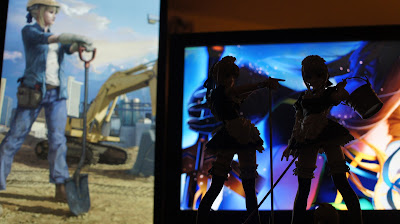
I’m in a figure state of mind: sales, selling stuff, cleaning, putting things where they belong…and did I say cleaning?
The Yard Sale
I’m in a figure state of mind: sales, selling stuff, cleaning, putting things where they belong…and did I say cleaning?

I’m not sure if anyone made the connection yet, but what does Spirited Away and Type-Moon-verse’s Mahoutsukai no Yoru have in common? Actually there are probably several things, but there is one specific thing I’m looking for.
This time around Spirited Away feels almost like, well, a great film. I really enjoyed it much more this time, and details that didn’t pop out at me when I watched it times prior, did. The way Chihiro shook during her first night at the brothelbath house; the visiting of her parents during the first morning subsequent; how Chihiro ate the mud-dango [insert some Sencolle reference], and then applied it on her friends later; the way she held down a flapping dragon; and most importantly, the answer to the question I posed earlier, which has nothing to do with Chihiro.
I made that weird connection very early on in this viewing and it sort of pinned down the attitude I held throughout the film. Yubaba’s bickering with the people around her and the big baby now makes a lot more sense, as well as the way Zeniba treated Sen and her friends. Well, maybe I should credit having fully absorbed the Totoro experience between now and the last time I saw Spirited Away. It helps to unpack a lot of the details. Or maybe just that since then and now, I saw roughly like, Ghibli’s entire catalog of feature films? Oh wait, still no Yamada’s. At least when Chihiro did her bid-goodbye line at the end, it reminded me how Lin reminded Chihiro to do the same in the very beginning. I guess that’s just me showing weakness! Or maybe it’s the result of my training–of watching all this Ghibli in a short period of time.
I took the two films as double headers because I could. Ocean Waves made a nice chaser. So did my 2nd supper made up of shawarma, bakalva, and mint tea in between the films. In retrospect, Ocean Waves is a much more subtle film but yet much easier to process. You can enjoy it without thinking too much, and “get” all of it. Or at least that’s how it feels at this point. Within 60-70 minutes it makes a very compelling case, and in a lot of ways it feels like what a Makoto Shinka should’ve done if he were to direct a Ghibli film.
The thematic takeaway this time feels a little odd. For some reason I focused a lot on the 1-year reunion scene, in the way all these kids fondly think back to their high school times, ups and downs. Remember the scene right before it, one dude punched the other, one girl got scared but made a bunch of other girls mad. But now they’re having a great time. Is that how I feel today? Is Akiko Shimizu’s point spot on? I guess that’s the thing–some things gets even better. It’s a very positive way to look at the loss you had in your earlier days. It’s very practical and yet romantic, although at this point I’m not sure how Matsuno thinks about it. Maybe Shinkai is just telling his side of the story, 10 years later.

It [NSFW] might not cause pain per se, but it’s a hassle to catch a bunch of movies in the span of such a short time. And it’s often on a weeknight. Invariably each movie is a hit in the wallet and in the overall consideration of time, but invariably it is all so very much worth the while.
The North American distribution of Ghibli works, GKIDS, is throwing another feast of Ghibli screenings in NYC starting this week and ending on Dec. 20. Hopefully I will be able to catch a bunch, most notably the ones I missed from last year. Well, I’m not sure I will watch twelve movies again, but definitely at least 2. Spirited Away is up next, and hopefully Castle in the Sky and the Yamadas will finally make their entries in this blog at some point. I still owe Kiki a date! So that’s 3-4 films, and hopefully I can catch them all. (What’s scary is that I think I can watch Porco another three times! It’s been about a year, after all.)
You can find all the details here.
More realistically speaking, I think I’ll end up watching: Spirited Away, Kiki’s, Howl’s, Ocean Waves; maybe Yamada’s, maybe Totoro, and/or maybe Pompoko. Whisper, Porco and Laputa are long shots. Hopefully, also, I can catch the “dub that I haven’t seen before” for some of these, as I’ve heard only the English dubs for some, and Japanese dubs for others. Well, I’m not going to worry too much on missing the English dub other than Kiki’s (which I have at home anyway). So even if I go for broke I’m not going to catch 10 or whatever many films that I did last year. That’s a good thing.
I voted for more shows dropped and more time shooting aliens this November, but I got wet from Konya wa Hurricane. The net total is this post about random observations. If I didn’t mention a show here I probably dropped it, or on hold until whenever like E7Ao.

Chuunibyou demo Koi ga Shitai! – It’s less mentally offensive than Hyouka because it doesn’t try to engage me on higher level of analysis and thought, so it is much easier to watch. But in a lot of ways it’s definitely inferior. I suppose this is why Dekomori and Kumin exist. I said most of what I wanted last post.
Teekyuu – What I watched: Teekyuu. What I expected: Sofuteni. What I got: Zero Punctuation. Also, this is Mappa? Good on them. About 3000 yen for all of it on Amazon! [Side note: man, pagerank for CR on this keyword is horrible.]
Seitokai no Ichizon & Ebiten – I lump the two together because clearly both are being screened on Nico first (how about that US merger huh) and then picked up by a TV station the season after. HOPEFULLY this means CR will stream it starting in Jan 2013. As far as Seitokai no Ichizon goes I’m pretty okay with the new season, once I got used to the new Akaba voice. It was easier to deal with Mafuyu’s voice because it’s a very neutral tone, although I miss the very subtle tonal acting that was present before, that gave it an extra edge of melancholy. Oh, I probably should mention Seizon Lv.2 Episode 0 was AWESOME, because man, I miss Houko.
Oniai – On the merits, it’s probably worse than NakaImo, and it is more or less the same schtick–crazy girls tries to get into main guy’s pants, entertain mostly with OTT antics and not with so much fanservice, hides its plot/character chops. Takeaways are the two underage seiyuus in Ibuki Kido (as the main sister girl) and Sumire Morohoshi (the 12-yo manager genius). Kido is actually a year younger than Akiko, and Morohoshi a year older than Arisa. My favorite gag has to be the T-shirts. It’s like “Primary schoolgirls are great” but even better. Because I can wear something like Che Akiko and not get arrested.
Zetsuen no Tempest – I’m fascinated by this show, but it’s not the most engaging thing. All the characters are mysterious and hard to read, and you don’t really know what’s going on. How can they build a compelling plot on that? Just turn a bunch of people into metal and have giant eyes float out from the ground, I guess. Oh, add a romantic triangle involving some really messed-up interpersonal relationships. What’s the best about all of this is that it’s done with the precision of a Shakespearean play, instead of something more, well, relatable and visceral. What’s the worst is that it’s all posturing and TL;DRs, with the reasons and rhymes in thoughtful dialogues and monologues. Yeah, it can be kind of dull. It’s no surprise that I like Tempest; I’ve always liked shows like this. Having Bones behind it just make it a lot easier and makes it possible that I can talk to some people who may be drawn in for those superficial reasons. Book of Bantorra, anyone?
Hidamari Sketch S4 – Really digging it so far. Although, as others pointed out, unless they do something with the new first years in a major way, this is going to be pretty much more of the same for another 13 episodes. What they did in episode 6 is exactly what has to happen for Nazuna and … the girl with the PC.
Jormungand S2 – Eh, it’ll do. A lot of the suspense is gone with the second season. Maybe I should write a blog post about sequels like this. And Hidasketch.
Space Bros – It’s gotten to the point where the anime just has to make one more mistake before I drop it (for the manga). Invariably it makes a mistake and I’m like, man, I don’t want to read manga, because I just don’t have that mode of consumption handy in the way my routine is. But invariably, also, Space Bros redeem itself in some minor way for me to keep putting up with it.
Psycho-Pass – I can put up with this. At least it rewards with some pretty cool ideas. And a strangled Ayanyan.
Robotics;Notes – This anime is my Yoshino Nanjou coming-out-of event. Granted at this point it’s all kept in the dark, plot-wise, so I can’t really say anything about this anime besides that it’s already seeding important details, as all non-linear narratives invariably do. I’m not sure it has given me enough to go on but I’m just blindly rolling along with Tall Robot Nerd Poplar. And is Kai a jerk? Who cares?
Magi – I think this is my top show this season. But it’s one of those “watch but don’t buy” kind of thing since the show itself is just excellent, but not something I’d obsess over. Maybe it will change and upgrade into something worth owning.
Busou Shinki – This is pretty lame. Limp, even. Especially when it’s less like Strike Witches and more like… Infinite Stratos? At least that’s how I’m watching it–for the mecha battles. The animation is what I like best, along with the tech/setting. But I’m not sure how else it appeals to the cute-girls-do-cute-things demographic. Maybe I’ll punt it after all?
K – The music is so pimp that I feel like playing Persona 4 Golden. Might punt it. And yes, this show works great as a comedy…and that’s it.
JoJo – OMG. On the other hand it’s just as I expected from David Pro.
Girls und Panzer – This show is brilliant. Not only it capitalizes on what is obvious as the concept became a thing, it did enough of a twist to make the whole venture seeming worth the while. Its ensemble-cast style organization yet focusing on a handful is a gamble ultimately, not because they’re doing that, but they better be focused on the best five girls out of that lot of dozens.
Medaka Box S2 – I guess this anime took the Negima turn? Not that I mind; Medaka makes a good protagonist, although it’s really just a 2-person show between her and Zenkichi vs. the world at this point. Not that I mind that, either.
Shin Sekai Yori – It’s the “different” anime this season, although how it’s different is unclear. I think it’s at least something interesting for a more “mainstream” audience (because it isn’t really mainstream) but this is definitely overrated. If I had to criticize it, two things–the pace is horrid and the direction and scripting is clumsy. Usually these two things cause me to drop shows, but the setting sort of redeems it. Or the underage sex, I’m not sure. I predict at least one commentator at the end of this cour will complain how it does not fully utilize its setting.
Muv-luv Alternative: Total Eclipse – Lots of BETA action in the first half. Second half is more about Total Eclipse of the Heart amirite.
Little Busters – It’s the sort of moment when you recall every Key/VA anime event you’ve personally experienced since the beginning and you go, “we’ve came a long way.” It isn’t to say the visual novel to anime mechanism has improved to the degree that those products are something worth while–maybe it has. But Little Busters was originally the concept, and now it has arrived; perhaps its only flaw was this anime existed starting after Angel Beats. None of that, however, heals its deadly pangs of boredom.
Initial D Fifth Stage – I guess no one sleeps in Tokyo in the night of fire about love and money. And I still would like to test out a FR-S/BRZ sometime.
Sakurasou no Pet na Kanojo – The Pet Girl of Sakura House? Inn? Guilty Crown? I enjoy the roomful-of-lunatic approach to the series and it is very much got everyone looking at the characters as characters, and that is already a win for the anime. As usual I have a harder time buying in, but the array of otaku references makes the low production-value pill easy to swallow. [LOL I forgot about this show srsly…now it is included!]
I really want to keep watching Kamisama Kiss, but I have to drop something in exchange. I might.
At a glance you can tell Funimation is pushing a lot of new titles this season. It’s a promising thing because in the past 18 months they are major slacking on new acquisitions in my opinion, given the share of home video releases they put out. On the other hand, while I have been test driving their premium account across my phone and PC (mostly on the PC), their quality of service is still rather lacking. It’s better than just embedded Hulu streams that TAN is doing, but that’s like comparing your current self with yourself in 2002. At least I can get things to work after enough experience “jiggling” the various nobs and switches. Like how in Chrome when you change resolution to 720 it autoplays, and half the time it tries to play 2 streams in the same player if you hit the wrong buttons in the wrong in sequences.
At times like this I wish I was the kind of otaku who only watched anime off the tube, so I can cut it loose and just stick to this sort of services, paid or not.
There are three fronting shoujo series this season. Two go to CR, one to Funi and AN gets one of the two from CR. Not sure which one wins but that sounds at least fair.
Overall a pretty mild season without a smash hit, unless that boring Urobuchi show turns out to be a gem or Sakurasou becomes the second coming of Toradora. The various continuing series are all pretty strong and they will entertain, where as new series will have to flounder a bit before they find their footing. We’re at the half way point now, but I think shows like Garupan and Oniai have no real grasp on the audience at this point. Maybe that’s okay for those kinds of shows.

Much like Hyouka, I have a love-hate relationship with this season’s Kyoto Animation product, Chuunibyou demo Koi ga Shitai! I love it because visually it is a cornucopia of all things that power anime and make it an enjoyable medium. I don’t like it because ultimately it’s the same tiresome teenage-coming-of that Kyoto Animation has done a dozen times before…most recently in Hyouka. Its saving grace, probably, is in the two anime-only characters. Dekomori, specifically, simply made the show a lot more fun as far as her fast-pace personality and those gags for a character smarter than her pay grade.
I want to specifically talk about episode 7, because throughout this episode the dreamy Kumin-senpai reminded me how things would be like if Kyoto Animation animated The iDOLM@STER. This random post is brought to you by the seiyuu connection between Kumin and Yukiho, Azumi Asakura.
Isshiki probably did not say that Kumin looked like a Showa idol in the novel, but in the anime it is quite the trigger, at least for someone with my disposition. It means Kumin channels those old-timer (well, ’60s-80s) TV and stage personalities (I suppose the term applied to only women) who stood tall and sang, giggled gracefully as they mingle with various MCs on variety shows or visiting soldiers on tours of duty. It’s that kind of image you see inside run-down Japanese bar restrooms, on beer posters. It also personifies, today, a kind of lost past that some people long for. A lot of ink has been spilled in the recent years about Japanese idols generally, but this kind of thing is more about a class of people who conduct themselves in a certain way? It’s charming.
[This blog post is also brought to you by Animazement, an anime con that has consistently brought over Japanese voice guests that personify this idea.]
As a matter of comparison, Yukiho Hagiwara is no Showa idol. She’s more like your timid AKB48 understudy, except proficient with the shovel. Someone like Takane or Azusa is closer to that concept. Kumin, on the other hand, is slowly getting enough screen time to show off her after-school regalia, complete with a strategically placed mole. As Isshiki said, Kumin fits that ideal to a tee, right down to her white, one-piece swimsuit. How quaint, I guess.
And it is quaint. Dekomori and Rikka may be in a world to themselves, but Nibutani sets a different kind of ideal–the one I’m more used to. I’m not sure how realistic Nibutani’s attitudes are, as far as what goes for “normal,” but it seems reasonable. Here we have a totally someone from the left field in Kumin and, well, it’s kind of nice, not to mention it is entirely natural. It’s like having a visual (Rik-)kei idol next to an ’80s idol, and then you have Britney Spears-tani right here. To that end I’m not sure what the show has to say about any of this, besides that Isshiki would shave his head for any one of them.
For North Americans, you can catch Love, Chunibyo & Other Delusions!, Ep 7 “Reminiscences… of Paradise Lost†at the AnimeNetwork, with a subscription. The translated episode title happens to describe Showa-era nostalgia too, doesn’t it?
PS. There is one strangely technical aspect about Chuu2 that I like: Nijine is the composer. I previously stumbled on his work from Hatsukoi Limited, and the same weirdly fitting music came across in Chuu2 as, well, weirdly fitting. I really like that overly sentimental take from Hatsukoi Limited but as far as I know I am the only person ever who took note from that show’s music (outside of the OP/ED and Marble connection). In this anime, well, I’ve not made up my mind yet. But I think this Nijine person really has it together, given this pretty impressive list. Impressive only because I like a lot of these songs.
PPS. Seiyuu X-COM is kind of on hiatus, partly because of the approaching holiday, and also because I have a current-season backlog that I’m trying to hack away. It is as if I’m barely getting by and keeping my face above the surface, but only to be overwhelmed on every Thursday. Losing a week of broadband internet because of Sandy certainly didn’t help. With Thanksgiving coming up hopefully that means I’ll have time to catch up for good. Or maybe I’ll drop even more shows.