To Rewatch, To Buy Blind: Herald for Kanon

She Kicks High

Just how often do we rewatch something, and just how much does “not knowing what happens next” drive us to certain consumer (or non-consumer) decisions? The more I think about this topic I realize two interesting notes. At first my answers to these questions merely fill out the presumed value of a bigger economics picture, but it seems that it can help answer some substantive questions as well. Like, what do well-received anime series have in common?

The questions about rewatching and why we watch/buy shows we have not seen are invariably linked, I think, because the same mechanics play in part to answer both questions. One way to look at it is a simple, common-sensical approach that a great show is worth re-watching. In some context this means you simply pull out that copy of Haibane Renmei to feed your melancholy soul on a snowing Saturday afternoon. Another context means I bought Cowboy Bebop to rewatch, partly, but also as something to have in my library so others can watch it too. At least in both instances we are making use of what people buy home videos for.

The reasons that drive us to pursuit new, unviewed material are different, it seems. Perhaps, and for many bloggers, it means to find out what is new, and to discover if this new anime is of any merit. As long as there are new anime coming out, they will naturally find its audience and people will watch new things. For some, they watch new things only because it’s “good” — on par of the old things that are “good.” (“Good” here meaning having one or more desirable attributes.) Many people decide new things to buy based on this standard. Sometimes some of us stumble upon new shows.

But the pattern that is underlined by both is a matrix between quality and sharing. To some, a pursuit for new is a qualitative matter: we hate cliffhangers and unanswered questions. To others, it’s to find more of the same: “good” shows, show with attributes we like. Also, in the process of blogging, or mapping it into the fan scene consensus, or simply talking about a show that interest you, it generates interest for that show. It brings people into awareness of its existence, and in turn, an interest to see it.

To that end, a “good” show that gets talked about all the time is de facto the show that will get watched the most. Evangelion comes to mind. A show that no one talks about, and is crap, will not get watched. I can probably name some names but that would do the really obscure and crappy show no justice.

That much is probably common sense, too. But what’s interesting now is how we could tweak the parameters of “Interest” (to denote what makes sharing likely) and “Quality” to explain some other things one sees. Like the popularity of Naruto or DBZ. Like why Kirameki Project is obscure. Like the importance of the first episode. Like the importance of sending out the “right” “vibe.” Like how to market your show to the right audience.

To me, after all this analysis, it seems to describe my anime watching habits pretty completely. The reason why I watch a lot of new TV fansubs is because “new” is a qualitative trait I look for in shows–being kept up as to what’s happening in the scene, what are the new developments. It’s also a preference towards art style, as I don’t particularly like certain styles of retro-looking animation.

What’s interesting is that shows themselves can create “Quality” elements. Watching the 16 episodes of Simoun, for example, creates a (very, very strong) desire to find out what the hell happens next. For some, the first 2 episodes of Fushigi Yuugi would have done the same, at a lesser degree. Or the first 2 episodes of Initial D. The “pilot” effect is strong when coupled with this sort of hook. Some people look for this kind of quality as a “good” thing, too. There are other responses which a work can solicit from us, that people desire. A very funny show naturally is qualified by its humor or jokes. It could even be a tongue-in-cheek sort of humor, but as a rule of thumb there aren’t too many people who can appreciate it to the extent as other more obvious traits.

There are also places where “Quality” and “Interest” overlaps. These elements, both qualitative and external to a show, are where the most excellent shows and franchises do well in. I suspect why Suzumiya Haruhi’s “perfect storm” rationale behind its massive popularity is a combination of hitting people with the right kind of qualitative traits (high production quality, good acting, suspension of belief, the right genre) and some not-so qualitative traits: such as capturing a very important, vocal segment of the fanbase; a wide approach instead of a narrow, element-based appeal; and having the right amount and right type of marketing (during a market lull to a degree).

On the “Interest” side of thing that tend to be external, we have obviously, the right kind of marketing. Samuel L. Jackson, for instance; or the name GAINAX. Shoujo is a good tag word in the North American market, as another example. Even having the right OP/ED song by the right kind of people makes a huge difference, but that might also be qualitative.

A strong fan interest kindles more fan interest. Hype begets hype. Suiseiseki is not a lonely doll but the banner of an army. VIPPERs. Dancing VIPPERs. SaiMoe. Animesuki forums. Anime conventions. Comiket. 2ch. And many others. All these are factors, “Interests” which leverage people into buying, watching, rewatching, or finding out about shows. It may be simple word-of-mouth. It could be hype. It could be just that a person sees for the first time images from a new show, and is interested.

Continue reading


Tsuyokiss Aria REVOLUTION: Genre Kings x Delineation

This Picture Is Protected by OFP! ZOMG

You all have your own opinions on this, so I’ll be brief about laying the foundation and get into the meaty theoretical crap. The premise is simple: as genre is refined and redefined, people start to take cue as to what’s the best way to pitch within a familiar context, and evoking the same feel to reach out to the same demographic. The parallel is drawn from the “genre innovation” model that describes the video gaming industry and Nintendo, so if you’re familiar with that, you should have a good foundation.

From a cynical perspective, it all resulted from some successes like Love Hina or Ranma 1/2, where these genre-breaking/creating masterpieces started a trend. Just like telling your friends that “Trinity Blood is kind of like Trigun” will automatically get some of them to check it out, even if it isn’t really like Trigun… When a show resembles a certain something popular it gives the creators the incentive to mimic.

And there’s nothing wrong with mimicry. But when a genre is so well-defined (enough for a wiki article but not enough for bright line rules) because of the excessive mimicking, that if you toss all the divisible elements of what makes a harem anime into a randomizer and when the result of this mad-lib returns as a familiar premise of a real show, something is wrong. It’s not just because it’s absurd, but it’s so absurd that the work stands not on a creative bedrock recognizable by law. (Or is it?)

Thankfully, there are many ways out of this trap, and I think the anime industry has long since started to climb out of. When people like myself with no prophetic powers can see that, it means others are probably annoyed as well. Tsuyokiss is one example: the harem narrative reversed on its head; a typical bishoujo game adaptation has been spun around by the anime’s core team to draw a familiar story. But even then, such an “obvious” trick doesn’t distinguish the trite attempts at entertaining in TonaGura, for example, with Tsuyokiss. When the dumb shtick slapstick becomes the defining characteristic of your show, you’re not going to go anywhere.

But I suppose what these two shows told me, more specifically, is that people are ready. Sure, shows like Shuffle and DearS may prey on the weak still, but when I see Higurashi or even Negima, the vibe is just slightly different. In as much as in a post-Love-Hina reality we no longer can do a shounen romance show without the harem taint, people are tired of that. People are looking for the same, patently haremic elements elsewhere (looking at the new round of SaiMoe for some clues)–Aria, Rozen Maiden, School Rumble, and Mai-Otome, just to name a few. We want the relationships, the characters, the lightheartedness, outside of the traditional harem context. For some it is the desexualization of the context (Rozen Maiden); or it’s the focus on mood without drama (Aria); or inversely just the drama (Mai-Otome); or even pure comedy with little anything else (School Rumble). These shows all contain, for practical purposes, “harems.” However they do not carry themselves structurally as so typically.

Here is where we’re at a loss. This MMORPG dude says where things are going for them. Where are we going?


I Love Ufotable? TARTAN CHECK This!

I literally was rolling and laughing when I found out about Manabi Straight. Not because it’s UFOTable publishing both manga and picking itself up for the anime production, but they call their manga branch…

TARTAN CHECK.

What’s so funny, you might ask? That’s because I am a Tartan. Just looking at their checker-filled website fills my heart with giggly delight. If you’re unfamiliar with that kind of self-designation, you should consider reading up on college sports culture in the United States. It is crazy and possessive and a lot of fun.

Oh Japan, how you combine the weirdest things and gives me this out-of-context joyride. Mutant Dwarf has nothing on this one, well, for me at least.

Meanwhile you can read what little more about Manabi Straight that is available. Like how Horie is the voice actress for Manabi herself, Marina Inoue (of the Cossette fame) is going to also be in this show, and what other image CDs are going to be released…


Saiunkoku Summer Ale – Less Filling, More Taste, Equally Patriotic

Hayate Yagami Salutes! (Has nothing to do with Saiunkoku Anything)

If one were to liken story-driven anime series to beer, Saiunkoku Monogatari would make a nice drink under the tepid breeze of summer. To me, however, that’s sort of besides the point. It is either delicious or disgusting. It either goes well with what I am eating and doing, or it doesn’t. It’s either affordable or overpriced.

In as much as I compare anime with beer at all, something like Windy Tales or Mushishi is by all means much more interesting; and dare I say, superior than beer, so the imagery wouldn’t work so well. To cop a line from Bokura ga Ita, those kinds of shows are like either like drinking hot cocoa after spending a turgid December day outdoors, or hearing your favorite song play on the radio on your drive home from work.

But I got nothing against beers. It’s just that since it’s such a prevalently consumed beverage in North America I figured a rather stock-genre show like Saiunkoku Monogotari would fit better as a comparison. When people praise this show for its deep intrigue and complex character relationships and expositions, to me it means simply that the original writer got its job done. It speaks little to the merit of the animated adaptation. That’s what these kinds of show are suppose to do, folks. It’s like NOT able to find an attractive girl in all of Negima: they went out of their way to avoid that problem. An added thing is just that this faux-Chinese historical thing just doesn’t do me any favors. I’ve had enough of it from just the live action stuff my relatives watch alone. Check the wiki, for crying out loud.

So only names like Kunihiko Ryo (my latest favorite anime soundtrack composer), Houko Kuwashima in a very demanding lead female role (I’m sort of torn regarding her performance though), and plus a generally un-hate-able assembly of big guns…NHK knows its conspiracy. It knows production value (for the most part).

And it goes down like a nice cold one. Take it as a warning and a suggestion at the same time. It’s slotted for 39 episodes, so it’s not a light commitment (though the first 7 episodes are self-contained). I’m knee-deep in this crap already, and it only took a day. We’ll see how this pans out.

Continue reading


Fifteen Seconds of Obscurity Is Fifteen Seconds Too Many

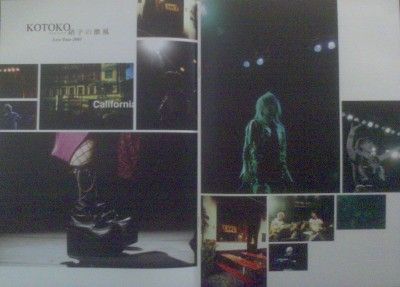
KOTOKO - Glass no Kaze Tour 2005

Ever appeared in a film, TV show, commercial, or a news segment? Or even radio? Ok, yeah, Youtube and its ilk do not count.

Appearently the very first one that featured my ugly mug was a KOTOKO DVD. I kid you not.

What is funnier is how KOTOKO made the comment about American concert types rock however they want to, where as the Japanese do so as if they’re in school, complete with the class prez leading the hand motion, uniformly.

And gah, it’s just so embarrassing seeing yourself cheering like that.

The (other) funny thing is I remember finding out about this late last year, when someone ripped and distributed the said DVD. It isn’t a typical distributed-by-Geneon kind of a deal so it was rather hard to buy. In fact, due to one thing or another, I finally got the physical copy today.

It does feature some big crowd shots at Anime Expo 2005, so a lot of American fanboys and fangirls probably got their arms or legs in! Too bad I’m not sure if you can still get it today, but it definitely warrants a watch. It’s just me, but I’d like to have a copy of all the commercially produced material that has me in it, so.

Continue reading