Category Archives: Franchises

Run Ichika Run

Ok, so it finally made sense. Ichika is someone that unites the girls in their simple goal of… winning for whatever their hearts desire. Revenge, currying favor, satisfaction, confidence, whatever it is that drives the multi-national cast, all for one, one for all. It’s a pretty neat theme. Thanks, episode 11.

In that sense, Infinite Stratos is an exceedingly appropriate anime during a time of crisis in Japan. Japan needs our help, so France, Germany, China and the UK are going to step up to the plate and help ’em out right?

In the “final” ending sequence, people are running in sync. In the previous ones, Ichika ran at the same pace only with one other girl at a time. Who knew running would bring it all together? I guess it would be something I noticed earlier if I wasn’t spending all my time staring at Charlotte’s legs.

Other random comments about Infinite Stratos ED:

  • The Japanese chick is the tallest and biggest! Wau, what a bold statement.
  • Only if all the English chicks are oujosamas.
  • Wait, if Laura’s pants are designed like the skirts, why aren’t Orimura’s?
  • I like this seiyuu ensemble thing. Anime otakus do, too, generally. I think I’ve liked them like, every season. Or do I just like Marinajou’s and Hiyocchi’s vocals?
  • There’s no way they are running at the same speed, since their legs are of different lengths.

I guess I’ll leave the obvious LOL-American (not quite anti-American) and the usual nationalist slants to someone else.


All Good Girls Have Twin-Tails Inside

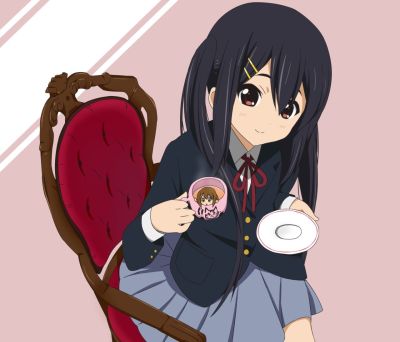
I’m sympathetic to 2DT’s take. I always thought Azusa was someone who had to be liken to in some way to a previous experience. The stereotypical saccharine-filled neko-mimi sweets-lover is not why she won Saimoe last year, nor is it why Azusa is probably my favorite K-ON girl (tho I think Yui is still the best, whatever that means).

To put it in the right context, 2DT saw the light because he realized that Azusa is actually based on some real-life notion of ideals. In the comments he explicitly stated this connection (emphasis and added link mine).

I wasn’t so much a fan of her myself… until I realized that all the students I have who are like her, I love! [] Such a sweet, good child. I understand her classic moe pull.

I’m not going to talk much about that classic moe thing (by the way, classic moe is better a term than old moe, because there’s, well, actual old moe involving old people). It is different than the somewhat more mature, hime-cut Yamato Nadeshiko moe (Really? You’d think a Yamato Nadeshiko is naturally attractive?) that is better characterized by Mio, so even “classic” is not exactly a great moniker. Furthermore, moe is so dead, I would rather not talk about it if I could avoid it.

What I will share, however, is my previously-mentioned (well, it was over a year ago) note on how I like K-ON because I see that band dynamics play out in my own experience. In short, Mio reminds me of this guy I know. He is adorable, musically talented and everyone likes him, just like Mio is among her friends. Both of them had a fan club. Well, YMMV, as it is with anything personal.

People are multi-motivational and complex things. It takes time to get to know them, and it is is tough to do fiction where part of the charm comes from mapping characters to actual people in a typical yet lifelike way. The good-girl appeal, however, is always going to be a draw to people who like them. I think it channels some sense of righteousness that many of us have within us, a sense of right and wrong, or good and evil. And going by that measure, that applies to most. I just want to separate out the two different kinds of good girls.

So the story goes, to begin with a scene from Conan the Barbarian (lol thanks JP):

Mongol General: Hao! Dai ye! We won again! This is good, but what is best in life?

Mongol: The open steppe, fleet horse, falcons at your wrist, and the wind in your hair.

Mongol General: Wrong! Conan! What is best in life?

Conan: To crush your enemies, see them driven before you, and to hear the lamentation of their women.

Mongol General: That is good! That is good.

Thanks to a certain parody subber, I have long since fallen with Simoun–more importantly, Mamiina. Simoun has a large cast that comes together for some pretty delicious drama. One of these is exactly the very heart-warming, turn-around good girl that newfags may find familiar in the character Kyouko Sakura from Madoka Magica, if Simoun is unfamiliar to you. Just like Kyouko, Mamiina is not a model citizen. In fact there’s nothing to her that makes me want to stick a pair of cat ears on her head. It’s the difference between a stray cat and a house cat, I guess. But it’s just that Mamiina screams loudly, through her actions, that she is indeed the very sweet, good girl you find in Studio Ghibli’s adventures, even if she is at times antagonistic.

The same idea plays out along the lines of all these Azusa-type moe characters. This is where 2DT’s observation comes into play, but only to a point. Because while we have our Kikis and Sheetas, there’s the Sans and, arguably, Nausicaas in the Ghibli lineup. I’m going to say that there are two sides to the Good Girl archetype, and the difference between the two is a philosophical divide in which only some of us can reconcile.

Back to Mamiina. She is a good girl because she jumps this gap between antagonism and protagonism in order to demonstrates her inner qualities, and she does the Right Thing at the Right Time. It leaves an emotional crater, a desired dramatic impact, especially when framed in the context of her intercharacter relationships. But at the same time, I can imagine a Mamiina-type character would be the nemesis or rival to an Azusa-type character (it probably is the plot to some battle show, wouldn’t surprise me). Without the external stimulus that put these characters through the crucible of tragedy or suffering, maybe the difference between the two types of good girl archetype lies within the answers between the random Mongol and Conan. Conan was just some normal barbarian at first, after all.

Another hypothetical may demonstrate better. Remember the YuiAzu episode? Let’s say if we replace Azusa with the antagonist version of Azusa, what would instead happen is that rather being a type A Good Girl, the antagonist Azusa would not volunteer to help Yui with the performance, yet later on do so anyways for some plot-specific reason. It seems like a typical gap moe tsundere type thing, but that is not directly relevant to a demonstration of character. You can be good or bad and still possess this duality.

I suppose that’s all part of the specification of being good; there is a strictness within Azusa’s tenderness, or the flip side of the coin, a tenderness in Mamiina/San’s intensity. It turns some of them evil, some of them slaved to passionate antagonists, some to reason and some to strange plot devices about clones. I’m not sure how much I can stretch this, but all I’m trying to say is that are Good Girls among us, and there are many. And like girls generally, they have a plurality of face!


Reiterating the Problem

Why am I doing this? Probably because I am conditioned to do so upon certain keywords. It is as if after x period of time since the last regurgitation, upon hearing a certain key phrase (or in the viral sense, when a certain idea enters the mind) I will then attempt to express a certain thing. This thing, well, you can read below.

So, like, why do I think Anime no Chikara is important? I think it is important because it’s kind of neat attempt at a programming block. But more because it is an effort to create original anime. I mean, why don’t people ask why is Yamakan making an original via Fractale, as a way to “fix the industry” he ranted on about, for example? It’s not an arbitrary thing.

When we talk about media mix business strategies, we’re talking about the usual deal where you take some kind of idea and create it across one or more media. So let’s say you have a novel, and you make an anime based on it, then you make a radio show, and video games, and manga, what have you. You make money from one idea via many different outlets. Then you can spin it off the traditional way, with figures and toys and other merchandise.

The thing is, Japan is very good at this. By good I mean it within certain sense of the notion of “good,” where we can take any idea and cheaply produce a line of things you can sell across different mediums. It’s good marginal value. And if you know anything about Tezuka’s Curse you would understand how that can be a problem: the thing is cheap to create compared to how much it is sold for, but the people making the buck are those who are selling, not those who are creating.

Put it in other words–when we want to value and reward creativity, we have to accordingly pay for it. When that creative process is unhinged from the copyright mechanism, it will be subject to market pressure, especially when it is butting heads against other monopolies (well, copyrights). If we look at the global export of anime-based medium from Japan versus every other mass medium except maybe video games, you can see how it is disproportional when comparing the money and thought space it occupies domestically versus overseas. But in Japan, the copyright financing structure protects manga and print publishers, and hangs animation houses to dry.

It is a very different situation, in other words, when Japan adopts some manga or light novel for a media mix project, than your latest Hollywood comic book adaptation or resurrecting your childhood in another inferior summer blockbuster. The latter is largely motivated by marketing and playing safe, the former is more about who controls the copyright and who is being paid with lucrative royalty contracts or added sales from advertising.

For example, when Ume-sensei gets her cute, sunlit manga adopted, she probably also gets a pretty penny from the production committee. But what does Shaft get out of that deal? [SHAFT! /zing] Well, it’s not a bad deal for them, after all, because animation studios get their money from anime sales, and Hidamari Sketch sold above the Manabi line.

But there is the problem. The animation production team is probably the #1 responsible party in producing everything we love about HidaSketch on this side of the Pacific. The manga is more like added sales: without it, Ume Aoki’s art school adventure will just sit as yet another4koma gag manga in a sea of them. [Imagine making the case for K-ON if you want to talk about this inequity.] When we buy the manga or a cute figure of a worm, it’s not because of Ume-sensei’s manga. It’s because some producer types realized this title will make good commercial sense as an anime, and is a good match with the talents at Shaft. I’m hoping you are well-familiar with the whole anime-as-paid-advertising thing, yeah? It feels like we like the commercial more than the thing it is selling us.

Of course, that’s partly because the commercial is the thing it is selling us: If you are the anime publisher and the anime studio, whose income is increased with the sale of the anime itself, you do have an incentive there. It’s just that being the non-copyright-owner of the original material, they have really no stake in the production committee beyond the anime itself. Everything on top of that is at the mercy of the various parties splitting that pizza-pie-chart of net revenue from any given joint production venture. It’s like going to a shop for their kanban musume, but she is actually the owner’s daughter and gets no bonus for sitting pretty and dealing with creeps like us.

To contrast, for an anime original like Sora no Woto, we’re talking about someone who puts money behind the animation production team as the main copyright owner. It is still financed in a committee structure–for example, Azone probably could care less which entity owns what in the committee–but that extra royalty money from licensing merch is now going back into animation production, rather than keeping some dead tree media afloat. And even so, a media mix of anime original can result in novelization and manga spinoffs that will also help sell dead tree stuff. It’s probably more commercially sound to publish a tie-in than something entirely original, too, for the manga publisher.

The alternative, you know, is do what Bandai does. Unless the financing structure for anime in Japan changes, we’re going to be dealing with people whining about moe or stagnation or how anime used to be better until Kingdom Come. But who knows, maybe it is easier to fix people’s ignorance than to fix the way Japan does business.


Revisiting Entropy

I think after considering the various narrative constraints, I am beginning to agree more with the assumptions and conclusions Darkmirage set forth in his rant about infinite energy via time traveling. Oh, spoilers for Madoka Magica onward, I apologize.

It’s one of those persistent paradoxes in which some other issues have to be reconciled in your model of time traveling in order to make sense of it all. In that sense, the physics is not as important.

Time traveling by itself can be consistent with the Second Law. Certainly, the arrow of time can go forward as usual, and traveling to the future is something all of us do. One form of time travel is just going to the future faster than everybody else.

The reverse situation, too, can be tied to some kind of mechanism in which the net total entropy is a positive value. The question thus becomes more in the lines of conservation of mass-energy, and, as always, linearity of states.

There are good reasons to assume that the typical groundhog day mechanism implies a single, linear outcome of cause and effects, in which one cause at a certain time propagates consequences irrelevant of each “reset.” Here, Homura’s resets are played fast and loose; it seems that she can reset at will, even if Madoka survives the bewitching eve and the big bad witch of the west is slain. More importantly, it doesn’t seem QB maintains memory of Homura.

So what does that mean? It means Yuki Nagato is still better than QB. It also means that we don’t know what gets transplanted back in time. It may very well be that nothing “physical” gets passed back, and we can’t really say anything about it until we know more about soul gems and souls.

TL;DR: The Big Reveal episode teaches us very little, if anything, new that we didn’t know before, about the xenophysics of Madoka.

So why am I slowly changing my position? I think if QB’s race can create a system where people can travel to the past with that sort of information, they would have came up with a way to pass the information on reducing entropy to an earlier point in their civilization. In other words, while Homura is a determined little girl who is driven by undying hope and love, there’s nothing stopping an entire race from doing the same. Thankfully, I don’t see how we can take any of the known setting elements out of its presentation and make an argument that bypasses the black box of the soul gem. And so until they explain that to us, we’re going to be in the dark. At least the objection of “a wizard did it” only applies in the time traveling mechanism, but maybe wizards like the taste of white mascot animals with ears coming out of their ears, and that is what makes them so.


Star Driver, Sharks, Theater

The phrase “jumping the shark” only has meaning when we walk the careful planks over a suspension bridge of belief. Do we want to use that term in regards to Star Driver? Does it really matter when Fonzie jumped it? Does it really matter when Takuto pulls out a new trick every battle?

The answer for both cases, of course, is that it does. In Star Driver’s case, however, sharks are a regular of the set. Maybe that’s just how it is on the planet of Fish.

In reality, the ebb and flow of the series tumbled up and down and we were on something like a roller coaster for the past 22 episodes, ever since Mr. Protagonist beached on a certain southern island. For each, uh, shark, that we hopped over along with Takuto et. al., we lost some people on the bandwagon. The overly theatrical nature of the series doesn’t help at all, either.

And Star Driver is, if anything, theater. Should it bother us when Mizuno, uh, jumped the bus? Or when Sakana-chan had weekly one-person plays? I don’t know; but a little, almost-undetectable hair-fracture-slice of my belief in the show evaporated for each Kiraboshi salute or for each time Professor Green’s underboob showed up on screen. It isn’t that I disliked any of it, it just became something that was, for its own sake, theatrical. I no longer understand why it is theatrical.

I mean, at least Glee gave me a song and dance every now and then.

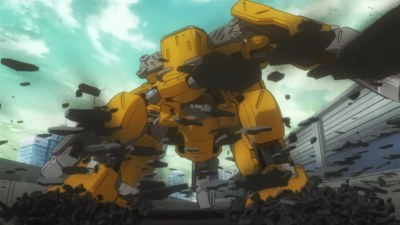
Maybe Star Driver just needed more dancing; Utena had the right idea with that at least, although I too appreciate it when giant robots tangoed under a prismatic starry sky. Perhaps all that we need is a bed of roses and an ax. Star Driver, instead, gave us an Inception-esqe school play (a play within a play?) as both an allegory for viewers and an alternative way to communicate between characters, within an already exceedingly theatrical construct at the basic level. Was there anything unusual in this latest installment besides over-subbed dialog and artful display of constraint in prop use (to signify this is suppose to take place on a stage)? In other words, isn’t a dream in a dream still just a dream? Why do this to us? It’s too much.

In conclusion: there needs to be a stage play for Star Driver. Or better yet, Star Driver: The Musical. Someone makes this happen, please!