Category Archives: Modern Visual Culture

Go Goth

Gothic Lolita is a very specific thing. It is not to be confused with other “goth” things.

White Wolf Logo

Of vampires and mages and werewolves and mummies…and normal thugs, cops, mastermind; heroes, heroines, crusaders and normal Jane and Joe. White Wolf’s World of Darkness has long been the playground of geeks and teenage punks and college kids looking for some fun with friends.

What is interesting isn’t about the system itself, but how it tries very hard to make the mood and feel a central aspect to the game system. Sort of like how Apple Jacks tries first to taste a certain way before it tries to be nutritious and affordable? Not quite. The gothic depressive/angsty feel has long been something of a common experience, a motif, and dare I say, something alternative. It’s what drives people to write crappy teenage angst poetry and blog on and on and on on their myspace. Plus the music, can’t forget the music.

The ideological purée of all these things can be repackaged, reprocessed, and resold. Here is where gothloli comes in. And how White Wolf makes its meager living. And why alternative music and indie music are “in.”

It isn’t really a big deal, one could think. Not until you have to come into terms with what this repackaged thing really is. Imagine when your diet is mostly organic and natural, and then you try to eat a hot dog at your friend’s BBQ. It’s not quite the same as anything else you have had. It helps to be consciously ignorant of its content.

Which is to say, in the wild, you see cosplayers, you see angsty teenage poetry. You even know a few drama queens and people who wants to join Suicide Girls. That’s fine. What is messed up to see this repackaged essence, having to work with it, and come up with a fictitious character idea.

Vicariously living only goes so far.

But don’t take me wrong. I love hot dogs. I think tabletop RPG system theory is fascinating and very powerful as a perspective to look at social theory. Not to mention is a healthy exercise of modeling. I even think WoD is pretty interesting as a whole. What really bothers me is when I open the Vampire core book, for example, the way it looks. What it tries to do.

It’s almost like taking that beloved hot dog, and put it on a solitary tray, dress it up with cilantro and some Chef Ming’s Oriental Bistro Citrus Sauce that takes 2 hours to make by itself, and costs about as much as a 50-pack of Sabretts. What the hell? To put it in other words, I am talking about the chasm between a game, a concept about having fun, or tooling with some ideas; creative writing and fiction; and of course, roleplaying. All that doesn’t quite mesh with “not across the street but down the road“; the attitude, the emotion, the feeling and despair.

The chasm is visible because this entire package is manufactured. If it were to come naturally, it’d be ok. If it was subtle, it wouldn’t be so bothersome. But it’s trying too hard and failing the same. Sigh. Second-rated marketing.

Ah, yes, I am going somewhere related to anime. Magipoka.

Pachira Is Sailor Moon Ciel

Because, believe it or not, this show does a better job demonstrating that stereotypical purée better.

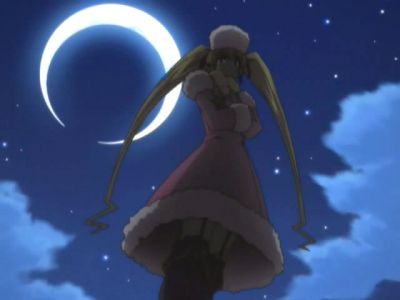
Pachira. Aiko. Liru. Uma. Don’t you think they fit right in within World of Darkness? Probably. Their cheery and make-believe setting is equally fantastical as the gritty underworld right out of, say, Blade 2. Both is full of dirty sex and violence; magic; and even death.

Obviously, if you’ve seen Magipoka at all you know that is just preposterous. It shouldn’t invoke any resemblence between the two worlds. But yet I can’t shake the feeling that something like WoD fundamentally is inspiration for Magipoka.

Of course, Pachira would have been torpor for a really long time. But.


A Data with a Kindred Spirit

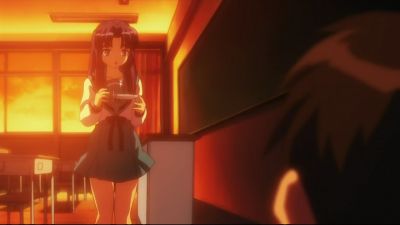
I like Ryoko Asakura.

Nagato Has A Backside

Only because I like Nagato too.

To be fair, I think both character archtypes are worth looking into because they represent a very odd stereotype by something that ought to be stereotypical. Normality is rather astereotypical–reality is often stranger than fiction in my own experience. The thought goes, how about alien entities’ perception of human reality? Or even, a writer’s decision in the perception of this alien entity? Ryoko and Yuki presents us with two personalty extremes, maybe.

But it’s one of those detracting factors about Suzumiya Haruhi no Yuutsu. There are few like-minded people in this show. Perhaps some can be said of Itsuki and Kyon, and maybe Kyon and Mikuru. We can explain away Ryoko’s socially-pure persona and Yuki’s detachment with human society as a demonstration of how well these aliens grasp the human condition. We can even explain away why Ryoko has a charmingly igorant thing for death, as well as why Yuki forgot her glasses. KyoAni is no stranger to moe. But are Yuki and Ryoko so stereotypical? Maybe. They are rather colorfully played out I think, so they seemed also a little less stereotypical than other archtypes in other anime.

But Itsuki? Is he also stepped deep into the conspiracy? His commonsensical normalcy is all that’s left attaching him to this show. That, plus as a plot device.

Asakura Ryoko Is A Plot Device

Well, Ryoko is fairly just also a plot device too. I can only imagine her impact in the novel was way greater than how she gets second-handed here in the anime.

I don’t know enough about Mikuru to say much besides her personality likewise may represent (same with Itsuki, too) the perspective of the faction that sent her into this mess. It’s a well-thought-out literary parallel.

Which leaves us no surprise that Kyon is our amusing straight-man. He is us.

But what does that leave Tsuruya? We all like her too!


Maid to Thrill

The age old debate between ninjas and pirates ends with Black Lagoon. Maid wins.

Roberta 2000

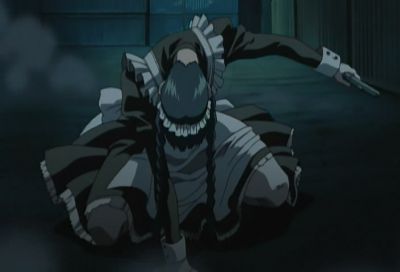
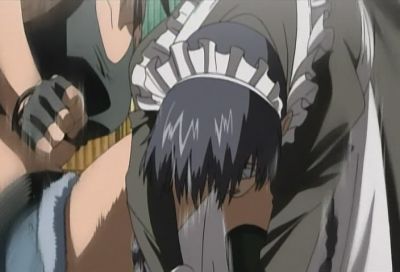
Words were barely sufficient to describe how it feel to watch Desperado or Terminator 2 the first time for me. Little more can be said about this masterpiece of an episode that is Black Lagoon episode 9. I really had little to share aside from awe and “I wanna … watch this again and again and again!” It’s all I can do to keep that image of Roberta’s humble-looking shoes rotating counterclockwise along with the regular-pattern lace trims of her uniform from replaying itself to burnout in my brain. Oh, it would also fast forward to the rotating umbrella and when she does a “peek-a-boom!” Or I could replay, in my head, how she forms into a rigid, flat-fisted running style while whipping out that combat knife. Well, actually what I did immediately was make Terminator 2 jokes first, then to relish the goodness that was this piece of animation.

You can feel the love brimming from this episode. The people who worked on those scenes must have loved what they were doing. It is the only logical explanation.

To be fair, I was seriously bugged about Roberta at first. I read the manga for Black Lagoon after realizing I would be digging this show seriously. I stopped at volume one because I get the feeling that this manga is going to do what I thought it’s going to do exactly, for better or worse. Sure, the series is about outrageous mercenary action with a bent towards a realistic-feeling grittiness. Thematically it deals with the scummy real life of criminals versus the somewhat crummy real life that we know. It does escapism well; the action scenes are smart but unfortunately the manga falls to mediocrity when it tries too hard to pander to conventions (maybe on purpose).

Remember Noir? I’m one of those people who thought that he liked what he saw in Noir, only to be totally bugged by the fact that it turns into this weird lesiban slide show with secret societies. To be honest, it could have worked out if not for Chloe. Roberta, as a result, reminded me of Chloe–both in their outlandishness but also, heh, they are SOLDATS! Oh, of course, they’re both badasses in a fight.

Hmm. Noir would have been a better show if Chloe was a maid, don’t you think? Thankfully we wouldn’t have to ask the same about Black Lagoon. It’s Maid to win.

Actually, there’s also a part-2 to this entry… It started with Gunslinger Girls.

Hi Jose!

There’s nothing wrong with killer maids, nor is it such a novel concept. The dichotomy was probably best explored in an anime context through GSG, so it’s no surprise Roberta reminded me of it. But in light of our other girls in Black Lagoon, what sort of concoction would Roberta be? Just another daily special at the Yellowflag?

Certainly if Rebecca was Suzumiya Haruhi, Balalaika would act a bit like Nagato Yuki and stop and save…Rock (and Dutch and Benny) from their certain death? It explains why I rather was taken by Asakura Ryoko.


Sing, Sing Like You Want to Win!

Con season means karaoke season.

Demon-Possessed Bishoujo Band

Bakakozou had their fansub idol competition with e-cash as prizes. Oddly enough I actually heard of it in time before the contest started…if I wanted to participate, I could have. Alas, the trip was in the way so I didn’t do anything.

What’s much more interesting is this website. ZOMG. ZOMG again. HAHAHAHAHA. I just have to contribute something. And I did.

Since 2002 I’ve been doing one song (or more) at Otakon annually. I try to pay attention to various con’s karaoke setup (AN2006 had a karaoke hour 11pm on Friday, but I couldn’t go to that; partly because I just got out the car about then. The jrock idol thing was pretty ok and I was there for most of that). It’s a very different experience than some otaku singing in front of their computers by themselves and goof around with audio editing software. Live is better. For good and for evil.

But it’s just that much easier to sit in front your computer and belt out the words to some songs you don’t know that well. Heck, you can even use various singing aids. And it’s something people can point and laugh repeatedly! Better than my deserted and lost-forever karaoke website?

Enough. It’s time for action! Sing! Dance! Watch Evangelion!


The Raw Illiterati Conspiracy

Anime speaks a familiar tongue to me. The unspoken language.

Older Tiz

If you are like me, you are in good company. I mean, there are over 6 billion people in the world, but less than 1/40 of them speak Japanese. That’s right, 39/40 (and more) of the world population do not.

It feels like one of those “think of the children!” moment, but it is something to think about. We don’t really care that most people can’t speak Japanese, but if we were to concede that what makes anime anime is partly cultural, then it is speaking something that goes beyond the language and culture which rings true to those of us who can appreciate it and not being a part of its primary audience.

That seems like a handful. Let’s break it down.

In disguise it is a “what is anime” question re-visited, but what is unique about it? A cross-cultural exchange of the human experience isn’t unique to anime, but is there something about this exchange substantively different? Maybe, I don’t know. I know that some people ended up watching anime because it is quite different than what they’re used to see on TV, so there’s that.

In form, however, there is definitely a stylistic bend to anime that others are missing. The obvious one is what you see–art style. BESM and all that. But that’s kind of shallow: OEL manga is a good example how this is shallow (when it fails) or where the real difference lies (when it doesn’t). In fact, looking at it closely gives you a better clue to the gap between style and content and what makes anime (or manga) just that different. Serial narratives are also something fairly typical in anime but not common in the mainstream. The narrative styles and tropes, sure…

Does that explain why at all I post so much at the MT forums? Probably not.

Honestly, though, that’s not why I’m writing this blog entry. I want to document how someone who can’t speak a word of Japanese to save his life (well, I dunno about that) can watch raw anime and actually understand most of it. When I say most of it I mean it–most of anime series, most of an episode of an anime, most of the dialogues and certainly mostly what is going on narrative-wise.

Would this be true of an episode of Spongebob Squarepants? Dora the Explorer? Ok maybe for children’s programming…but The Simpsons? Futurama? Family Guy? Robot Chicken? Well, maybe it’s true for Over The Hedge or Ice Age 2, but how about Team America? I ask because I don’t know.

But what we could first think about is the children’s programming barrier. Presumably children’s animation are more visually expressive in terms of exaggerated motion to make sure the viewer doesn’t miss the visual cue. So when a show like Love Hina or Suzumiya Haruhi no Yuutsu is so expressive, they’re clearly meant for … you get my point. So is that because they are relics from anime and manga’s earlier days, that it was meant for children but the tropes and meme stuck on? Maybe.

But on the other hand some anime are not that visually expressive; or that they are more akin to acting? Jin-Roh comes to mind. It’s a fairly expressive film when it comes to character drama and the characters’ expressions. Or shows like Cowboy Bebop and Genshiken?

But that still doesn’t explain why it’s rather easy to understand these things. Maybe it wasn’t ever a hard thing to understand, after all? Or maybe it’s something that just comes to you after you’ve seen enough? Certainly possible.

But it is a silent conspiracy. A lot of raw watchers outside of Japan probably don’t really speak much Japanese at all. Why do we do it? Is the language just not a barrier? Or better put, is comprehension not a barrier? Or the fear of miscomprehension/incomprehension not a barrier? I imagine that’s one big thing people get hung up on, at least from the people I talked to.