Some time last year I got fed up on how Americans don’t do calls and wrote up a set of calls for Gokujou Smile based on the JP calls out there. With WUG Final tour over, I reviewed my old post as a matter of writing up the tour, and decided I have to write a new post to update the material in the old post, for WUG Final SSA.
Basically, it’ll sound like this:
Do you mix to WUG? Only a few songs, like Gokujou Smile. And even then most people do mostly just the fast mix part and not the full mix part, opting to do the Fu-fuu calls with the group instead.
One change from the old post is that people do the urya-oi as per normal course, but that’s not so important in Gokujou Smile. If you know what you’re doing you would already know what you need to do. If you don’t or if you are unsure, just follow the crowd. The 3rd tour video is still a good reference that will get you through the whole song.
https://www.youtube.com/watch?v=itcSxWYmIAA
I am mostly still romanizing the calls, via here. The calls are in parens and colored in red. The mixing is in blue, which is entirely optional and do so at your own risk. Actually there are just 2 normal mixes and 3 speed mixes with lead-in calls, and you can pick and choose which you want to do. The normal mixes conflict with the 3 fufuu calls at the end of each lead-in so most people choose to not do them.
Notes:
There are some hand motions that can be done during a few parts, like “housoku housoku†in which you make a upward arrow with your hands, and “nandaka chigau†which you can do the “no” hand motion.
The calls with a music note in the paren are sing-along responses.
There are some timed jumps. People furicopy normally but the main melody has a jump like 2 bars into it and from what I’ve seen recently, MayuC cues the audience for the jump sometimes. You can review the video from 3rd Tour (above) as an example.
Fuwa x4 are not clap clap Fuwa x2 but some people do it. Most people do the 4x.
The “Fuu?†call is just a fuu with different intonation. In JP it’s denoted with down and up arrows. (フー↓ウッ↑)
(starting signal) just means the usual mix starter phrase. I’m not aware of a standard one used in this but there are some standard phrase people do use.
I use an asterisk to indicate the start of the speed mix for typography reasons. Just put the paren in the following line into that. I also wrote speed or standard mix where applicable to indicate the tempo only.
===
EGAO! (Fufu!) GOKUJOU! (Fufu!) SUMAIRU! (Fuu!)
(hey x12)
(standard mix on 2nd half) (Starting signal) (TIGER FIRE CYBER FIBER)
(Fufu! Fufu! Fuu!) (DIVER VIBER JAA JAA)
KURAUDO ni kakareta SUKEJUURU (Yay!) Nandaka samishii shuumatsu wo (Yay!) Nandemo ii kara umerutte iu no ha chigau (Nandaka chigau~!)
Honto jimi na no futsuu no hi ha (Whoo!) Douga de neko wo utsushitetari (Whoo!) Doudesho tamani ha heya no moyou ga he nanka ne
Minna no shashin (sha~ shin~♪) SURAIDO shite mita (‘te~ mita~♪) SUMAIRU ippai de zenkai de SUMAIRU darake de SUMAIRU? SUMAIRU?mairu Waratte shimau (shi~ mauu~♪) genki ni natta yo (natta~ yo~♪) Akiramenai (TIGER) haru (FIRE) natsu (CYBER) aki (FIBER) fuyu (*) no hi mo (* speed mix TIGER FIRE CYBER FIBER DIVER VIBER JAAJAA)
SHINDOI kisetsu wo shiteru kara (Whoo!) Kawaranu egao wo mederu (Fuwa x4) NIPPON no egao ga uwagaki suru (Whoo!) Nanka tsurai toki mo NIPPON no egao ga kawaiku suru (Whoo!) Saki koboreru SAKURA iro (Fuwa x4) SHINDOI kisetsu wo shitte koso no(Whoo!) Egao(Fufu!) gokujou (Fufu!) SUMAIRU (Fuu!)
(Hey x8)
Tenki ga ii hi ha dekakeyou (Yay!) Densha ni notte chotto toode shiyou (Yay!) Denenfuukei suteki na yasai mo toreru (Housoku! housoku!)
Choppiri nigate na mono datte (Fuu?) Oishii no tabetara suki ni naru (Fuu?) OIOI ima made shiranaide gomen to omou
Umi ha hiroi (hi~ roi~♪) yama mo sugoi (su~ goi~♪) MEIDO IN JAPAN ha saikou sa MAI MAI MAI SUTAA Nandatte umidaseru Asobi ni kite (kite~ ne~♪) ai ni kite ne (kite~ ne~♪) Kono hashi (TORA) kara (HI) hashi (JINZO) made (SENI) wo (*) hashi no kuni he (* speed mix TORA HI JINZO SENI AMA SHINDOU KANSEN)
SHINDOI kisetsu wo shiteru kara (Whoo!) Kawaranu egao wo miseru (Fuwa x4) NIPPON no egao ga uwagaki suru (Whoo!) Nanka tsurai toki mo NIPPON no egao ga motenashi suru (Whoo!) Saki koboreru SAKURA iro (Fuwa x4) SHINDOI kisetsu wo shitte koso no (Whoo!) Egao (Fufu!) gokujou (Fufu!) SUMAIRU (Fuu!)
(Hey x8)
(Hey x8)
(speed mix CHAPE APE KARA RARA TUSUKE MYOHONTSUSUKE)
DONMAI namida wo shitteru kara Kawaranu egao wo mederu DONMAI na egao ga uwagaki suru Nanka tsurai toki mo DONMAI na egao ga kawaiku suru (Whoo!) Saki koboreru SAKURA iro (Fuwa x4) DONMAI namida wo shitte koso no (Whoo!) Egao(Fufu!) gokujou (Fufu!) SUMAIRU (Fuu!)
(hey x12)
(standard mix on 2nd half) (Starting signal) (TORA HI JINZO SENI)
[Rather than finishing my year in review, here goes a diversion.]
I too watched the first/preview episode of The Rising of the Shield Hero adaptation. It was a bit compelling but probably slightly more uncomfortable than compelling. The problem I have with it is its narrative voice. It reads(?) like someone is writing a light novel that target incels as the audience. That in itself is not terrible but seeing a show pandering to someone, no matter who, is not a great sign. It is not about the false accusation of rape, but the construction of the characters and motives surrounding it, that marks it poorly for the online lynch mob. (BTW linking Jeko because my post is basically a rebuttal of his and reading that motivated me to write this one.)
This post came to my mind primarily because, well, you can have a dramatic story about a hero who was falsely accused of rape, and not be misogynistic. He is right in that the innocent accused alone doesn’t make it per se misogynistic. So what makes Shield Hero so misogynistic thus far? Shield Hero is misogynistic because it reduces the women in the story to less than human specifically to further its emotional narrative. This is exactly what incels do as a fundamental concept to their cause. Of course, this is just based on one episode and I should overall disclaim that I don’t know what the story is like after this point besides from reading the Wiki entry. Given the quality of the story and the way the events are presented, though, I don’t expect it to be anything good. I certainly could be wrong (well, am I really wrong on SAO)?
So far in the series, things are not so offensive because, well, even the main character is hardly beyond a pile of tropes and I think even Nasu Kinoko wrote more compelling characters in the 90s than this. It is below par for the course for this genre. When you are eyeballing a pile of trash, that pile of trash is a bunch of trash, so even the bad ideas fail to be that terrible. I enjoyed Shield Hero e1’s general production quality (I guess it was technically the preview, so not the actual first episode). The baseline concept is not the worst among all the isekai light novel adaptations I’ve watched in the past couple years. I do like how the different heroes came from different versions of Japan. I even like (based on Wikipedia) how the main character grows to trust his female slaves over time, despite his trust issues with people, and despite that they had to actually utilize slavery as a key story element and not just some side dressing.
The unfortunate thing is, you can tell a story about a guy who suffers through all these common psychological issues without framing it using modern misogyny. Albeit almost as bad, but last year’s How NOT to Summon a Demon Lord similarly tacked this issue in a subplot without too much ick. (Although I was swimming in quite a bit of ick as is at the time.) I guess it is cool and hip and meme-worthy with some folks to tell a story Shield Hero tells. I am not particularly arsed by this because, ultimately, this is a work of fiction (and fantasy at that) and mature viewers (definitely not appropriate to show this kind of thing to children without parental guidance) should be able to realize what it is.
I think the story could be a lot better right off the bat by basing the main character not as a freeloader nerd laughing at bitches in his light novel. That is totally not the right way to start this story. If we want to go heavy with a fake rape accusal, Shield Hero will have to open with some heavier story elements, rather than just giving us the dumb lines he has been saying and the defensive (and borderline hypocritical) attitudes alone. I mean, maybe this indicates the author’s attitude about this particular plot element. It also doesn’t help, even before encountering the rape accusations, the main guy came across like a giant tool to begin with, and his cheerful “hey I’m in an Isekai Light Novel wink-wink-wink” attitude was the only thing that makes me want to root for him. This is also why that whole rape not-trial scene seemed really trite and a giant pander to incel thinking–as literally here’s a guy don’t own up to their tool-ness and blame others for their own failures, even if it may be a natural reaction and he might have a case for it. It’s a simple lesson in narrative storytelling–you are not suppose to be presenting facts of an internet argument to win your viewers’ sympathy. In terms of trustworthiness, our hero has very little one episode in because he has not done anything to earn any, so his plight also will ring hollow in the hearts of the viewers. Worse, it makes you think who would? Someone who was falsely accused of rape too? LOL.
Hopefully all those things I mentioned are just setup for future character development. It should be clear that despite the misogynist elements in this particular light novel turned anime, the core of the story is very, uh, staple, to use a nicer word. There is too much poor execution, so much unoriginality, enough to blunt of any strong message it wants to actually send at this point. I think it’s a lot easier, if you want to talk about misogyny regarding Shield Hero, to run a Bechdel test after the season is over. Truth is anyone who still want to discuss after sticking around probably already have their minds made up.
PS. How NOT to Summon a Demon Lord is a fun, but really bad mary sue sort of a story. It makes SAO S1 look good (aside from the fact that SAO S1 does…look quite good, but that’s not what I mean). And now we have something even more problematic. Dare I predict in another 2 years we will have even worse garbage (and I will probably still watch it….). Or, I can’t believe Death March is the best generic Isekai anime in the past year. Well it does have Suki no Skill…
Since this spring, the seiyuu unit Wake Up, Girls! have been on a farewell tour. It reminds me of Major League players who announced their retirements during the off season of their final season, getting treats as their team travel around the league and getting presents from teams the player visit over the course of the regular season. It’s not that different for this seiyuu idol unit in a sense, given the extensive farewell they have received at Animelo Summer Live and Animax Musix Yokohama earlier this year. (AnimeJam is this coming weekend and it would be interesting to see what they do for WUGchans!)
While the shut-down date set as end of March, 2019, the IP will live on (most notably in a mobile game) as the voice actresses will be off contract for the main project. They will still work on the franchise, of course, but not as performers of live shows, and likely not so extensively tied to the various media opportunities such as their ongoing radio shows (though this remains to be seen), live action theater, as “solo artists” and most importantly doing new songs and concerts.
There is a actual farewell tour for WUG, which is broken into 3 parts. First two parts were announced right off the bat after the disbanding announcement. Part 1 covered Chiba, Kanagawa (Zama) and Saitama (Omiya). Part 2 covers Osaka, Iwate (Morioka), and Kanagawa again (Yokosuka). Part 3 will cover Kumamoto, Osaka (again), Nagano, Tokushima, Aichi (Nagoya), and finally Miyagi–or Sendai. It’s a lot of stops. Each stop promises at least 2 shows (early and late). The Aichi stop has 5 shows. Osaka totally gets 8 shows between parts 2 and 3. About half of these sold out, but it isn’t hard to get tickets for some of the more remote and remaining ones, even as I write.
The locations are important in that the farewell tour will take all the WUGs to their home prefectures. Yoppi is probably the most difficult, all the way out in Kumamoto, so it’s good it finally will happen. Iwate is where Kaya is from, and this tour marks the second WUG visit to Morioka. Minyami and Myu are from Kanagawa and Chiba respectively. MayuC is from Osaka, and Osaka is the city WUG toured the most outside of the Tokyo region proper. Nanamin is from Tokushima, which is also a rare stop for WUG tours but thanks to Machi Asobi, WUGchans have frequented Tokushima quite often. Of course, Aichan is the Sendai native who will invariably hold court for that final stop on that final tour, and it’s the second most common tour stop outside Kanto for them. You would think, right?
Sendai is obviously a super special place for Wake Up Girls. It gave birth to the group and the project, and promoting the (kinda still) struggling Tohoku region is a core mission for the team. The way the team was put together in 2012-2013 was just as much of a promotion of Japan’s rural areas as it is a way to represent them in this fandom niche–seiyuu idol and media mix. It’s really heartful to see the management stick to this aspect of the mission. I mean I would not have had reasons to go to Sendai until next year but for WUG, a good 3.5 years after my real first visit. It taught me a lot of places to visit, either ones I had in the past or will in the future, and sights to see and recommend to others. The TUNAGO solo tour earlier this year is a great example, when fans had to travel across Tohoku to see the WUG member solo events in tiny live halls in the countryside. It ended with a bus tour that took you even to rebuilding banks of the Eastern shore and survey the reconstruction after the 3/11 tsunami waves had left their marks.
In the same spirit, my visit to Morioka to attend WUG Final Iwate was just as much about WUG as much about Morioka. I am really going because timing worked best, not because Iwate or Morioka is special, plus honestly I can’t see myself ever going for another reason, so why not visit a part of Japan I don’t think I’ll ever go again?
The actual concert is on Sunday afternoon and evening. I had booked a flight back home leaving Haneda in the morning Monday after. In order to make the flight I had to travel by night bus (as the most reasonable transportation option), which was both reasonably priced and convenient, as the bus depot is right at the JR station Morioka, and a short walk from my hotel. The fact that it snowed overnight Saturday was a little disturbing, but it wasn’t a problem at all for me–the weather was still warmer in Morioka than at home. And unlike Kanto proper, this part of the country regularly deals with snow, so it isn’t as much of an issue for transportation.
Arriving Morioka by train Saturday morning, it was a fast ride up the Tohoku/Akita line, taking about 2.5 hours. At Morioka the Hayabusa and Komachi trains separates, which you can actually go see. The Komachi in front decouples, moves forward, and both it and the Hayabusa train retract the latches and the cover pops back to keep that aerodynamic nose shape. Literally, Shinkalion.
Right at the station, a famous local food, the fukuda pan, can be had. They literally are just rolls with different fillings, kind of like souped up buttered breads. I had chestnut and plain butter, and it was pretty good because the bread was of good quality and it was fresh.
Transit in Morioka is JR only, and there is no local mass transit on rail. You can take a pretty cheap bus to go around, but it’s hardly faster than walking. The JR local trains take you to the suburbs, so it’s not even helpful. There is a tourist bus, but I ended up walking around the area between JR Morioka and the main castle park area.
At the time there was a Salmon Festival in the park. Too bad most stuff there can’t really be had. You either had to eat it there, or bring home a fish or a sack of clams or something. The salmon looked good though.
The main park area is three things: a park, the remains of the Morioka castle, and a temple. It’s not what I’d say scenic in a dreary December weekend, but I imagine it looks good with some cherry blossom to go with. Very nearby is a historic house and museum, and some older buildings from before the War. Also a couple blocks away are the government buildings, and the famous Rock-Breaking Cherry Tree that grew through a boulder. As people (nee: Kayatan) say, the Ishiwari-zakura encapsulates the spirit of Iwate.
There weren’t a lot of sights in Morioka proper. I walked a bit to kind of take in the place. It is cold and I didn’t want to walk too much (but still probably did too much walking). It is kind of inaka-y but it felt more urban than it really was. The side where the older town was (where I was walking) did feel very much like “Morioka” in that it reminds me of Sendai and Hakodate, maybe because it’s kind of in between the two places. The other side of the JR Shinkansen tracks felt more like modern, newer developed suburb-y part of the city. There was a huge Bic Camera and Round 1 where my hotel was, where as the other side of the station had the densely zoned businesses and homes you expect in a Japanese city.
So instead of walking, we ate. Morioka has 3 famous noodles: the jya jya men, the reimen, and the wanko soba. Naturally we had all 3.
Reimen is a form of korean cold noodles. I’ve actually had varieties of this across the USA and even in Taipei. It’s more commonly the clear wheat version that you see, but the Morioka style is served up like a cold ramen, with sweet flavorings. It’s served with apple or pear in the broth, in the winter, and with watermelon in the summer. The ideal pairing for this is either hot weather, or because you have just had a lot of korean BBQ/yakiniku so you can cool down with it. We did not have BBQ with ours, but it was still tasty. You should get it spicy when you could, just know that Japanese eateries generally downtune their spicy levels.
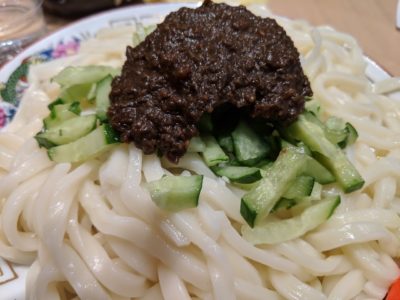
The jya jya men in Morikoa is similar to the Chinese and Korean versions, except it is made with miso instead of black soy bean paste or fermented flour paste. This means it’s a meat miso that you mix with your noodles, and it pairs with similar toppings. Because miso is actually more mild than soybean paste or fermented flour paste, there are more options for topping such as umeboshi and grated ginger, or even rice vinegar. The noodle used is much thicker too, they are basically udon level. It makes for a cheap and hearty meal. 600 JPY fills me up, with chi tan tan, which is a complementary soup they serve you in the same bowl by mixing an egg with hot noodle water.
Somehow I had it three times, because you can get Pairon (which is like the one famous name for the dish) jya jya men at the station, and JJM was the easiest eat that you can have all day long. Other than these noodle bars, most places don’t open late in Morioka so jya jya men is a good substitute if you would have ramen instead.
Wanko soba is more of an experience than a dish. Basically the idea is a server will serve you bite size portions of soba at a time until you are full. There’s some ceremony to this, so you ought to go with Instagram ready with a small group. Our server served the three of us over 300 servings, and it is a pretty (ugly?) sight (unsightly?). It is at a rapid fire pace, when you eat it, the next serving comes. You get a break when the server runs out of noodles on her plate, but these rounds can be brutal. Wanko soba is lightly flavored in soy sauce, so you can also add other condiments like grounded chicken or grated daikon or whatever, which they provide to you. Not that it matters, you are literally eating as fast as you can most of the time, and if you are not drawing the meal out, the whole experience can be over in less than an hour. But yeah, having Moriokan(?) waitress throw noodles at you non-stop turned out to be surprisingly fun. To stop eating there’s a procedure you do with putting the lid on top of your bowl. The server’s trick is to throw noodles in it while you show it to her empty. It continues if you let it happen as you have to finish what’s in your bowl.
I wonder if this is why Kayatan is kind of S.
As a proper dining experience, wanko soba should really be had as a proper meal, but most places close quite early (like, 8:30pm). And according to what I hear, wanko soba in Tokyo is just not as good as wanko soba in Morioka, but who knows. We went to Azumaya by the JR station, which I guess is well-detailed in this CNN article.
I dump thoughts on this blog, usually in a hard-to-understand way. This is not that hard to understand, I hope.
Question: How many hours of continuous illumination can all my IDOLM@STER penlights provide?
Background: THE IDOLM@STER has a line of merch for their events in which button-cell (LR44) penlights are available for purchase. Each character gets her own penlight (fixed color). There are also penlights for groups (SideM, Shiny, Cute/Cool/Passion, Princess/Fairy/Angel). Here’s a link for example. In short: there are a lot of them.
Assumptions: Assuming 3 hours per light, and all my lights are running for 3 hours. It’s probably a fair assumption given most of my lights are hardly used, and the 3-cell ones probably run closer to 4 hours. Newer IDOLM@STER character lights are 2-cell but most of mine are the older, 3-cell types. I’m also generally assuming I can use one for light, and use another once that one runs out, so the total hours here is just the total number of lights times 3.
It would be obtuse (but rigorous) for me to dig out all my lights and count them. Instead I will do it from memory. No big deal if I miss a few I guess.
Series 1 CG Cu/Co/Pa: 3 Series 2 CG Cu/Co/Pa: 3 ML Pri/Fa/An: 3 765Pro series 2: 14 765Pro series 3: 14 765Pro 10th: 14 CG 10th: 13 ML 10th: 13 ML 1st day 2 box: 5 ML 2nd (all 3 boxes): 21Â CG 4th SSA – one for every idol (not sets, minus 10th ones): 34 ML 3rd – One for each one that I didn’t have before (estimate): 19 Miscellaneous CGs: 7 Duplicates: 6 Matsuri ML 4th, 6 Matsuri Hotchpotch, 1 Makoto Hotchpotch, 1 Makoto Hatsuboshi Enbu
Total: 177 Times 3 hours for each light: 531 hours, or 22 days and 3 hours.
Assuming I only need light 8 hours a day, it’ll keep me lit during a power outage situation for 66 days and 3 hours. Not long enough for some Puerto Ricans. But definitely enough for 12 days of Christmas.
This light merch is all a racket and I’ve already had my fill years ago. Now I only buy lights to replace old ones as they start to have problems, or because I broke them at the live. I guess I still do for new idols that I don’t have lights for. I guess this is also why it won’t end anytime soon, if ever.
In a few months, Million 6th tour will begin. I will have to rely on penlights that I got like 4 years ago (if I get to go). Hope they still work, LOL.
One thing about long-running franchises is that they are cyclic and have patterns. You can read into it and figure out what’s going to happen next to an extent. For IDOLM@STER, they’ve even started an official schedule list of events, as of 2016 onward (the event-only history goes from 2013). It makes a lot of sense as something fans need to keep track of the dozens of stuff that happens every month. Unfortunately it is not that forward-looking, so it is more useful as an archive.
The biggest news for prognosticators I think, that came out last weekend’s Million Live event, was that the next Theater election program will include the 765Pros. It’s pretty obvious that Million Live plays with the inclusion of the 765Pros both ways. It was first a booster, but now the Millions are also dragging their senpai team into the next decade. Not even mentioning the successor aspect, being a mobile game allows the Millions to do stuff all year long, where as the core 765Pro AllStars run on yearly cycles for the current gen of PS4 games, which might be coming to an end with a pattern change.
In the past, the Million elections could not have had included the 13 revered figures of 765Pro due to the need for all 37(+2) of them to get a footing in fandom by themselves. Five years in, this is no longer a necessity, and I agree.
The other thing this addresses is the fact that Million stopped having 765Pro AllStar music. The SP@RKLE line, or the latest line of character solo songs, only featured the Million Stars 39 and not the other 13 that LTP and LTH has had. I think this makes a lot of sense, for one, those early solo songs almost never gets performed. Sometimes it’s performed at 765Pro events! What would Million Ps have to do to see those performances? It’s kind of a mess.
This also means we might get a lull during which the 765Pros might not get a lot of solo activities. We know 2020 is the 15th anniversary of the franchise, so if we expect MOIW 2020 (hopefully featuring all 5 (6?) branches) then a chill 2019 makes sense. I think there will be more of a flurry of activity next year from the production side to support a MOIW level thing in 2020. Considering if the next Million election occurs towards November/December and we get the CDs released 9-12 months out, that would time things well into the 2020 hype cycle as such a big live will have a long lead-in.
The other nuggets of info I thought relevant were:
ML6th tour is once a month and broken out by type-teams (Angel, Princess, Fairy). No Tokyo regional stop.
Generations series is ongoing.
Each of the Million tour stops is 2-days over the weekend. None lands on this year’s longer-than-usual Golden Week. But the progression is obvious even before the announcement because Shiny 1st was announced to be mid March, so we know Million tour had to be after March. Here is the Lantis-M@S live scheduling like from now on out (ignoring release events):
October: Million Kanshasai
November: Anisong Premium (SideM)
December: Lisani TW (Million)
January ’19: Lisani (SideM and Million)
Feb: ??? (HK?)
March: Shiny 1st, 315Pro Promeet
April: Million 6th Sendai
May: Million 6th Kobe
June: Million 6th Fukuoka
July: ??? (AWM?)
August: ??? (Anisama? AWM?)
Assuming the Generations line resumes its release cadence of 1 Generations CD per month, we have D/Zeal in December, and 3 more by April–probably including April’s release makes 5 Generations CDs. It’s hard to say what this means for the release events in April though, but the release event is unlikely still going to be once a month or so, give or take.
Last year we have the SP@RKLE series during the same time as Generations series, so this might mean after Theat@r Boost 3 (due out 11/28) we will get a new run of something. This could probably play into what goes into ML6th. New LTDs? That would be swell.